

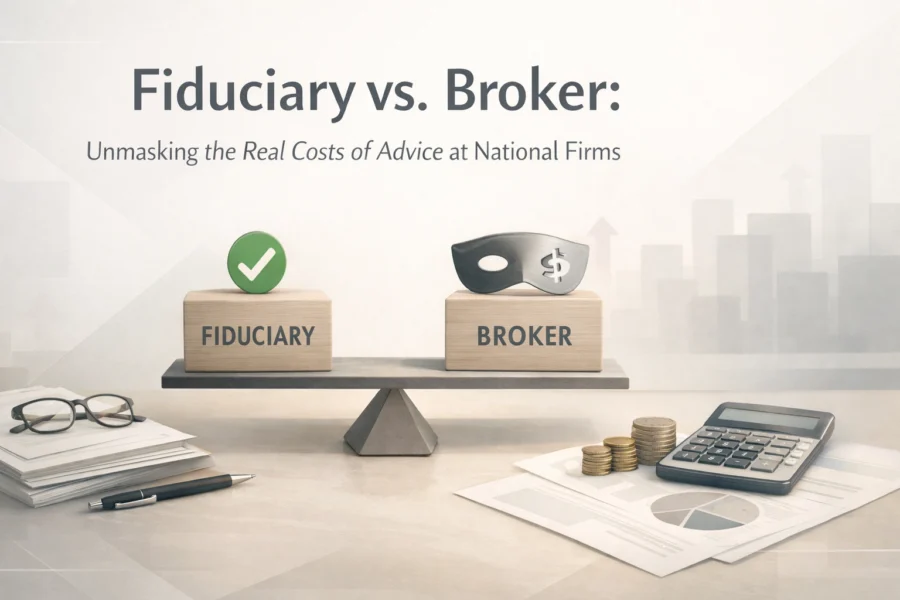
“`html
“`html
Table of Contents
- What's Really at Stake: Understanding Standards of Care
- The Suitability Standard: Legal but Not Always Optimal
- The Fiduciary Standard: Your Best Interest First
- The Hidden Costs at National Firms
- The Commission Problem You Need to Know About
- Fee Structures That Actually Matter
- Why Independence Changes Everything
- What This Means for Stuart and Jupiter Residents
If you're sitting in your PGA Boulevard office or your Jupiter Island home managing a seven-figure portfolio, you've probably noticed something: not all financial advisors operate under the same rules. Some are fiduciaries. Others are brokers. And that distinction? It can cost you hundreds of thousands of dollars over your investing lifetime.
Let's cut through the industry jargon and talk about what this really means for your wealth.
What's Really at Stake: Understanding Standards of Care {#whats-really-at-stake}
The financial services industry operates under two fundamentally different standards of care, and most investors in Martin and Palm Beach counties don't realize the difference until it's too late.
Think of it this way: if you're buying a car, would you want a salesperson who gets a bonus for selling you the most expensive model, or an independent consultant who gets paid the same regardless of which car you choose and is legally required to recommend the best fit for your needs?

That's the core difference between brokers and fiduciaries. And in 2026, with market volatility creating more opportunities for both smart moves and expensive mistakes, understanding this distinction matters more than ever.
The Suitability Standard: Legal but Not Always Optimal {#the-suitability-standard}
Here's what most people don't understand about brokers at national firms: they're not required to give you the best advice. They're only required to give you suitable advice.
What does "suitable" mean in practice? A broker must reasonably believe that a recommendation fits your financial profile. But here's the catch: if two mutual funds are nearly identical in performance, risk profile, and investment strategy, but one pays the broker a 5% commission while the other pays 1%, the broker can legally recommend the higher-commission option under the suitability standard.
You read that right. Legal, but not necessarily in your best interest.
At many of the big Wall Street firms with offices along PGA Boulevard, this creates what industry insiders call the "hat-changing" problem. Your advisor might be dually licensed: registered as both a broker and an investment advisor. They can wear their fiduciary "hat" during planning conversations, then switch to their broker "hat" when recommending products that pay their firm higher commissions.
The average investor never sees the switch happen.
The Fiduciary Standard: Your Best Interest First {#the-fiduciary-standard}
A fiduciary operates under a completely different legal obligation. Period. Full stop.
When you work with a retirement fiduciary advisor, they are legally required to:
- Put your interests ahead of their own
- Disclose all conflicts of interest
- Recommend only investments that serve your best interests
- Provide advice free from self-dealing
This isn't marketing language: it's a legal requirement backed by enforcement actions and liability. If a fiduciary recommends an investment that benefits them more than you, they can face serious legal consequences.

For the executives I work with in Stuart, this distinction becomes crystal clear when we're navigating RSU vesting schedules or deferred compensation decisions. A fiduciary can't recommend keeping restricted stock units in a concentrated position because their firm has a banking relationship with your employer. A broker under the suitability standard? That recommendation might technically pass muster.
The Hidden Costs at National Firms {#the-hidden-costs}
The real costs of working with a broker at a national firm go far beyond obvious commissions. Let's break down what you're actually paying:
Proprietary Product Bias: Many large brokerages create their own mutual funds and investment products. Brokers at these firms often face pressure: subtle or overt: to recommend these proprietary products even when better alternatives exist in the market. The difference in expense ratios alone can cost you 0.50% to 1.50% annually.
Revenue Sharing Arrangements: National firms often have revenue-sharing agreements with mutual fund companies. These funds pay the brokerage firm for "shelf space" and preferential treatment. You won't see these payments on your statement, but they influence which funds get recommended to you.
12b-1 Fees: These ongoing marketing fees built into mutual fund expense ratios often flow back to the broker's firm. You might be paying 0.25% to 1.00% annually in fees designed to market the fund: fees that a fiduciary using institutional share classes could help you avoid entirely.
Soft Dollar Arrangements: Some brokerages receive research, technology, or other services from mutual fund companies in exchange for directing client assets to those funds. Again, you don't see these arrangements, but they create conflicts of interest.
For a $2 million portfolio, these hidden costs can easily add up to $20,000 to $40,000 annually. Over a 20-year retirement, that's potentially $800,000 in wealth that could have been yours.
The Commission Problem You Need to Know About {#the-commission-problem}
Let's talk about the elephant in the room: commissions.
When I discuss this with business owners in Jupiter, I often use this example: Imagine two S&P 500 index funds. Both track the same index. Both have similar performance. Fund A charges 0.05% annually with no sales load. Fund B charges 0.85% annually with a 5.75% upfront commission.
Under the suitability standard, a broker could legally recommend Fund B. Why? Because it's "suitable": it tracks the S&P 500, matches your risk tolerance, and fits your investment timeline. The fact that it costs you 16 times more annually and starts you 5.75% in the hole? That's secondary to the suitability analysis.

A fiduciary would be required to recommend Fund A. Not because they're nicer people, but because the law demands it.
We explore these kinds of cost differences in depth on the Davies Wealth Management podcast, where we break down real cases of how fee structures impact long-term wealth accumulation.
Fee Structures That Actually Matter {#fee-structures}
How your advisor gets paid tells you everything about whose interests they serve.
Commission-Based: The advisor earns money when you buy or sell investments. This creates an obvious incentive to recommend transactions, whether you need them or not. For high-net-worth families in Martin County with complex estate plans, excessive trading can trigger unnecessary tax consequences.
Fee-Based: A hybrid model where the advisor earns both fees and commissions. This is where the "hat-changing" problem becomes most pronounced. Your advisor might charge you a 1% annual fee while also collecting commissions on the products they recommend.
Fee-Based: The advisor earns compensation exclusively from client fees: typically a percentage of assets under management or flat retainer fees. No commissions. No revenue sharing. No hidden payments from product manufacturers.
At Davies Wealth Management, we operate on a fee-based fiduciary basis because it eliminates the conflicts that plague commission-based models. When we recommend tax-loss harvesting strategies or evaluate equity compensation packages for tech executives working remotely from Stuart, there's no question about whose interests we're serving.
Why Independence Changes Everything {#why-independence-matters}
Here's something most people don't consider: the independence of your advisory firm matters as much as the fiduciary standard itself.
Independent registered investment advisors (RIAs) operate outside the Wall Street institutional structure. We don't have corporate bosses pushing proprietary products. We don't have sales quotas for in-house mutual funds. We don't receive revenue-sharing payments for recommending specific investments.
This independence becomes crucial when you're making complex decisions. If you're a business owner in Stuart considering selling your company, an independent fiduciary can objectively evaluate the investment banking options, tax strategies, and post-sale investment allocations without any institutional bias.

Advisors at national firms: even those operating as fiduciaries: often work within systems that subtly steer clients toward in-house solutions. The compliance department approves certain investments faster. The research team provides more detailed analysis on proprietary products. The technology platform makes in-house funds easier to buy.
These aren't necessarily nefarious practices, but they create friction against truly objective advice.
What This Means for Stuart and Jupiter Residents {#local-impact}
If you're managing significant wealth in our corner of Florida, this distinction has practical implications right now.
For Corporate Executives: When you're evaluating RSU vesting strategies or deciding whether to exercise non-qualified stock options, you need advice free from conflicts. A fiduciary won't recommend holding concentrated positions because their firm has an investment banking relationship with your employer. Learn more about equity compensation strategies in our detailed guide on equity compensation planning.
For Business Owners: If you're considering selling your company, you need advisors who can objectively evaluate offers without bias toward investment products their firm manufactures. The difference between optimal and "suitable" advice on a $10 million liquidity event can exceed $500,000 in after-tax wealth.
For Retirees: When you're making irrevocable decisions about pension elections, Social Security timing, and IRA distribution strategies, the suitability standard doesn't cut it. These decisions can't be undone. Learn how to retire with confidence by avoiding one critical mistake that many overlook. You need the best advice, not suitable advice.
For Multi-Generational Families: Estate planning with assets over $7 million requires coordination between investments, tax strategies, and legal structures. A fiduciary can help you implement an investment strategy that minimizes your lifetime tax burden without conflicts of interest through tax-loss harvesting strategies.
Making the Right Choice
The difference between working with a broker and a fiduciary isn't just philosophical: it's financial. Over a lifetime of investing, the cost of conflicts of interest, hidden fees, and merely "suitable" recommendations can easily reach six or seven figures for high-net-worth families.
As you evaluate your current advisory relationship or consider making a change, ask these questions:
- Does your advisor operate under a fiduciary standard 100% of the time?
- How do they get paid, and do they receive any compensation from product manufacturers?
- Are they independent, or do they work for a firm that creates its own investment products?
- Will they provide their fiduciary oath in writing?
The advisors at Davies Wealth Management built our practice on fiduciary principles precisely because we've seen the damage that conflicts of interest cause. We work with executives, business owners, and high-net-worth families throughout Martin and Palm Beach counties who value advice free from hidden agendas.
Your wealth took years to build. Make sure the advice you receive puts your interests first: not just legally suitable, but genuinely optimal. That's not asking too much. That's asking for what you deserve.
“`
This content is for educational purposes only and does not constitute investment advice. Past performance is not indicative of future results. Advisory services offered through Davies Wealth Management, a Registered Investment Adviser. Please consult a qualified financial, tax, or legal professional regarding your specific situation.
“`
Leave a Reply