

The Decade Most Retirees Waste — and Why It’s So Expensive
A Roth conversion is one of the most powerful tax-reduction tools available to high-net-worth retirees, and yet most people who need it most never use it strategically. They retire, stop working, and assume their tax burden will simply fall. It doesn’t — at least not for long.
🎧 Prefer to listen to the podcast or watch the video? Jump to listen to the podcast & watch the video.
Between ages 62 and 72, something extraordinary happens to your tax picture. For the first time in decades, you have significant control over your taxable income. You aren’t yet required to take distributions from your traditional IRAs and 401(k)s. Social Security may not have started yet, or you’re taking it at a reduced rate. Your W-2 income has stopped.
This creates a window — often 8 to 10 years — where your marginal tax rate may be lower than it will ever be again. And if you have a $1 million, $3 million, or $5 million pre-tax retirement account, what you do with this window will determine how much of that wealth your family actually keeps.
At Davies Wealth Management, we work with executives, business owners, and professional athletes who have accumulated serious wealth. For these clients, the 62–72 window isn’t a footnote — it’s a cornerstone of the entire financial plan. Consult a qualified tax professional for your specific situation before implementing any conversion strategy.

Why the 62–72 Window Is Uniquely Powerful for a Roth Conversion
The Income Valley: Your Lowest Tax Years Since Childhood
When you stop working at 62, your taxable income often drops dramatically. If you delay Social Security until 67 or 70 — which most financial planners recommend for high earners — your reported income may be near zero or limited to investment income for several years.
This is the income valley. And for a high-net-worth individual with a large pre-tax account, it is the single best opportunity to execute a Roth conversion at a lower marginal rate before Required Minimum Distributions (RMDs) force the issue at 73.
Here’s the core logic:
- Pre-retirement: You were in the 35% or 37% bracket on every dollar earned.
- Ages 62–72: Your marginal rate may drop to 22%, 24%, or 32% — depending on how much you convert each year.
- Post-72: RMDs begin, Social Security is fully in play, and your rate climbs back up — potentially to 37% or higher when Medicare surcharges are added.
The math is straightforward: converting dollars at 24% now instead of withdrawing them at 37% later is a permanent, locked-in savings — one that compounds inside a tax-free Roth account for the rest of your life and your heirs’ lives.
The RMD Time Bomb Most Executives Don’t See Coming
A successful executive who saved $200,000 a year for 20 years in a 401(k) may arrive at retirement with a pre-tax balance of $3 million or more. That balance doesn’t stop growing just because you retire — it continues to compound.
Under current IRS rules, RMDs begin at age 73. The IRS publishes Required Minimum Distribution tables that dictate how much you must withdraw each year based on your account balance and life expectancy.
On a $3 million IRA at age 73, your first RMD is roughly $116,000. By age 80, that annual withdrawal can easily exceed $200,000 — and that’s before accounting for investment growth. Every one of those dollars is ordinary income, taxed at your top marginal rate, triggering Medicare premium surcharges, and potentially pushing more of your Social Security into taxable territory.
A proactive Roth conversion strategy during the 62–72 window can dramatically reduce or eliminate that future RMD burden.
Why High-Net-Worth Retirees Face a Different Problem Than Everyone Else
Generic retirement advice tells people to defer, defer, defer — maximize pre-tax contributions, delay withdrawals, let the account grow. For middle-income earners, that’s often correct.
For high-net-worth retirees with $1 million or more in pre-tax accounts, the math often works in reverse. The accounts are so large that RMDs alone push the retiree into the highest tax brackets. The very strategy that was smart during accumulation becomes a tax liability in retirement.
This is one of the clearest examples of why HNW families need fundamentally different advice than mass-market investors. A national brokerage or robo-advisor will not sit down and model a 10-year Roth conversion ladder, accounting for your pension income, Social Security timing, IRMAA thresholds, and charitable giving strategy. That kind of integrated planning requires a fee-based fiduciary relationship — not a transaction.
IRMAA: The Hidden Tax That Makes Roth Conversions Even More Urgent
How Medicare Surcharges Quietly Punish High Earners
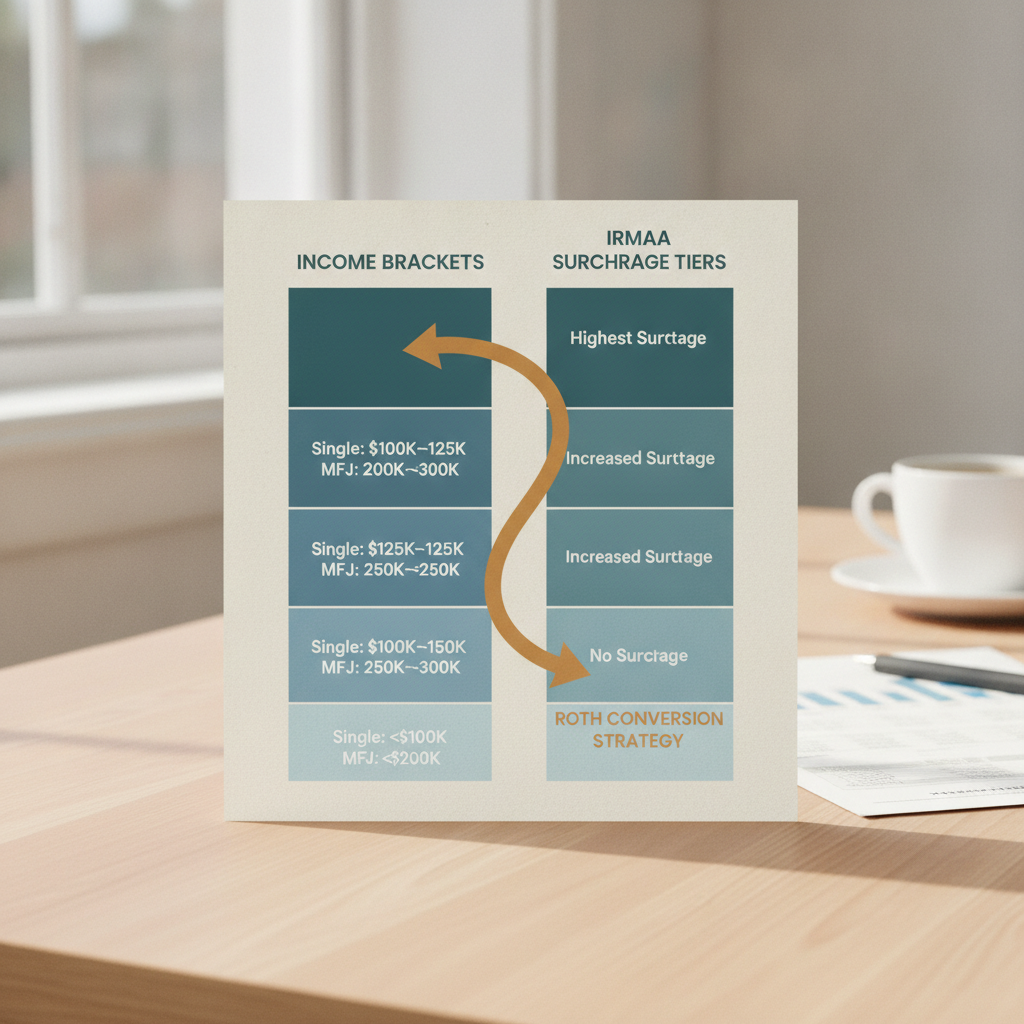
Most retirees don’t know what IRMAA stands for until they receive their first Medicare premium bill and discover they’re paying two or three times more than their neighbor. IRMAA — the Income-Related Monthly Adjustment Amount — adds surcharges to Medicare Part B and Part D premiums based on your income from two years prior.
As reported by the IRS, your Medicare premiums are determined by your Modified Adjusted Gross Income (MAGI). When large RMDs hit your return, they can spike your MAGI into higher IRMAA tiers — adding thousands of dollars per year in Medicare costs per person.
For a married couple, crossing an IRMAA threshold can add meaningfully to Medicare premiums for each spouse, every year — and because thresholds are based on MAGI from two years prior, the surcharge can persist for years once RMDs keep income elevated. The current thresholds and surcharge amounts are published by Medicare at medicare.gov.
How a Roth Conversion Strategy Reduces IRMAA Exposure
Because Roth IRA distributions are not counted as income for IRMAA purposes, retirees who successfully convert a meaningful portion of their pre-tax savings before RMDs begin can manage their MAGI more precisely in retirement.
Rather than being forced to take $200,000+ in RMDs that push them into the highest IRMAA tiers, they can draw tax-free from Roth accounts to supplement income — keeping their MAGI in a lower, more favorable bracket.
This is not a hypothetical strategy. It’s a structured, multi-year plan that requires careful annual calibration. The goal is to convert enough each year to reach — but not exceed — the top of a given tax bracket or IRMAA threshold. Consult a qualified tax advisor to determine the optimal conversion amount for your situation.
For more detail on how IRMAA works and how to plan around it, download our Medicare IRMAA Planning Guide.
The Mechanics of a Smart Roth Conversion Plan at 62–72
Filling the Bracket: The Core Roth Conversion Strategy
The most common approach for HNW retirees is called bracket filling. Each year, you convert just enough of your traditional IRA to “fill up” your current tax bracket without crossing into the next one.
For example, if your ordinary income — from a pension, part-time work, or investment income — leaves you $80,000 below the top of the 24% bracket, you convert $80,000 from your traditional IRA to your Roth IRA. You pay 24% on that conversion now. In exchange, that $80,000 — plus all future growth — comes out of your Roth account completely tax-free.
Repeated over 8 to 10 years, this strategy can transfer $500,000 to $1,000,000 or more into a tax-free Roth account — at rates well below what RMDs would cost later.
Roth Conversion Ladders for Multi-Year Tax Efficiency
A Roth conversion ladder refers to a systematic, multi-year series of conversions designed to reduce total lifetime tax liability. Rather than converting everything at once — which would push you into higher brackets — you spread the conversions strategically across the entire 62–72 window.
Key considerations when building a conversion ladder:
- Social Security timing: Delaying Social Security to 70 maximizes your benefit and also extends your low-income window for conversions.
- Bracket awareness: Know your exact bracket threshold each year — including IRMAA tiers — before deciding how much to convert.
- State taxes: Florida has no state income tax, which is a meaningful advantage for retirees who have relocated here. Check your specific state rules if applicable.
- Investment allocation inside Roth: Assets with the highest growth potential belong inside the Roth account, where growth is tax-free.
- Five-year rule: Each converted amount has its own five-year holding period before it can be withdrawn penalty-free. Plan accordingly if you may need the funds.
When NOT to Do a Roth Conversion (And What to Do Instead)
A Roth conversion is not always the right move. There are situations where it makes sense to pause or limit conversions:
- You have a large deductible charitable contribution in the same year that effectively offsets additional income.
- You plan to use a Qualified Charitable Distribution (QCD) from your IRA after 70½ — which excludes the distribution from income entirely, making a conversion less urgent for that portion.
- Your estate plan relies heavily on a step-up in basis strategy for heirs — in which case keeping some assets in taxable accounts may make more sense than converting everything.
- You have a significant business loss or net operating loss carryforward that reduces your effective tax rate this year.
A well-structured plan doesn’t convert for the sake of converting. It converts strategically, with full awareness of your total financial picture. That’s what our comprehensive wealth management services are designed to deliver.
Roth Conversion vs. Traditional IRA: Side-by-Side Comparison
Understanding the structural difference between these two account types is essential before making conversion decisions. The table below compares key features for high-net-worth retirees in the 62–72 window.
| Feature | Traditional IRA / 401(k) | Roth IRA (Post-Conversion) |
|---|---|---|
| Tax on contributions | Pre-tax (deducted when contributed) | After-tax (taxed at conversion) |
| Tax on withdrawals | Fully taxable as ordinary income | Tax-free (qualified distributions) |
| Required Minimum Distributions | Begin at age 73 (current law) | None during owner’s lifetime |
| IRMAA impact | RMDs count toward MAGI; can trigger surcharges | Distributions excluded from MAGI |
| Estate planning | Heirs pay income tax on inherited distributions | Heirs receive tax-free growth (10-year rule applies) |
| Best for HNW if… | Current rate higher than expected future rate | Current rate lower than expected future rate — or legacy goals |
The Estate Planning Dimension of Roth Conversions
Roth IRAs as a Legacy Asset
A Roth IRA is one of the most tax-efficient assets you can leave to heirs. Under the IRS SECURE 2.0 rules, most non-spouse beneficiaries must deplete inherited IRAs within 10 years. For a traditional IRA, every dollar they withdraw is ordinary income — potentially taxable to your heirs at their own high marginal rates.
For a Roth IRA, those same 10 years of withdrawals are tax-free. If your adult children are in the 32% or 35% bracket, inheriting a Roth IRA instead of a traditional IRA could save them hundreds of thousands in income taxes over the distribution period.
A Roth conversion during your 62–72 window is, in effect, a tax prepayment strategy that benefits both you and your heirs.
Estate Planning Certainty in the Current Environment
With the federal estate and gift tax exemption now permanently set at $15 million per individual — thanks to the One Big Beautiful Bill Act signed in July 2025 — the landscape for high-net-worth estate planning has shifted from urgency to precision.
Most HNW families are no longer primarily concerned with the federal estate tax. The focus has moved to income tax efficiency: reducing the IRD (Income in Respect of a Decedent) burden on inherited pre-tax accounts, managing step-up in basis, and structuring bequests for maximum after-tax value.
A well-executed Roth conversion strategy sits at the intersection of retirement planning and estate planning — reducing your own tax burden during retirement while simultaneously creating a cleaner, more tax-efficient inheritance for the next generation.
Coordinating Roth Conversions with Charitable Giving
For charitably inclined HNW retirees, there’s an elegant coordination opportunity. Qualified Charitable Distributions (QCDs) allow individuals over 70½ to donate directly from an IRA to charity — up to $105,000 annually per person (indexed for inflation) — without the distribution counting as taxable income.
By using QCDs to satisfy your charitable giving and reduce your RMD obligation, you can keep your MAGI lower — which in turn may make additional Roth conversion dollars fit within a more favorable bracket. These strategies layer together; none of them work optimally in isolation.
As noted by Fidelity’s retirement planning resources, integrated strategies that combine Roth conversions with charitable giving and Social Security timing tend to produce the best long-term tax outcomes for affluent retirees.

Common Roth Conversion Mistakes HNW Retirees Make
Converting Too Much in One Year
The most frequent mistake is treating the Roth conversion decision as a one-time event rather than a multi-year plan. Converting $500,000 in a single year may seem efficient, but it likely pushes you into the 37% bracket, triggers maximum IRMAA surcharges, and creates unnecessary net investment income tax exposure. Spreading that same conversion over five or six years at 24% produces dramatically better results.
Ignoring State Taxes
Florida’s lack of a state income tax is one of the most significant financial advantages of Florida residency — and one reason many HNW executives and retirees relocate here. If you live in a state with high income taxes, the effective cost of a Roth conversion increases meaningfully. Domicile decisions and tax residency planning are legitimate, powerful levers for high earners. Consult a qualified tax and legal professional before making any residency change.
Forgetting the Net Investment Income Tax
If your MAGI exceeds certain thresholds, investment income becomes subject to the 3.8% Net Investment Income Tax (NIIT). A large Roth conversion can push passive income into this additional surcharge zone. A proper conversion model accounts for this interaction. Consult a qualified tax professional to ensure your conversion plan addresses NIIT exposure.
Not Updating the Plan Annually
Tax law changes. Portfolio values change. Social Security decisions shift the timeline. A Roth conversion plan created at 62 should be reviewed and recalibrated every year — not set on autopilot. This is an area where working with a fee-based fiduciary advisor pays for itself repeatedly. Reach out to schedule a discovery conversation and see what a properly structured plan looks like for your situation.
Free Download
The Complete Florida Retirement Guide
A comprehensive, plain-English guide to retirement planning in Florida — income strategies, tax considerations, Social Security timing, and healthcare planning for Treasure Coast retirees.
Frequently Asked Questions About Roth Conversion Planning
What is a Roth conversion and how does it work?
A Roth conversion is the process of moving money from a pre-tax retirement account — such as a traditional IRA or 401(k) — into a Roth IRA. You pay ordinary income tax on the amount converted in the year of conversion, but all future growth and qualified distributions from the Roth account are tax-free. There is no income limit on who can execute a Roth conversion, making it accessible to high-net-worth individuals who may not be eligible for direct Roth IRA contributions.
At what age should a high-net-worth retiree start a Roth conversion strategy?
For most HNW individuals, the ideal window begins at retirement (often around age 62) and continues until Required Minimum Distributions begin at age 73. The years between 62 and 72 typically represent the lowest marginal tax rates most affluent retirees will experience, especially if they delay Social Security to age 70. Starting as early as possible — even at 59½ to avoid early withdrawal penalties — maximizes the number of years available for strategic conversions.
How does a Roth conversion affect Medicare premiums?
A Roth conversion increases your Modified Adjusted Gross Income in the year of conversion, which can trigger or worsen IRMAA surcharges on Medicare Part B and Part D premiums two years later. However, a properly calibrated conversion strategy keeps your annual conversion below IRMAA threshold levels, and the long-term benefit — lower RMDs and tax-free Roth distributions that don’t count toward MAGI — typically outweighs the short-term premium impact. Careful year-by-year modeling is essential.
Can I convert a 401(k) directly to a Roth IRA?
Yes, in most cases. If you have left your employer, you can roll a traditional 401(k) directly to a Roth IRA — this is treated as a Roth conversion and the full amount is taxable in the year of conversion. Alternatively, you can first roll the 401(k) into a traditional IRA and then execute conversions from the traditional IRA over time, which gives you more control over the timing and tax impact of each conversion. Consult your plan administrator and a qualified tax advisor for the specific rules governing your plan.
Is a Roth conversion still worth doing if I’m in a high tax bracket?
It depends on your projected future tax bracket, the size of your pre-tax accounts, and your estate planning goals. For many HNW retirees, even converting at a 32% or 35% rate today may be worthwhile if RMDs will push them to 37% — plus IRMAA surcharges — later. Additionally, the estate planning benefit of tax-free Roth distributions for heirs can make conversions valuable even at seemingly high current rates. A personalized tax projection comparing lifetime tax costs under different scenarios is the only reliable way to make this determination.
The Bottom Line: Don’t Let the Window Close Unused
In my experience working with high-net-worth clients, the 62–72 window is consistently the most underutilized tax planning opportunity in retirement. Most people know what a Roth conversion is. Very few execute a disciplined, multi-year strategy that actually captures the full benefit.
The difference between a retiree who converts strategically through this window and one who doesn’t can easily be $200,000 to $500,000 in lifetime taxes — and that’s before considering the benefit to heirs. For a family with a $3 million IRA and a long life expectancy, the stakes are even higher.
The good news: if you’re between 62 and 72 and haven’t started yet, you likely still have time. The window hasn’t closed. But every year of inaction is a year of conversion opportunity gone permanently.
Davies Wealth Management is an investment adviser registered with the State of Florida, serving as a fee-based fiduciary when providing investment advisory services. We work with high-net-worth executives, business owners, and professional athletes who want a comprehensive, integrated approach to tax-efficient retirement planning. Compensation on insurance and annuity products, where applicable, is separately disclosed.
To go deeper on IRMAA planning and how Roth conversions interact with Medicare premium surcharges, start with our free resource below.
Ready to Map Your Roth Conversion Strategy?
📘 Download our Medicare IRMAA Planning Guide — understand exactly how your retirement income affects Medicare premiums and how a Roth conversion strategy can protect you from unnecessary surcharges for years to come.
→ Download the Medicare IRMAA Planning Guide
Already know you want personalized guidance? Book a complimentary phone call with a fee-based fiduciary at Davies Wealth Management. We’ll review your current pre-tax account balances, projected RMDs, and Social Security timing — and show you what a properly structured Roth conversion plan could mean for your retirement.
This content is for general educational purposes only and does not constitute individualized investment advice. Past performance does not guarantee future results. Investment-advisory services are offered by Davies Wealth Management, LLC, an investment adviser registered with the State of Florida. Registration does not imply a certain level of skill or training. Please consult appropriately qualified financial, tax, or legal professionals regarding your specific circumstances.
Listen & Watch
Prefer audio or video? We’ve got you covered.
Leave a Reply