


Medicare Part B is not a flat, equal-access benefit for everyone. If your household income exceeds certain thresholds, the federal government charges you substantially more — sometimes more than three times the standard premium — through a mechanism called the Income-Related Monthly Adjustment Amount, or IRMAA. For retirees with $500,000 or more in annual income, this is not a footnote. It is a material, recurring cost that demands deliberate planning.
This guide explains how Medicare Part B and Part D pricing actually works at high income levels, what thresholds apply in 2026, and — most importantly — seven specific strategies you can use to manage those costs intelligently.
How Medicare Part B Premiums Actually Work at High Income Levels
Most Americans enroll in Medicare expecting to pay the standard Part B premium. In 2026, that standard premium is $202.90 per month per person. But that number only applies to individuals with a Modified Adjusted Gross Income (MAGI) at or below $109,000, or married couples filing jointly at or below $218,000.
Above those thresholds, IRMAA brackets stack progressively higher surcharges on top of the base premium. The Social Security Administration determines your IRMAA tier using your tax return from two years prior — meaning your 2024 income determines your 2026 Medicare Part B costs. This two-year lookback is critical for planning purposes.
The 2026 Medicare Part B IRMAA Brackets
Below is a comparison of the full 2026 Medicare Part B and Part D premium tiers for individuals and married couples filing jointly. These are not hypothetical — these are the actual surcharges applied to high-income Medicare enrollees.
| Individual MAGI | Married Filing Jointly MAGI | Monthly Part B Premium (per person) | Monthly Part D IRMAA Add-on |
|---|---|---|---|
| ≤ $106,000 | ≤ $212,000 | $185.00 | $0.00 |
| $106,001 – $133,000 | $212,001 – $266,000 | $259.00 | $13.70 |
| $133,001 – $167,000 | $266,001 – $334,000 | $370.00 | $35.30 |
| $167,001 – $200,000 | $334,001 – $400,000 | $481.00 | $57.00 |
| $200,001 – $500,000 | $400,001 – $750,000 | $592.00 | $78.60 |
| Above $500,000 | Above $750,000 | $628.90 | $85.80 |
Sources: Social Security Administration, Centers for Medicare & Medicaid Services. 2026 figures. Consult a qualified financial professional for your specific situation.
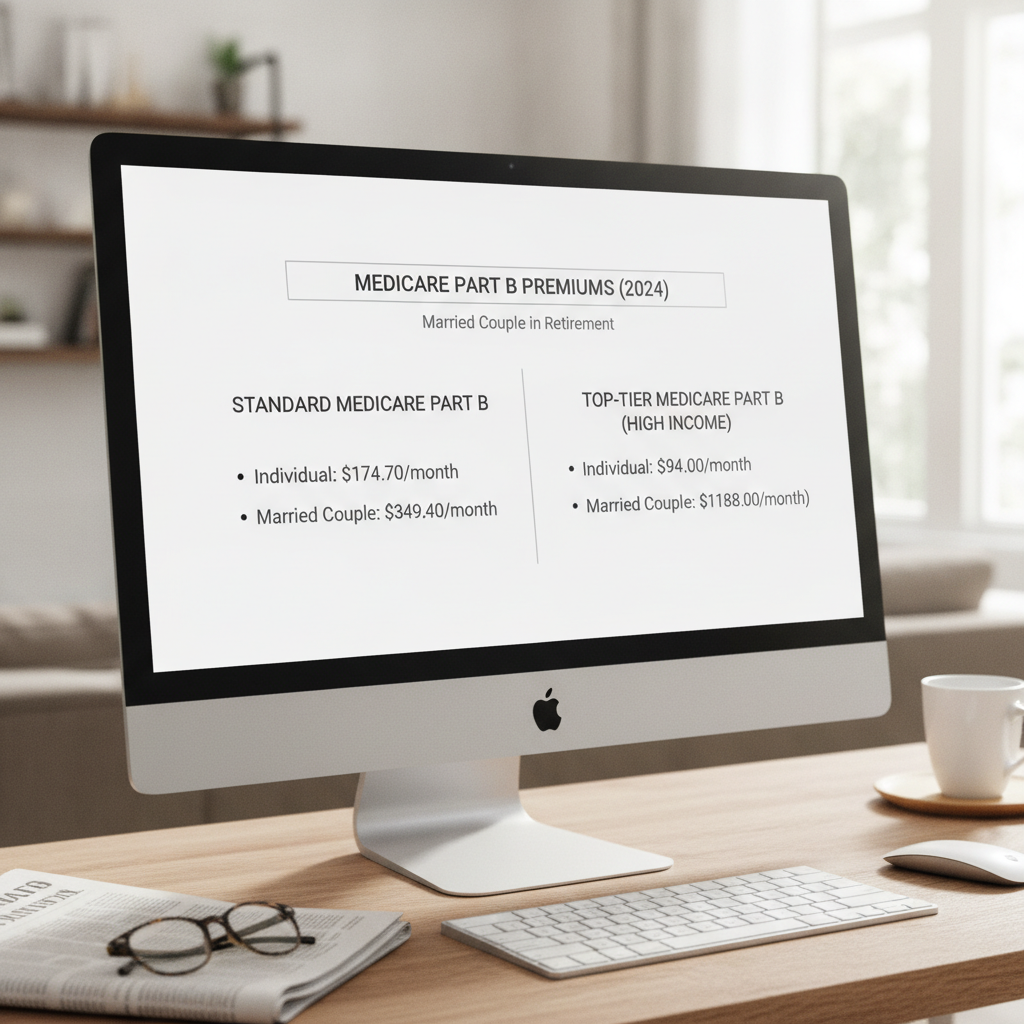
A married couple both enrolled in Medicare who fall into the highest IRMAA tier pays $1,257.80 per month in Part B premiums alone — more than $15,000 per year — before any Part D surcharges. That is a significant annual expense that most mass-market retirement planning tools do not adequately model.
Why High-Net-Worth Retirees Face a Different Medicare Problem
A retiree with a $2 million portfolio pulling $80,000 per year from a traditional IRA and Social Security might stay below the IRMAA threshold entirely. But a retired executive or business owner with $5 million in assets — a mix of taxable accounts, IRAs, and deferred compensation — often faces income events that look very different.
Income Sources That Trigger Medicare Part B Surcharges
IRMAA is calculated on your MAGI, which for most retirees includes the following:
- Traditional IRA and 401(k) distributions (fully taxable)
- Required Minimum Distributions (RMDs) beginning at age 73
- Capital gains from the sale of a business, real estate, or concentrated stock positions
- Roth conversions (added to MAGI in the conversion year)
- Rental income, dividends, and interest from taxable accounts
- Deferred compensation payouts
- Social Security benefits (up to 85% of which may be taxable)
For someone with $500K or more in retirement income, crossing a single IRMAA bracket threshold can cost a married couple an additional $3,000 to $5,000 per year in Part B premiums alone. Managing MAGI is not a fringe optimization — it is core retirement income planning.
The Mass-Market Versus High-Net-Worth Medicare Planning Gap
Most Medicare resources — the ones you find on consumer websites or in general retirement guides — focus on helping middle-income retirees understand their coverage options. They are designed for someone choosing between a Medicare Advantage plan and Original Medicare for the first time.
That advice is largely irrelevant to someone with a $5 million IRA, a concentrated stock position, or a pending business sale. High-net-worth retirees need a fundamentally different approach — one that coordinates Medicare planning with income tax planning, estate strategy, and multi-year cash flow modeling. This is exactly the kind of integrated guidance offered through our comprehensive wealth management services.
7 Proven Strategies to Reduce Medicare Part B and Part D Costs
Strategy 1: Multi-Year MAGI Management Through Income Smoothing
Because IRMAA uses a two-year lookback, income spikes in any single year echo into Medicare costs two years later. The first strategy is deliberate income smoothing — spreading large income events across multiple tax years rather than concentrating them.
This is particularly relevant for business owners selling a company, executives receiving a deferred compensation payout, or retirees with large capital gains. A $2 million gain recognized in a single year may push Medicare Part B premiums to the highest bracket for two consecutive years. Structured installment sales or payout deferrals can sometimes spread that income more favorably.
Consult a qualified tax professional before structuring any sale or payout to evaluate your specific situation.
Strategy 2: Strategic Roth Conversions Before Medicare Enrollment
One of the most powerful levers available to pre-retirees is the Roth conversion ladder — systematically converting traditional IRA funds to a Roth IRA during years when income is lower, typically between retirement and age 73 when RMDs begin.
Roth distributions in retirement are tax-free and do not count toward MAGI for IRMAA purposes. A retiree who converts aggressively in their early 60s may significantly reduce the RMDs that would otherwise push them into higher IRMAA brackets at 73 and beyond. The math on this can be compelling — but it requires careful modeling of multiple tax years.
According to IRS guidance on Roth IRAs, qualified distributions from a Roth account are excluded from gross income, making them a powerful tool in MAGI management for IRMAA purposes.
Strategy 3: Qualified Charitable Distributions to Reduce MAGI
If you are 70½ or older and charitably inclined, Qualified Charitable Distributions (QCDs) allow you to transfer up to $105,000 per year (2026 limit, indexed for inflation) directly from your IRA to a qualified charity — without that amount ever appearing in your MAGI.
A couple each directing $105,000 via QCDs can reduce MAGI by up to $210,000 in a given year. For someone sitting in a high IRMAA bracket, that reduction can mean dropping to a lower premium tier — saving thousands annually in Medicare Part B and Part D costs while also satisfying charitable giving goals.
This is one of the few strategies that simultaneously reduces income taxes, IRMAA exposure, and satisfies philanthropic intent. The IRS provides detailed QCD requirements that must be followed precisely for the exclusion to apply.

Strategy 4: Appealing an IRMAA Determination After a Life-Changing Event
Many retirees do not realize they can appeal an IRMAA surcharge if their income has dropped significantly due to a life-changing event. The Social Security Administration allows IRMAA reconsideration based on events including:
- Retirement or reduction in work hours
- Death of a spouse
- Divorce or annulment
- Loss of income-producing property
- Loss or reduction of pension income
- Receipt of a settlement from an employer
If your 2026 Medicare Part B premium is based on your 2024 income — and your 2025 income was substantially lower — you can request that SSA use your more recent tax data. Form SSA-44 is the vehicle for this appeal. This is not widely publicized but can provide immediate premium relief.
Strategy 5: Harvesting Capital Losses to Offset Gains
For retirees with large taxable investment portfolios, tax-loss harvesting is not just about reducing income taxes — it directly reduces MAGI and, therefore, IRMAA exposure. Strategically realizing losses in the same year as large gains can help keep MAGI within a lower IRMAA bracket.
This strategy is especially valuable for high-net-worth retirees managing concentrated stock positions or diversifying out of low-basis assets. Done systematically across a multi-million dollar portfolio, tax-loss harvesting can represent meaningful annual IRMAA savings in addition to income tax savings.
Strategy 6: Leveraging Health Savings Accounts Before Medicare Enrollment
If you are still working and covered by a High-Deductible Health Plan, the Health Savings Account (HSA) is one of the most tax-efficient vehicles available. Contributions reduce MAGI. Distributions for qualified medical expenses are tax-free. And unlike FSAs, balances roll over indefinitely.
In 2026, the HSA contribution limit is $4,400 for individuals and $8,750 for families, with an additional $1,000 catch-up contribution for those 55 or older. Critically, you must stop contributing to an HSA once you enroll in Medicare Part B. Building a large HSA balance before retirement can provide a tax-free pool of funds specifically for healthcare expenses — including Medicare premiums paid out of pocket — without affecting MAGI.
Strategy 7: Coordinating Retirement Income Timing With Your IRMAA Tier
Not all income is created equal from an IRMAA perspective. In the year you plan to sell a business, liquidate a major asset, or receive a large distribution, the goal is not to eliminate all income management — it is to be intentional about which tier you land in.
If your MAGI is already going to hit $400,000 in a given year, there may be little additional IRMAA cost to recognizing another $50,000 of gains in that same year versus spreading it to a year when your income is lower. Conversely, avoiding a $1,000 income item that would push you from one IRMAA bracket to the next can save thousands annually for two consecutive years.
This kind of bracket-awareness requires precise income modeling — not a one-page tax estimate, but a detailed multi-year projection coordinated with your investment plan.
Medicare Part B and Part D Planning for Business Owners and Executives
The Business Sale Problem
One of the most common scenarios we encounter involves a business owner who sells their company and receives a large lump sum — often $2 million to $10 million or more. That gain, even if partially offset by deductions, typically creates a MAGI spike that locks in maximum IRMAA surcharges for two years.
Advance planning — ideally two to three years before a sale — can include strategies such as Charitable Remainder Trusts (CRTs), Qualified Opportunity Zone investments, or installment sale structures that spread recognition over time. Each has trade-offs, and the right choice depends on your specific tax situation. Consult a qualified tax and legal professional for your circumstances.
Executives With Deferred Compensation Payouts
Many corporate executives accumulated significant balances in non-qualified deferred compensation plans. These payouts are fully taxable as ordinary income when received and are included in MAGI. An executive receiving $500,000 in deferred comp in their first year of retirement may face maximum Medicare Part B premiums for two consecutive years regardless of other planning efforts.
Understanding the payout schedule and coordinating it with other income sources — Roth conversions, Social Security timing, RMD planning — is essential for executives transitioning into retirement. Fidelity’s retirement planning resource on Medicare costs offers additional background on how income affects coverage costs.

The IRMAA Appeal Process: A Practical Guide
How to File an IRMAA Appeal Using SSA-44
If you experience a qualifying life event that significantly reduced your income, you can request that Social Security use a more recent tax year to determine your Medicare Part B premium. Here is how the process works:
- Obtain Form SSA-44 from the Social Security Administration website or your local SSA office.
- Identify your qualifying event from the approved list and document it with supporting paperwork.
- Provide your estimated current income and the tax year you would like SSA to use instead of the two-year lookback year.
- Submit to your local SSA office — this can be done by mail, in person, or sometimes online.
- Follow up — processing times vary, and appeals can take weeks to months to resolve.
A successful appeal can reduce Medicare Part B costs immediately, sometimes resulting in refunds for overpaid premiums. This is an underutilized option that many retirees simply do not know exists.
When to Involve a Financial Advisor in the IRMAA Appeal
If your income reduction involves a complex tax event — a Roth conversion strategy, a partial business sale, or a significant investment loss — having a fiduciary advisor who understands how these items affect MAGI can strengthen your appeal documentation. To schedule a discovery conversation with our team, we are happy to review your specific situation.
Frequently Asked Questions About Medicare Part B and High-Income Planning
What is the highest Medicare Part B premium in 2026?
The highest Medicare Part B premium in 2026 is $628.90 per month per person, applicable to individuals with MAGI above $500,000 or married couples filing jointly with MAGI above $750,000. This is based on the income-related monthly adjustment amount (IRMAA) surcharge system.
Does a Roth conversion affect my Medicare Part B premium?
Yes. A Roth conversion is included in your MAGI in the year it is executed, which can push you into a higher IRMAA bracket and increase your Medicare Part B premium two years later. However, future Roth distributions do not count toward MAGI, making strategic conversions highly valuable for long-term IRMAA management. Consult a qualified tax professional to evaluate the trade-offs for your situation.
Can I appeal my Medicare Part B IRMAA surcharge if my income dropped?
Yes. If your income dropped significantly due to a qualifying life event — such as retirement, death of a spouse, or loss of a pension — you can file Form SSA-44 with the Social Security Administration to request that a more recent tax year be used for your IRMAA calculation. A successful appeal can reduce your Medicare Part B premium immediately.
Do Qualified Charitable Distributions reduce IRMAA exposure?
Yes. QCDs made directly from an IRA to a qualified charity are excluded from MAGI, meaning they do not count toward the income thresholds used to calculate Medicare Part B IRMAA surcharges. In 2026, each individual can direct up to $105,000 in QCDs annually, making this a powerful strategy for charitably inclined retirees. Consult a qualified financial advisor to confirm eligibility and implementation.
How does Medicare Part D IRMAA differ from Part B IRMAA?
Medicare Part D IRMAA works similarly to Part B — it is an income-based surcharge added to your prescription drug plan premium. However, the Part D surcharge is paid directly to Medicare (not your plan), and the amounts are smaller, ranging from $13.70 to $85.80 per month in 2026 depending on your income tier. Kiplinger’s Medicare IRMAA resource provides additional detail on how the two programs interact.
Taking Control of Your Medicare Part B Costs
For retirees with $500,000 or more in annual income, Medicare Part B planning is not a passive exercise. The IRMAA system is designed to extract significantly more from higher-income beneficiaries — and without proactive management, those costs compound year after year across your retirement.
The seven strategies outlined here — income smoothing, Roth conversions, QCDs, IRMAA appeals, tax-loss harvesting, HSA utilization, and deliberate income timing — are not theoretical. They are approaches that directly reduce the MAGI that drives your Medicare Part B premium tier.
What separates advisors who specialize in high-net-worth retirement planning from generalist financial professionals is the ability to model these strategies simultaneously across multiple tax years — coordinating your investment plan, tax strategy, estate plan, and healthcare costs into a coherent whole. According to research cited by Morningstar on the value of financial advice, coordinated tax and income planning at the portfolio level can add meaningful value over time for retirees in complex situations.
In my experience working with high-net-worth retirees, the Medicare cost conversation almost always reveals planning opportunities that were being left on the table — not because clients weren’t smart, but because no one had modeled the full picture in an integrated way.
If your household income exceeds $500,000 in retirement — or is projected to — you owe it to yourself to approach Medicare Part B planning with the same rigor you apply to your investment portfolio.
Your Next Step: Medicare IRMAA Planning Tools and Guidance
Download our Medicare IRMAA Planning Guide — a comprehensive resource built specifically for high-income retirees who want to understand their full Medicare Part B and Part D cost exposure and the strategies available to reduce it.
Download Our Medicare IRMAA Planning Guide →
Already know you want a personalized review? Ready for personalized guidance from a fee-based fiduciary? Book a complimentary phone call with the Davies Wealth Management team to discuss your specific Medicare and retirement income situation.
This content is for educational purposes only and does not constitute investment advice. Past performance is not indicative of future results. Advisory services offered through Davies Wealth Management, a Registered Investment Adviser. Please consult a qualified financial, tax, or legal professional regarding your specific situation.
Leave a Reply