


What the DROP Program Is — and Why It Deserves Serious Attention
When a Florida public employee is ready to books retirement but isn’t quite ready to leave the job, the Deferred Retirement Option Program — almost universally called DROP — offers a compelling middle path. Understanding how DROP works is essential before you make a decision that is largely irreversible once made.
🎧 Prefer to listen to the podcast or watch the video? Jump to listen to the podcast & watch the video.
DROP is available through the Florida Retirement System (FRS), which covers most state, county, and municipal employees, as well as school district and university employees. At its core, DROP lets you formally retire from a pension standpoint while continuing to draw your regular paycheck — for up to 60 months.
Your monthly pension benefit begins accumulating in a separate DROP account during that period. When you finally separate from employment, you receive that lump-sum accumulation in addition to your ongoing monthly pension. Done right, DROP can add hundreds of thousands of dollars to your retirement picture. Done carelessly, it can cost you just as much.

How the Florida DROP Program Actually Works
The Core Mechanics of Books Retirement Under DROP
To enter DROP, you must first be eligible to retire under the Florida Retirement System Pension Plan. That generally means reaching your normal retirement date — a combination of age and years of creditable service that varies by membership class. Once eligible, you elect DROP and set your retirement date.
From that election date forward:
- Your pension benefit is calculated and frozen at that point — future salary increases do not increase your pension
- Your monthly pension payment accumulates in a DROP account earning an annual interest rate set by statute (currently 1.3% for most FRS members, though rates have varied)
- You continue working and receiving your normal salary and benefits
- You continue making FRS contributions, but they no longer increase your pension multiplier
At the end of your DROP period — which cannot exceed 60 months — you must terminate employment. At that point, you receive your DROP accumulation as a lump sum (rollover to an IRA or other eligible plan is permitted) and begin collecting your monthly pension.
Who Is Eligible to Books Retirement Through DROP
Eligibility is tied to your FRS membership class. The FRS covers several categories, each with different retirement age and service requirements:
- Regular Class: Age 65 with any creditable service, or age 60 with 30 years of creditable service (for those enrolled before July 1, 2011 — newer members face different thresholds)
- Special Risk Class: Primarily law enforcement, firefighters, and corrections officers — typically age 55 with 6 years of special risk service, or 25 years of special risk service at any age
- Elected Officers’ Class and Senior Management Service Class: Separate criteria apply
Your employer must also participate in the FRS Pension Plan — not the FRS Investment Plan. If you are enrolled in the Investment Plan, DROP is not available to you. Consult your HR department and the FRS DROP portal to confirm your eligibility before making any decisions.
The DROP Interest Rate and What It Means for Your Accumulation
The statutory interest rate credited to DROP accounts is a critical variable most employees underestimate. At 1.3% annually, your DROP account grows modestly in nominal terms. If you are accumulating a $6,000 monthly pension over 60 months, the raw accumulation before interest is $360,000. At 1.3% credited annually, the growth is meaningful but not dramatic.
This low guaranteed rate is one reason the financial decision to enter DROP is not automatic — and it is exactly why higher-net-worth employees need to model the numbers carefully with an advisor who can compare DROP accumulation against alternative strategies.
The Financial Trade-Offs That Most Guides Skip
Opportunity Cost: What You Give Up When You Books Retirement Early
The moment you elect DROP, your pension is frozen. If you would have continued accruing service credit, a higher salary, or additional years in a higher pay band, that lost pension growth could be significant — often more than the DROP accumulation itself.
Consider a simplified example. A teacher with a final average compensation of $75,000 and a 1.60% multiplier earns a pension of $1,200 per month for each additional year of service. Two additional years of service would add $2,400 per month — for life. A DROP accumulation of $144,000 over 24 months (at low interest) cannot purchase a $2,400/month lifetime annuity at market rates.
The lesson: entering DROP too early in your career — even if technically eligible — can permanently reduce your lifetime income. This is the analysis most online DROP calculators ignore.
Tax Considerations When You Receive the DROP Lump Sum
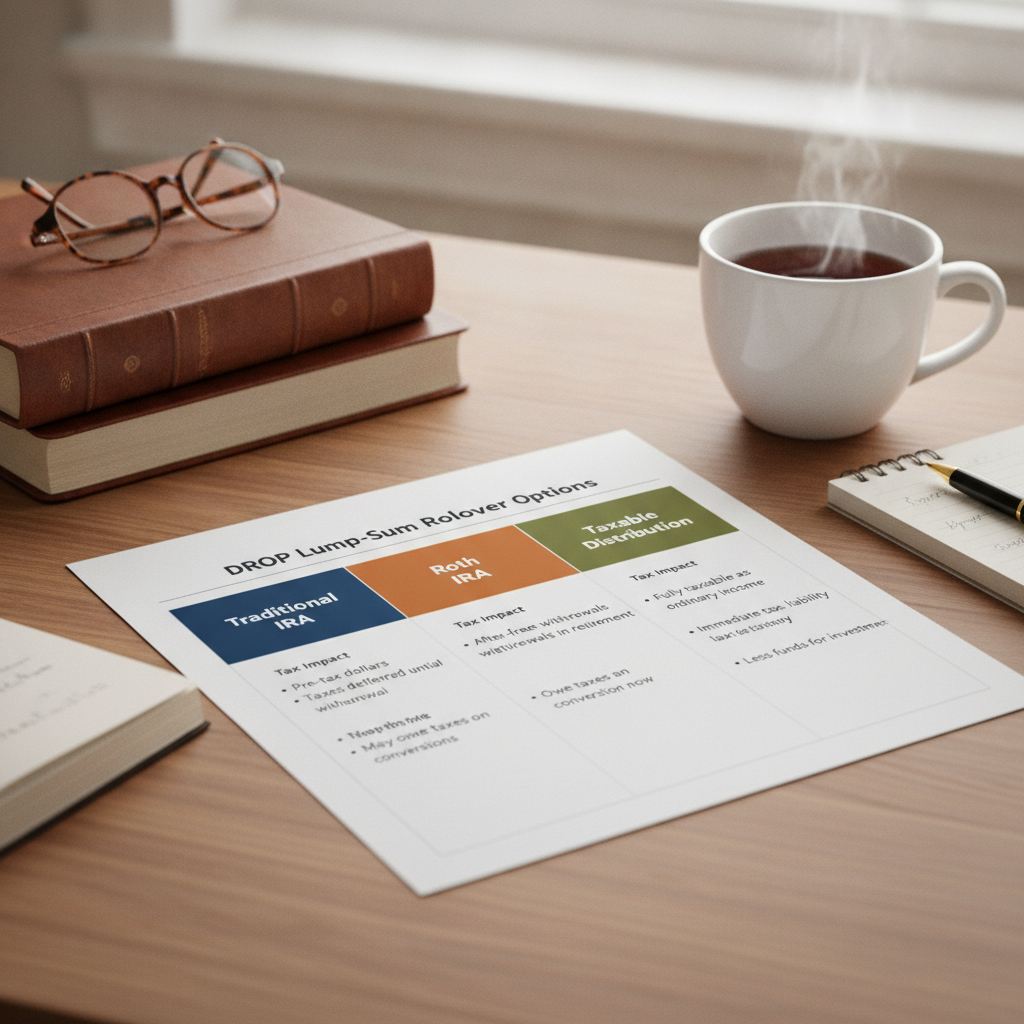
The DROP lump sum is fully taxable as ordinary income in the year you receive it — unless you roll it over directly to an IRA or eligible employer plan. For a high-net-worth employee receiving $300,000 to $600,000 in DROP proceeds, a taxable distribution could push you into the highest federal income tax bracket and trigger additional state taxes if you have relocated.
Florida has no state income tax, which is one reason that for employees who books retirement and remain in Florida, the DROP rollover decision is primarily a federal tax issue. Rolling the DROP balance directly into a traditional IRA defers taxes. Rolling into a Roth IRA triggers immediate taxation but enables future tax-free growth — a particularly attractive option for high earners who expect to manage required minimum distributions (RMDs) later.
Consult a qualified tax professional for your specific situation before deciding how to receive your DROP distribution.
Social Security Coordination
Many FRS members are not covered by Social Security, particularly in certain school districts and law enforcement agencies. If you are covered, your DROP election and subsequent retirement date interact with your Social Security claiming strategy. Retiring earlier — even just two to three years sooner than planned — can meaningfully reduce your Social Security benefit if you claim early, or reduce the wage-averaging base used to calculate your benefit.
For executives and high earners who are covered by both FRS and Social Security, this coordination deserves careful modeling before you books retirement under DROP.
DROP vs. Traditional Retirement: A Side-by-Side Comparison
| Factor | DROP Participation | Traditional Retirement (No DROP) |
|---|---|---|
| Pension Calculation | Frozen at DROP election date | Continues accruing until actual separation |
| Salary During Period | Continues at normal rate | N/A — employment has ended |
| Lump Sum Available | Yes — DROP account accumulation | No (unless a lump-sum pension option is elected) |
| Investment Growth on Accumulation | 1.3% guaranteed (statutory rate) | Pension fund managed professionally |
| Employment Flexibility | Must separate by end of DROP period | Can stay as long as desired and eligible |
| Best Suited For | Employees near peak salary who are ready to transition | Employees with significant service years remaining |
Who DROP Actually Suits — and Who Should Think Twice
The Ideal DROP Candidate When Books Retirement Makes Sense
DROP tends to deliver its greatest financial benefit for a specific profile. If you match most of these characteristics, DROP is worth a detailed analysis:
- You are at or very near your normal retirement date and have maximized your pension accrual
- You have reached a salary ceiling — future raises will be minimal, so the frozen pension calculation costs you little
- You want to work 2–5 more years but are ready to separate emotionally and professionally from a long career
- You have the financial sophistication to invest or deploy the DROP lump sum wisely
- You plan to remain in Florida, preserving the state income tax advantage on the rollover
- You have other assets — a 403(b), 457(b), or personal investment portfolio — so the DROP accumulation is additive rather than your sole retirement resource
When DROP Is the Wrong Choice for Your Books Retirement Plan
DROP is not universally advantageous. Here are situations where it frequently disappoints:
- Early eligibility with years of service remaining: Entering DROP the moment you are eligible — rather than at the optimal point — can permanently reduce your lifetime pension income
- Significant future salary growth expected: Promotions, administrative positions, or collective bargaining increases that arrive after DROP election do not increase your frozen pension
- Poor lump-sum management: The DROP benefit only compounds your retirement wealth if the lump sum is invested or deployed intelligently — simply leaving it in a low-yield account defeats the purpose
- High-income years remaining: For executives and senior administrators, the final two to three years of employment often represent peak earnings that establish the final average compensation used in pension calculation — entering DROP too early forfeits that
High-Net-Worth Considerations That Mass-Market Guides Ignore
Most DROP guides are written for the average public employee — not for a school principal earning $180,000, a senior law enforcement administrator, or a state university executive with significant outside investment assets. For high-net-worth public employees, the calculus is different in several important ways.
First, the DROP lump sum — potentially $400,000 to $700,000 or more for high earners in a full 60-month DROP — is large enough to meaningfully affect your overall asset allocation, tax position, and estate plan. It is not a windfall to spend; it is a concentrated lump of pre-tax retirement savings that needs a coordinated strategy.
Second, high-income public employees often have significant outside assets: deferred compensation plans, 403(b) or 457(b) balances, spouse’s retirement savings, real estate, and taxable investment accounts. Layering a DROP lump sum rollover on top of those assets requires sophisticated tax modeling — particularly around future RMDs, Roth conversion ladders, and potential IRMAA surcharges on Medicare premiums.
Third, for households with $2M+ in investable assets, the DROP decision is ultimately a piece of a larger financial planning picture — not the centerpiece. Working with a fiduciary advisor who provides comprehensive wealth management services ensures the DROP analysis is integrated into your full picture rather than evaluated in isolation.

Integrating DROP Into a Sophisticated Retirement Income Strategy
Rolling the DROP Balance: IRA vs. Roth IRA vs. New Employer Plan
When you finally separate from employment, you have meaningful flexibility in how you receive your DROP accumulation. The three primary paths are:
- Direct rollover to a traditional IRA: Defers all taxes. The balance joins your existing pre-tax retirement savings. Future withdrawals are taxed as ordinary income. Ideal if you expect to be in a lower tax bracket in retirement.
- Roth conversion (rollover to Roth IRA): Taxable in the year of conversion, but future growth and qualified withdrawals are tax-free. Particularly powerful if you have several years before RMDs begin and expect your tax rate to remain elevated.
- New employer plan (if applicable): If you take a second-career position with a plan that accepts rollovers, this preserves RMD flexibility and potential creditor protection.
A partial Roth conversion strategy — rolling a portion into a Roth IRA over multiple tax years — can be especially effective for high-net-worth retirees who want to manage their future tax burden without triggering a massive tax bill in a single year. Consult a qualified tax professional for your specific situation.
Coordinating DROP With Your 457(b) and 403(b) Balances
Many Florida public employees — particularly educators and government administrators — have accumulated substantial balances in 457(b) deferred compensation plans and 403(b) accounts alongside their FRS pension. When you books retirement through DROP, these balances become available for distribution or rollover simultaneously.
The 457(b) is particularly valuable because it has no 10% early withdrawal penalty, regardless of your age at separation. This makes it an effective bridge income source if you retire before age 59½ or want to manage your taxable income in early retirement before Social Security or Medicare eligibility.
Estate Planning Considerations for the DROP Lump Sum
A DROP lump sum rolled into a traditional IRA becomes part of your taxable estate and is subject to the inherited IRA rules under the SECURE Act. Beneficiaries who are not spouses must generally distribute the entire balance within 10 years. For high-net-worth families, this compressed distribution timeline can push heirs into higher tax brackets at the worst time.
Strategies worth evaluating with your advisor include:
- Roth conversions to eliminate the future tax burden for heirs
- Qualified charitable distributions (QCDs) once you reach age 70½ — an efficient way to satisfy RMDs from IRA assets while avoiding income recognition
- Naming a trust as IRA beneficiary for control and asset protection, if properly structured
With the federal estate tax exemption now permanently set at $15,000,000 per individual under the One Big Beautiful Bill Act (signed July 4, 2025), federal estate taxes are not a concern for most public employee retirees. However, careful income tax planning for the DROP rollover and its eventual distribution remains essential.
Practical Steps Before You Books Retirement Under DROP
The Financial Checklist Every DROP Candidate Needs
Before you elect DROP, work through this checklist with your advisor:
- Request an FRS benefit projection at your current service date AND at 12, 24, and 36 months later — compare the pension income difference against the DROP accumulation you would receive
- Model the lump sum rollover tax impact under multiple scenarios (traditional IRA, Roth, partial conversion)
- Coordinate with Social Security if you are covered — request a benefits estimate and model optimal claiming ages
- Review your outside assets — 403(b), 457(b), spouse’s retirement accounts — and understand how the DROP distribution fits into your total pre-tax balance and future RMDs
- Evaluate IRMAA exposure — a large DROP distribution in a single year could spike your income and trigger Medicare premium surcharges two years later, a commonly overlooked cost
- Confirm your beneficiary designations across all accounts before separation
- Understand your DROP period commitment — once elected, you cannot extend your DROP period or un-elect DROP; the decision is largely final
Working With a Fiduciary Advisor on Your Books Retirement Transition
The DROP decision is not a transaction — it is a planning milestone that intersects with your tax strategy, investment allocation, Social Security timing, Medicare planning, and estate goals. For high-net-worth public employees, the stakes are high enough that cookie-cutter guidance from an HR department or a generalist financial professional is insufficient.
A fiduciary advisor who works regularly with retiring public employees — particularly those with complex outside assets — can model the full financial picture and help you make the decision with confidence. This is precisely the kind of integrated analysis available through Davies Wealth Management’s comprehensive wealth management services.
If you are approaching DROP eligibility and want a second opinion before you books retirement, we encourage you to schedule a discovery conversation to discuss your specific situation.
Free Download
The Complete Florida Retirement Guide
A comprehensive, plain-English guide to retirement planning in Florida — income strategies, tax considerations, Social Security timing, and healthcare planning for Treasure Coast retirees.
Frequently Asked Questions About DROP and Books Retirement in Florida
Can I books retirement under DROP and then return to work for the same employer?
Generally, no. DROP requires a bona fide separation from employment at the end of the DROP period. Returning to the same employer — or a closely related employer in the same FRS system — can jeopardize your DROP benefits and pension. Check with the Florida Division of Retirement and consult an attorney before considering any post-DROP employment with a covered employer.
Is the DROP interest rate guaranteed, and how has it changed over time?
The DROP interest rate is set by Florida statute and can be changed by the Legislature. It has declined significantly over the years — from 6.5% historically to the current 1.3% for most members. This lower rate has reduced the financial attractiveness of DROP relative to what employees experienced a decade ago, making it more important than ever to model your specific numbers before you books retirement.
Does the DROP lump sum affect my monthly pension payment?
No — your monthly pension is not reduced by the DROP accumulation. The lump sum and the monthly pension are separate benefits. Your pension is calculated at the time of DROP election and begins paying when you finally separate from employment, while the DROP account accumulates separately throughout your working DROP period.
What happens to my DROP account if I die before separating from employment?
If you die during the DROP period, your designated beneficiary generally receives the DROP account balance. Your pension survivor benefits depend on the option you selected at DROP election — typically a joint-and-survivor annuity or a single-life annuity with a refund provision. Reviewing these elections with a fiduciary advisor before entering DROP is strongly recommended, as this choice is also largely irrevocable.
How does DROP interact with a high-net-worth estate plan?
The DROP lump sum, once rolled into an IRA, becomes a pre-tax asset subject to income tax at withdrawal and included in your taxable estate. For high-net-worth families, the most important considerations are future RMD management, potential Roth conversion strategy, beneficiary planning under the 10-year inherited IRA rule, and coordination with other estate assets. Consult a qualified estate planning attorney and financial advisor for your specific situation.
The Bottom Line on DROP and Books Retirement in Florida
Florida’s DROP program is a genuinely powerful tool for the right candidate — one who has maximized their pension accrual, is ready to transition, and has the financial sophistication to deploy the lump sum strategically. For high-net-worth public employees, the DROP decision is not a checkbox; it is a multi-variable financial planning question that deserves careful, personalized analysis.
The employees who benefit most from DROP are those who books retirement at the optimal moment — not simply at the earliest eligible moment. The difference between those two dates can represent tens of thousands of dollars in annual pension income for the rest of your life.
At Davies Wealth Management, based in Stuart, Florida, we work with retiring public employees, executives, and professionals who want their transition to be financially sound, tax-efficient, and fully integrated with their long-term goals. Founded in 2009 with a presence in Stuart since 2018, the firm has been serving clients in financial services since 1996.
When you are ready to make the most important financial decision of your career — books retirement in a way that protects and grows everything you have built — we are here to help you think it through clearly.
Take Your Next Step
Not sure how DROP fits into your full retirement picture? Our Florida Retirement Guide walks through the key planning decisions facing Florida residents — from pension timing to Social Security coordination to tax-efficient income strategies. Read our Florida Retirement Guide →
Ready for personalized guidance from a fee-based fiduciary? Book a complimentary phone call and let’s talk through your DROP decision and retirement strategy together.
This content is for educational purposes only and does not constitute specific investment, tax, or legal advice. Consult a qualified financial, tax, or legal professional for guidance tailored to your individual circumstances. Davies Wealth Management is an investment adviser registered with the State of Florida and acts as a fiduciary when providing investment advisory services. Compensation on insurance and annuity products is separately disclosed.
This content is for general educational purposes only and does not constitute individualized investment advice. Past performance does not guarantee future results. Investment-advisory services are offered by Davies Wealth Management, LLC, an investment adviser registered with the State of Florida. Registration does not imply a certain level of skill or training. Please consult appropriately qualified financial, tax, or legal professionals regarding your specific circumstances.
Listen & Watch
Prefer audio or video? We’ve got you covered.
Leave a Reply