


When couples use a couple retirement calculator, they almost always make the same mistake: they plug in combined income, combined savings, and one projected retirement date — and treat the result as their plan. For most households, that approximation is close enough. For high-net-worth couples with $1 million or more in investable assets, it can be dangerously wrong.
🎧 Prefer to listen to the podcast or watch the video? Jump to listen to the podcast & watch the video.
The reason is simple. Two lives do not move in lockstep. One spouse retires early; the other works another seven years. One collects Social Security at 62; the other delays to 70. Healthcare costs spike for one partner while the other stays healthy into their nineties. Each of these variables creates a fork in the road — and a single projected number cannot capture all of them simultaneously.
This guide walks through exactly why a single-number approach fails affluent couples, what a more rigorous couple retirement calculator framework actually measures, and what sophisticated strategies can protect the wealth you have spent decades building.

Why a Single Retirement Number Fails Two-Person Households
The Mass-Market Calculator Problem
Free online retirement calculators are built for the median American household. They assume one retirement date, one Social Security claiming age, a single spending level in retirement, and a straightforward asset drawdown sequence. For a household with $200,000 saved, those simplifications are reasonable.
For a couple with a $3 million portfolio, a deferred compensation plan, two different pension-like income streams, and a vacation property in Florida, those simplifications introduce errors that compound over a 30-year retirement.
The gap between a generic calculator and a personalized plan can easily represent $500,000 or more in lifetime income decisions. That is not a rounding error — it is a material planning risk.
What the Single-Number Model Misses
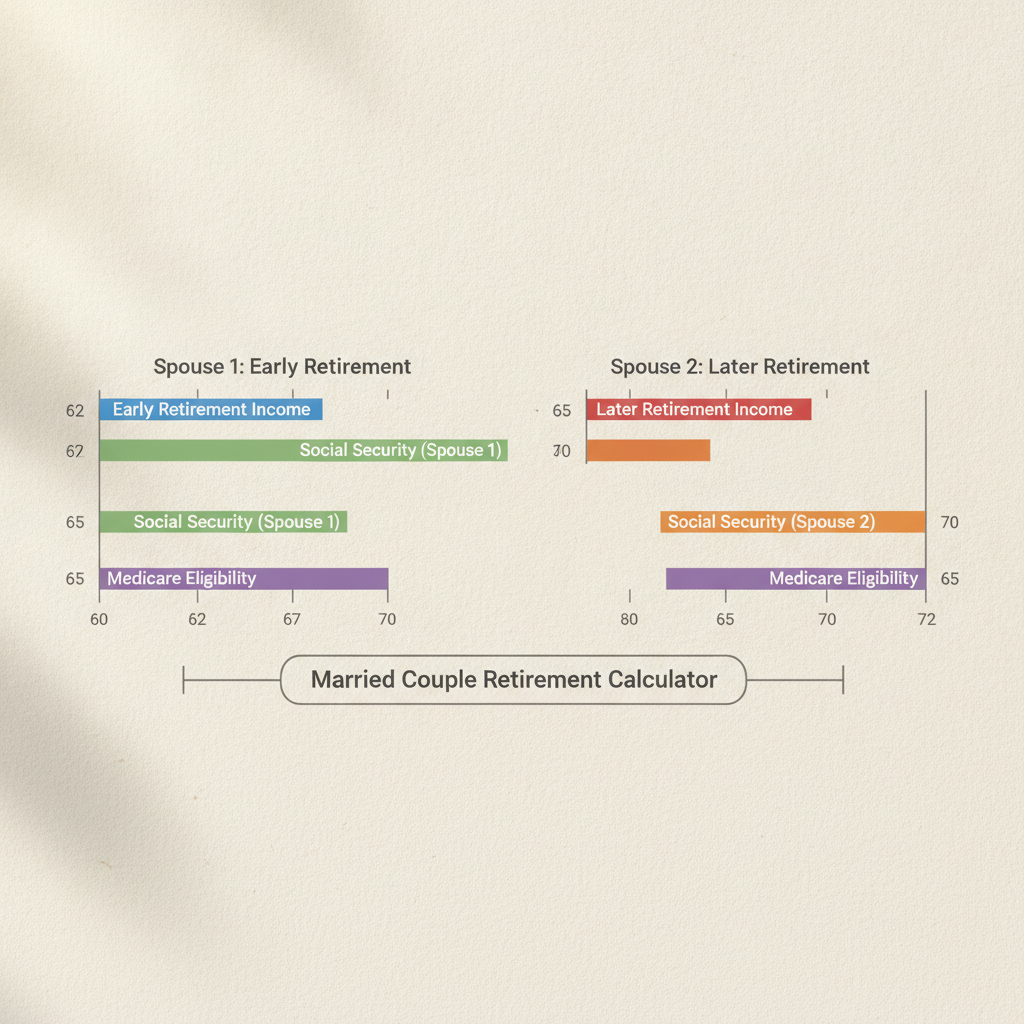
A standard retirement projection treats a couple as one financial unit with one retirement date and one lifespan. In reality, every couple faces a matrix of timing decisions:
- Staggered retirement dates — one spouse may retire 3–10 years before the other, creating a period with half the earned income and different tax treatment
- Different Social Security claiming strategies — the optimal filing ages for each spouse often differ by several years based on age gap, health, and benefit amounts
- Separate healthcare coverage windows — when one spouse leaves employer coverage before Medicare eligibility at 65, costs can surge dramatically
- Survivor income planning — a surviving spouse may face a dramatic income cliff when one Social Security check and certain pension payments stop
- Sequence-of-returns risk per spouse — who draws down assets first, and from which account, has lasting tax and longevity consequences
The Longevity Asymmetry Most Calculators Ignore
Actuarial data from the Social Security Administration shows that a 65-year-old woman has a median life expectancy near 87, while her male counterpart’s median is closer to 84. But medians are not plans. A healthy couple at 65 has roughly a 50% probability that at least one spouse will live past 90.
Planning to age 85 for a couple that has a coin-flip chance of one partner surviving to 90 is a structural error — not a conservative estimate. High-net-worth couples, who often have access to better healthcare and healthier lifestyles, should plan to even longer horizons.
5 Numbers Every Couple Retirement Calculator Must Model Separately
1. Two Retirement Dates, Not One
In my experience working with clients, the partner who retires first typically underestimates how much their early exit changes the household tax picture. During the gap years — when one spouse is retired and one is still earning — the household often finds itself in a favorable position for Roth conversions, asset repositioning, or strategic income recognition.
A rigorous couple retirement calculator models this gap period as its own distinct phase, not an average of two timelines. The tax planning opportunities in that window are substantial and time-sensitive.
2. Social Security Claiming Strategy for Each Spouse
Social Security optimization for couples is one of the highest-leverage decisions in retirement planning. According to research published by Fidelity, the difference between the worst and best Social Security claiming strategy for a married couple can exceed $100,000 in lifetime benefits.
Key considerations that a real couple retirement calculator must account for:
- The higher earner’s benefit determines the survivor benefit — delaying to age 70 protects the surviving spouse
- Spousal benefits (up to 50% of the higher earner’s primary insurance amount) depend on when each spouse files
- The age gap between spouses materially changes the optimal strategy
- Provisional income rules mean Social Security may be partially taxable depending on other retirement income
3. Healthcare Cost Modeling Before and After Medicare
Healthcare is the most volatile line item in any retirement budget, and for couples it is especially complex. If one spouse retires at 60 and the other at 67, the early retiree faces a 5-year window without employer coverage and before Medicare eligibility.
Private health insurance premiums for a couple in their early sixties can easily run $2,000–$3,000 per month or more, depending on coverage level and location. This cost must be projected as a separate, time-limited expense — not averaged into a flat spending assumption.
After Medicare eligibility, a well-constructed couple retirement calculator must also model IRMAA — the Income-Related Monthly Adjustment Amount. High earners pay surcharges on Medicare Parts B and D that can add thousands of dollars per year per person. Consult a qualified financial professional to understand how your specific income sources affect IRMAA thresholds. Learn more from the official Medicare cost information.
4. The Survivor Income Scenario
One of the most underplanned aspects of couple retirement planning is what happens financially when the first spouse dies. For high-net-worth couples, the survivor typically faces:
- A shift from Married Filing Jointly to Single tax filing status — compressing tax brackets significantly
- The loss of the smaller Social Security benefit
- Potential loss of pension or annuity income depending on survivor benefit elections made at retirement
- No change in spending for essential costs — housing, utilities, and healthcare often remain nearly the same
A complete couple retirement calculator runs the survivor scenario explicitly and asks: does the surviving spouse have enough income and assets to maintain their lifestyle for potentially 20–25 more years?
5. Account Drawdown Sequencing for Two People
Which accounts you draw from — and in what order — determines your lifetime tax liability. For HNW couples managing a mix of taxable brokerage accounts, traditional IRAs, Roth IRAs, and possibly employer stock or deferred compensation, the sequencing question is not simple.
A sophisticated approach considers:
- Required Minimum Distributions (RMDs) starting at age 73 for both spouses, potentially staggered by years
- Roth conversion opportunities in lower-income years
- Tax bracket management across two separate RMD schedules
- Capital gains harvesting and step-up in basis planning
How HNW Couples Face Different Planning Challenges Than Everyone Else
The Complexity Curve Rises Sharply Above $1 Million
Below are the most common planning challenges that separate high-net-worth couple planning from mass-market retirement planning:
| Planning Area | Mass-Market Couple | HNW Couple ($1M–$10M+) |
|---|---|---|
| Retirement income sources | Social Security + 401(k) | Social Security + multiple IRAs + taxable accounts + deferred comp + possible pension or annuity |
| Tax exposure | Modest; standard deduction covers most exposure | Significant; IRMAA surcharges, Net Investment Income Tax (3.8%), large RMDs pushing into higher brackets |
| Estate planning needs | Basic will and beneficiary designations | Trust structures, portability elections, state estate tax planning, multi-generational transfer strategies |
| Social Security optimization | File when eligible | Strategic delay coordinated with Roth conversions and income bridging from portfolio |
| Healthcare planning | Marketplace coverage until Medicare | IRMAA management, HSA strategy, long-term care insurance evaluation, Medigap selection |
| Advisor type needed | Generalist financial planning professional | Fiduciary advisor with tax integration, estate coordination, and income sequencing expertise |
The IRMAA Trap That Blindsides Couples
IRMAA surcharges are calculated on a two-year lookback — your 2026 Medicare premiums are based on your 2024 Modified Adjusted Gross Income (MAGI). For couples with large RMDs, a Roth conversion, or a business sale in a prior year, this can mean unexpectedly high Medicare premiums.
Each spouse is assessed IRMAA separately, which means a high-income couple can face combined surcharges that add substantially to their annual healthcare costs. A proper couple retirement calculator must project IRMAA separately for each spouse based on individual income triggers. For personalized guidance, schedule a discovery conversation with our team.
Roth Conversion Strategy in the Gap Years
When the first spouse retires and the second continues working, the household income drops — often into a lower bracket than will be experienced during full two-income earning years or later when both Social Security and RMDs are flowing. That gap period is prime territory for Roth conversions.
Converting traditional IRA assets to Roth during lower-income years reduces future RMDs, lowers the tax burden on the surviving spouse who will eventually file as Single, and creates tax-free income flexibility. But the conversion amount must be calibrated carefully to avoid triggering IRMAA surcharges or pushing capital gains into a higher bracket. Consult a qualified tax professional before implementing any conversion strategy.
Building a Real Couple Retirement Calculator Framework
Phase-Based Planning Rather Than a Single Number
A meaningful couple retirement calculator for HNW households organizes retirement into distinct phases, each with its own income, tax, and spending assumptions:
- Pre-retirement gap phase — one partner retired, one still working; optimize for Roth conversions and tax positioning
- Early retirement (both retired, pre-Social Security) — bridge income from portfolio; consider delaying Social Security for maximum survivor benefit
- Full retirement (both on Social Security, pre-RMD) — income coordination, IRMAA management, estate planning review
- RMD phase — mandatory distributions from both partners’ accounts; tax bracket management becomes critical
- Survivor phase — one spouse; income reduction, single filer tax treatment, longevity protection
Each phase has different optimal strategies. A single number cannot serve all five.
How a Fiduciary Advisor Runs the Couple Retirement Calculator Differently
When working with affluent couples, a fiduciary advisor providing investment advisory services approaches the couple retirement calculator conversation as a multi-variable optimization problem, not a lookup table. The process typically includes:
- Modeling each spouse’s income stream independently across all five retirement phases
- Running Monte Carlo simulations at conservative market assumptions for a 30+ year horizon
- Testing the survivor scenario under worst-case sequencing (early death of higher earner)
- Identifying the optimal Roth conversion amount by year across the gap phase
- Coordinating Social Security claiming ages with RMD projections and IRMAA thresholds
- Stress-testing the plan against healthcare cost inflation, which historically outpaces general CPI
This is where comprehensive wealth management services from a fiduciary RIA differ fundamentally from a self-service calculator or a product-focused broker relationship.
Estate Planning Certainty in the Current Environment
With the federal estate and gift tax exemption now permanently set at $15 million per individual and $30 million per married couple under the One Big Beautiful Bill Act, HNW couples have significant certainty for long-term estate planning. The manufactured urgency around a sunset deadline is gone.
That does not mean estate planning is complete. State-level estate taxes — particularly relevant for couples who split time between Florida and a higher-tax state — portability elections, step-up in basis planning, and trust structures for multi-generational transfers all remain important. Permanence creates opportunity for deliberate planning rather than reactive transfers.
The Vanguard research group has written extensively on how longevity risk remains the most underestimated variable in retirement planning — a finding that applies with particular force to couples, where joint longevity extends the planning horizon meaningfully beyond what either individual might assume.

Common Mistakes HNW Couples Make With Retirement Projections
Mistake 1: Using One Life Expectancy for Both Spouses
Running a retirement projection to age 85 for both partners simultaneously understates the risk that one spouse will outlive that assumption by a decade or more. The survivorship scenario should be modeled to age 95 or beyond for at least one partner.
Mistake 2: Ignoring the Tax Filing Status Shift
When one spouse dies, the survivor immediately loses the Married Filing Jointly bracket advantage. The same income that was taxed at one rate for the couple will be taxed at a higher rate for the single filer. This is one of the most significant and underappreciated risks in couple retirement planning. Roth accounts and tax-free income sources become especially valuable in the survivor phase.
Mistake 3: Treating Social Security as a Fixed Decision
Many couples claim Social Security based on immediate income need rather than optimizing the lifetime benefit. For a couple where the higher earner has a substantially larger benefit, delaying that benefit to age 70 can increase the survivor’s lifetime income by hundreds of thousands of dollars — funded by portfolio withdrawals in the interim.
According to Kiplinger, the break-even age for delayed claiming versus early filing typically falls in the mid-to-late seventies — well within the life expectancy of a healthy spouse today.
Mistake 4: Underestimating Long-Term Care Costs
For HNW couples, long-term care is both a financial planning issue and an estate planning issue. The assets that would otherwise pass to heirs can be substantially depleted by years of care costs. A couple retirement calculator that omits long-term care scenarios is incomplete. Consult a qualified financial and insurance professional to evaluate your options.
Mistake 5: Failing to Update the Plan After Major Life Events
A retirement projection is not a one-time document. It should be updated when either spouse retires, when Social Security claiming decisions are made, when significant assets are sold, and when health circumstances change. A static number becomes dangerously stale within a few years of a major life transition.
Free Download
The Complete Florida Retirement Guide
A comprehensive, plain-English guide to retirement planning in Florida — income strategies, tax considerations, Social Security timing, and healthcare planning for Treasure Coast retirees.
Frequently Asked Questions: Couple Retirement Calculator
What does a couple retirement calculator do differently than a regular one?
A couple retirement calculator models two separate income streams, two Social Security claiming decisions, two life expectancies, and a survivor scenario — rather than treating the household as a single financial unit. For high-net-worth couples, this distinction is critical because the gap between the best and worst decisions across these variables can exceed several hundred thousand dollars in lifetime outcomes.
How does Social Security claiming strategy work differently for married couples?
Married couples have the option to coordinate claiming ages to maximize the survivor benefit, which equals the larger of the two Social Security checks. The higher earner delaying to age 70 protects whichever spouse lives longer, while the lower earner may claim earlier to provide income during the delay period. The optimal strategy depends on both spouses’ benefit amounts, the age gap between them, and their health and longevity outlook.
Why do IRMAA surcharges matter for a couple retirement calculator?
IRMAA surcharges add to Medicare Part B and D costs for individuals above certain income thresholds, and each spouse is assessed separately based on their individual income. For HNW couples with significant RMDs, Roth conversions, or investment income, IRMAA can add thousands of dollars per year in healthcare costs — and must be projected independently for each spouse in any accurate retirement model. Consult a qualified financial professional for your specific situation.
What happens to retirement income when one spouse dies?
The surviving spouse typically loses the smaller Social Security check and may lose some pension or annuity income depending on the survivor benefit election made at retirement. At the same time, the survivor shifts from Married Filing Jointly to Single tax status, which compresses tax brackets on the same income. A complete couple retirement calculator runs this scenario explicitly to ensure the survivor has sufficient income and assets.
When should a couple update their retirement projection?
A retirement projection should be updated at every major financial event: when either spouse retires or changes jobs, when Social Security is claimed, after a significant investment event (business sale, inheritance, large capital gain), and annually as a general review. For HNW couples with multiple income sources and complex tax situations, an annual review with a fiduciary advisor providing investment advisory services is a sound minimum standard.
Building a Plan That Honors Two Lives
The couple retirement calculator question is ultimately not about finding the right number — it is about building a planning framework sophisticated enough to reflect two distinct lives, two separate financial trajectories, and the full range of scenarios they will navigate together and, eventually, apart.
For high-net-worth couples, the difference between a mass-market approach and a properly integrated plan is not marginal. It shows up in tax bills, in Medicare premiums, in Social Security lifetime income, and in whether a surviving spouse maintains financial security for the rest of their life.
A fiduciary advisor providing investment advisory services — one who coordinates your retirement income strategy, tax planning, and estate planning in an integrated way — delivers something no online couple retirement calculator can replicate: judgment applied to your specific situation, with accountability for the outcome.
Davies Wealth Management has been serving clients since 1996 and has been based in Stuart, Florida since 2018, working with executives, business owners, and professional athletes who need planning at this level of sophistication.
Take the Next Step
If you want to understand how your specific retirement picture looks across all five planning phases — including the survivor scenario and IRMAA projections — start with our Financial Wellness Quiz. It takes just a few minutes and gives you a clearer picture of where your plan stands today.
👉 Take our Financial Wellness Quiz — a quick, personalized starting point for HNW couples who want to retire with confidence.
Already know you need a deeper conversation? Ready for personalized guidance from a fee-based fiduciary? Book a complimentary phone call.
This content is for general educational purposes only and does not constitute individualized investment advice. Past performance does not guarantee future results. Investment-advisory services are offered by Davies Wealth Management, LLC, an investment adviser registered with the State of Florida. Registration does not imply a certain level of skill or training. Please consult appropriately qualified financial, tax, or legal professionals regarding your specific circumstances.
Listen & Watch
Prefer audio or video? We’ve got you covered.
Leave a Reply