
“`html
Table of Contents
- The Hidden Cost of Going It Alone
- The Seven Most Expensive DIY Investing Mistakes
- Emotional Decision-Making: The $457,000 Mistake
- Market Timing: Missing the Best Days
- Overconfidence Bias: When Business Success Doesn’t Translate
- Inadequate Diversification: Concentration Risk
- Tax Inefficiencies: Leaving Money on the Table
- Poor Portfolio Management: The Drift Problem
- Missing Institutional Opportunities
- How a Fiduciary Financial Advisor Adds Real Value
- The Professional Advantage: Access and Expertise
- Making the Transition: When DIY Becomes Too Costly
The Hidden Cost of Going It Alone
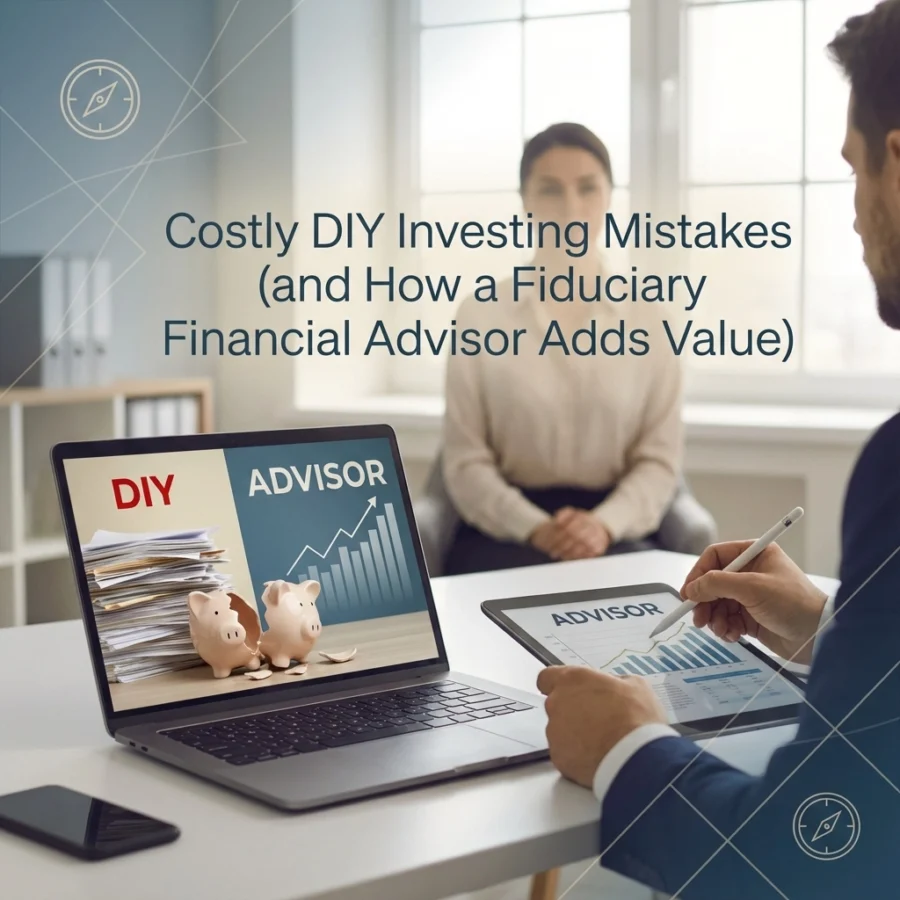
If you’re managing your own investments, you’re likely costing yourself significant wealth without realizing it. According to Morningstar research, DIY investors typically underperform the funds they’re invested in by nearly 1% annually due to behavioral biases and poor decision-making. Over a 30-year investment horizon, this seemingly small gap compounds dramatically: an investor earning 6.1% annually instead of 7.05% could lose approximately $457,000 in wealth.
For affluent individuals and families, these mistakes become even more costly. When you’re managing larger portfolios, every percentage point matters exponentially. The question isn’t whether you can learn to invest: it’s whether the opportunity cost of doing it yourself makes financial planning sense.

The Seven Most Expensive DIY Investing Mistakes
Emotional Decision-Making: The $457,000 Mistake
Fear and greed drive the most destructive investment behaviors. During market downturns, DIY investors often panic and sell assets at a loss rather than riding out temporary volatility. Conversely, after periods of exceptional performance, investors pour additional money into those same investments, essentially buying high after the gains have already been realized.
This pattern of chasing performance creates a devastating cycle. When markets crashed in March 2020, many DIY investors sold at the bottom, missing the subsequent recovery that saw the S&P 500 gain over 100% from its lows. Those who stayed the course: or better yet, rebalanced into equities during the downturn: captured these gains.
A Fidelity study revealed an interesting finding: their best-performing investors had one trait in common: they forgot they had an account and never checked their balances. This “do nothing” approach, when combined with professional oversight, often yields superior long-term results compared to active DIY management.
Market Timing: Missing the Best Days
Attempting to time market entry and exit points consistently fails, even for professionals. Missing just the 10 best market days over a 20-year period can cut your returns in half. DIY investors often hold money out of markets during perceived peaks, waiting for crashes that may never come, or occur much later than anticipated.
Consider this: if you invested $10,000 in the S&P 500 at the beginning of 2000 and held through the end of 2019, you would have earned approximately 6.06% annually. However, if you missed just the 10 best days during that period, your annual return drops to only 2.44%. Missing the 20 best days results in a negative return.
Overconfidence Bias: When Business Success Doesn’t Translate
Many successful business owners and high-earning professionals assume their expertise translates directly to investment management. This overconfidence leads to poor portfolio decisions and inadequate risk assessment. Building a business requires different skills than managing investments across global markets, understanding complex financial instruments, and navigating regulatory changes.
Professional investors spend decades developing expertise in economic analysis, asset allocation models, and risk management frameworks that even experienced business professionals may lack. Your time might be better spent focusing on your primary income source while delegating investment management to specialists.

Inadequate Diversification: Concentration Risk
DIY investors frequently construct poorly balanced portfolios, often concentrating heavily in a small number of investments they favor or understand well. Some investors have gone “all-in” on cryptocurrency, technology stocks, or their employer’s stock, bypassing traditional diversification principles entirely.
True diversification extends beyond owning different stocks: it includes geographic diversification, asset class diversification, sector allocation, and even diversification across time (dollar-cost averaging). Professional advisors use sophisticated tools to optimize these allocations based on correlation matrices and risk-adjusted return projections that individual investors rarely access.
Tax Inefficiencies: Leaving Money on the Table
Perhaps the most overlooked area where DIY investors lose money is tax optimization. Professional advisors implement strategies that can add 1-2% annually to after-tax returns:
- Tax loss harvesting: Systematically realizing losses to offset gains, reducing current tax liability
- Asset location optimization: Placing tax-inefficient investments in tax-advantaged accounts while keeping tax-efficient investments in taxable accounts
- Charitable giving strategies: Using donor-advised funds and charitable remainder trusts to provide tax benefits while supporting causes you care about
- Estate planning integration: Structuring portfolios to minimize estate taxes and facilitate efficient wealth transfers
These strategies require ongoing attention and expertise that most DIY investors simply don’t have time to implement effectively.
Poor Portfolio Management: The Drift Problem
DIY investors often neglect disciplined rebalancing, allowing market movements to drift their portfolio allocations away from intended targets. If you started with a 60/40 stock-to-bond allocation five years ago and never rebalanced, you likely now hold closer to 75/25 due to stock market outperformance.
This drift increases unintended risk exposure just when markets might be most vulnerable. Professional advisors implement systematic rebalancing based on both time intervals and threshold deviations, ensuring your portfolio maintains its intended risk profile regardless of market movements.

Missing Institutional Opportunities
Individual investors lack access to many investment opportunities available through professional wealth management:
- Private equity and venture capital: These asset classes have historically provided superior risk-adjusted returns but require significant minimum investments and accredited investor status
- Institutional-grade funds: Lower fees and superior management compared to retail mutual funds
- Alternative investments: Real estate funds, hedge fund strategies, and commodity investments that provide diversification benefits
- Structured products: Customized investment solutions designed for specific risk and return objectives
How a Fiduciary Financial Advisor Adds Real Value
A fiduciary financial advisor who is legally bound to act in your best interest provides several layers of value that extend far beyond investment selection:
Behavioral Coaching: Professional advisors help you overcome emotional biases through objective decision-making and accountability. When markets crash, your advisor keeps you focused on long-term goals rather than short-term volatility.
Comprehensive Tax Strategy: Beyond basic tax loss harvesting, professional advisors coordinate your investment strategy with estate planning, charitable giving, and business tax optimization to minimize your overall tax burden.
Risk Management: Professional risk assessment goes beyond simple questionnaires. Advisors analyze your entire financial picture, including concentrated stock positions, real estate holdings, business interests, and insurance coverage to identify and mitigate potential vulnerabilities.
Access to Opportunities: Professional advisors provide access to institutional investment platforms, private market opportunities, and alternative strategies typically unavailable to individual investors.
The Professional Advantage: Access and Expertise
At Davies Wealth Management, we’ve seen firsthand how professional oversight transforms investment outcomes. Our fiduciary approach means we’re legally and ethically bound to put your interests first: no conflicted product sales or hidden fees.
We regularly discuss these wealth management principles and real-world case studies on our podcast at www.1715tcf.com, where you can hear detailed examples of how professional management has helped clients avoid costly mistakes and capitalize on opportunities they would have missed on their own.
Our clients typically see value through:
- Systematic rebalancing that captures market inefficiencies
- Tax optimization strategies that add 1-2% annually to after-tax returns
- Access to institutional investment platforms with lower fees
- Behavioral coaching that prevents costly emotional decisions
- Comprehensive financial planning that integrates investments with estate, tax, and business planning
Making the Transition: When DIY Becomes Too Costly
The decision to work with a professional advisor isn’t about admitting failure: it’s about recognizing opportunity cost. If managing your investments requires 10-20 hours per month, and you can earn more than an advisor’s fee in that same time, delegation makes economic sense.
For affluent families, the stakes are even higher. Mistakes that cost middle-income investors thousands can cost high-net-worth families hundreds of thousands or millions. Professional oversight becomes not just valuable, but essential for wealth preservation and growth.
The most successful investors we work with didn’t abandon their interest in markets and investing: they simply recognized that their time and expertise were better deployed elsewhere while professionals handled the complex, ongoing work of portfolio management and optimization.
Your wealth deserves the same level of professional attention you give to your business, career, or other important endeavors. The question isn’t whether you can manage your own investments: it’s whether you should, given the true cost of going it alone.
“`
Leave a Reply