
Why Your Balanced Portfolio by Age Matters More Than Most Investors Realize
Your balanced portfolio by age is one of the most consequential decisions you’ll make as a wealth-builder — yet most investors treat it as an afterthought, a rule of thumb borrowed from a magazine article or a target-date fund’s automated glide path.
🎧 Prefer to listen to the podcast? Jump to listen to the podcast.
For investors with $1 million or more in investable assets, that approach isn’t just imprecise. It can be expensive. The standard “subtract your age from 110” guidance was built for mass-market investors with modest portfolios, predictable Social Security income, and no meaningful tax complexity.
High-net-worth families face a different set of trade-offs: concentrated stock positions, Roth conversion windows, multi-generational wealth goals, and income streams that may dwarf what a typical retiree draws down. Your allocation framework needs to reflect that reality.
This guide walks through how a balanced portfolio by age should shift from your 40s through retirement — and why wealthy investors often need to hold more in equities, for longer, than conventional advice suggests.
The Foundation: What “Balanced” Actually Means for High-Net-Worth Investors
Balanced Portfolio by Age: Beyond the 60/40 Cliché
The classic 60% stocks / 40% bonds portfolio has served as a benchmark for decades. It offers moderate growth with reduced volatility — appropriate for someone with a finite savings pool and limited flexibility. But for a household with $3 million invested, “balanced” means something different.
A truly balanced approach for affluent investors considers:
- Real spending needs vs. legacy or charitable goals (assets you’ll never spend can tolerate more volatility)
- Tax-efficiency across account types (taxable, traditional IRA, Roth IRA, trusts)
- Sequence-of-returns risk for assets you will draw from in the next five to ten years
- Alternative allocations — private credit, real assets, and structured notes — that complement stocks and bonds
- Income sources outside the portfolio — pensions, deferred compensation, rental income, business distributions
None of these factors appear in a target-date fund formula. That’s why bespoke planning matters.
The Problem With Generic Glide Paths
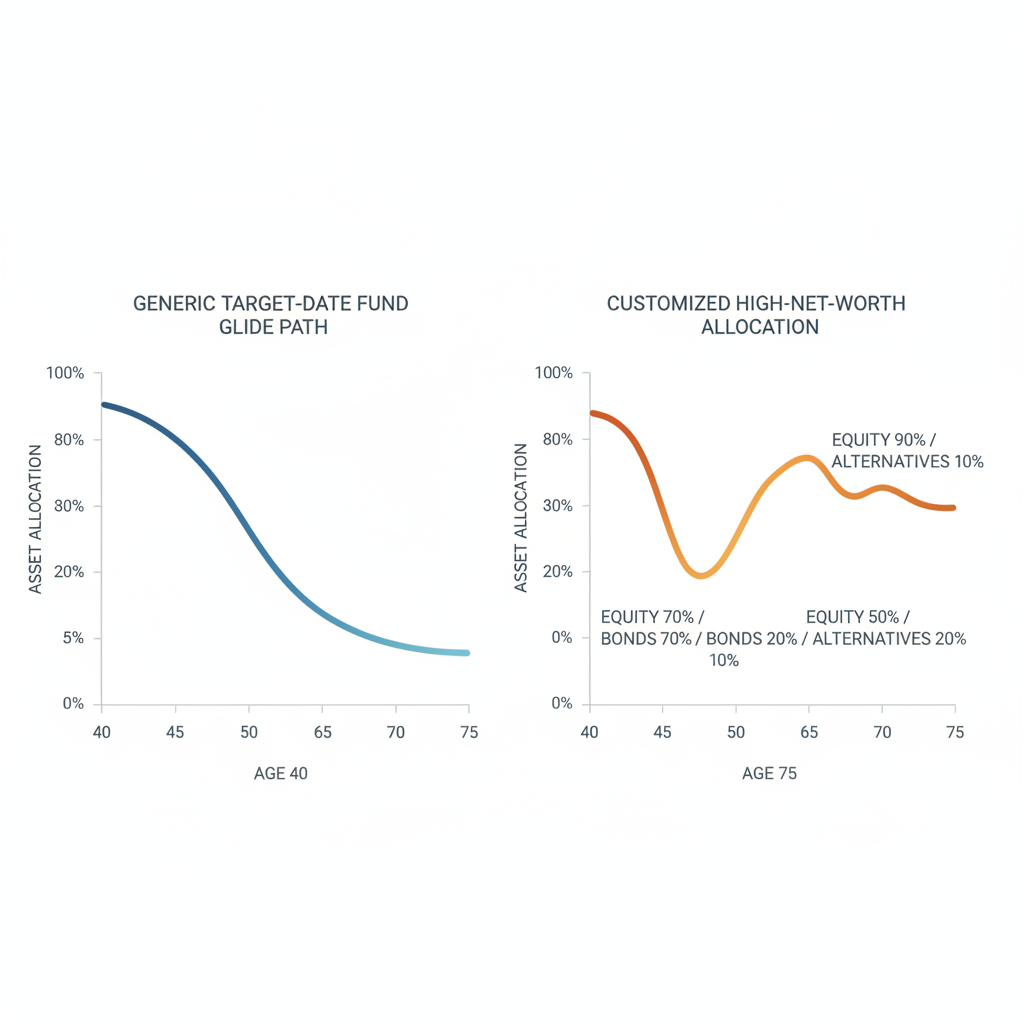
Target-date funds automatically reduce equity exposure as you approach a stated retirement year. That mechanism works reasonably well for someone accumulating $500,000 in a 401(k). For someone with $5 million across multiple accounts — including taxable brokerage accounts with embedded capital gains — the same glide path can trigger unnecessary tax events and leave too much in low-yielding bonds during peak earning years.
The goal isn’t to minimize risk. It’s to manage the right kinds of risk, at the right time, with full awareness of your tax situation.
Balanced Portfolio by Age: Your 40s — Accumulation With Intention
Why the 40s Are Your Most Powerful Compounding Decade
If you’re in your 40s with a portfolio of $1 million or more, you have one of the most valuable assets in wealth-building: time. A 45-year-old investing with a 20-year horizon before drawing down meaningfully can absorb market downturns with far less damage than a 65-year-old in the same situation.
That compounding runway argues for maintaining a meaningfully equity-heavy posture — typically 75% to 85% in growth-oriented assets for investors in their early-to-mid 40s who have substantial non-portfolio income and a stable financial foundation.
Asset Allocation Priorities in Your 40s
- Maximize tax-advantaged contributions — 401(k), defined benefit plans for business owners, backdoor Roth IRA
- Manage concentrated stock risk — executive equity compensation (RSUs, options) may represent an outsized portion of net worth; systematic diversification matters here
- Begin tax location strategy — place higher-growth, tax-inefficient assets (REITs, taxable bonds) in tax-deferred accounts; tax-efficient equities in taxable accounts
- Establish a bond ladder foundation — even a 15-20% allocation to fixed income provides dry powder during equity downturns
A Note on Risk for High Earners in Their 40s
Many executives and professionals in their 40s earn $500,000 or more annually. For them, the portfolio is a secondary income engine — not the primary one. That changes the calculus. You don’t need your portfolio to fund living expenses today, which means short-term volatility is genuinely tolerable.
This is one of the clearest examples where high-net-worth investors should hold more in equities than conventional wisdom suggests, not less. Consult a qualified financial professional to determine the appropriate equity allocation given your full income picture.
Your 50s: The Pivotal Decade for Balanced Portfolio Adjustment
Balanced Portfolio by Age 50-59: Transition Without Over-Correcting
The 50s are where many affluent investors make their most consequential allocation mistakes — they begin shifting aggressively toward bonds, treating age as the primary variable while ignoring their full financial picture. The result is a portfolio that’s too conservative too early, undermining decades of compounding.
A reasonable framework for investors in their 50s with $2 million or more:
- Early 50s (50-54): 70-80% equities, 20-30% fixed income/alternatives
- Mid 50s (55-57): 65-75% equities, 25-35% fixed income/alternatives
- Late 50s (58-59): 60-70% equities, 30-40% fixed income/alternatives
These ranges aren’t prescriptions — they’re starting points. Your specific allocation depends on your expected retirement date, spending requirements, other income sources, and risk tolerance. Consult a qualified financial advisor to determine the right mix for your situation.
Roth Conversion Strategy in Your 50s
The 50s are often the optimal window for Roth conversions. Many investors experience a brief income gap — perhaps between a peak earning year and required minimum distribution (RMD) age — where converting traditional IRA assets to Roth at a lower marginal rate makes sense.
This strategy has significant interaction with your portfolio allocation. Converting means realizing income now, which requires planning around:
- IRMAA surcharges on Medicare premiums (which become relevant in your 60s if your income is elevated in your 50s)
- The tax treatment of any capital gains realizations in the same year
- State income taxes — which is one reason many Florida residents find Roth conversions particularly attractive given Florida’s lack of state income tax
For a deep dive into how income levels affect Medicare costs, our Medicare IRMAA Planning Guide is an excellent resource.
Catch-Up Contributions and Portfolio Structure
Investors 50 and older can make catch-up contributions to retirement accounts — a meaningful advantage for those who want to supercharge tax-deferred growth in the final working decade. Business owners with defined benefit pension plans can shelter especially large amounts. Your portfolio structure should account for these contributions when building an allocation model.

Your 60s and Into Retirement: Sequencing, Income, and Longevity Risk
Balanced Portfolio by Age 60-69: The Sequence-of-Returns Danger Zone
The five years before and the five years after retirement represent the most financially dangerous decade for any investor. A significant market decline during this window — paired with active withdrawals — can permanently impair a portfolio in ways that are difficult to recover from. This is sequence-of-returns risk, and it deserves serious attention.
The appropriate response is not to move entirely into bonds. It’s to build a thoughtful income strategy that insulates near-term spending from equity volatility.
One framework that works well for affluent retirees:
- Bucket 1 (Years 1-3): Cash, money market, short-term Treasuries — covers near-term living expenses without touching equities during a downturn
- Bucket 2 (Years 4-10): Intermediate bonds, dividend equities, real assets — moderate growth with reduced volatility
- Bucket 3 (Years 10+): Growth equities, international stocks, private investments — long-term compounding for legacy or later-life spending
This structure allows a retiree with $4 million in investable assets to maintain 55-65% in growth assets while still having three years of expenses held in stable instruments. You’re not sacrificing growth; you’re sequencing it intelligently.
Why Longevity Changes Everything for High-Net-Worth Retirees
A 65-year-old couple has a meaningful statistical probability that at least one spouse reaches 90 or beyond. That’s a 25-year investment horizon — not so different from a 45-year-old’s. Planning for a 20-year retirement with a hyper-conservative allocation is, paradoxically, its own form of risk: the risk of outliving your purchasing power.
For investors with substantial assets, inflation is the long-term adversary. A portfolio holding 60% in low-yielding bonds may feel “safe” but loses ground to inflation quietly, year after year.
According to Vanguard’s research on long-term asset allocation, equity-heavy portfolios have historically outperformed conservative allocations over 20-year periods by a wide margin — even accounting for significant interim volatility.
Social Security Timing and Its Impact on Your Balanced Portfolio
Delaying Social Security to age 70 increases your monthly benefit substantially. For many affluent retirees, this decision has a direct effect on portfolio allocation — because bridge income from the portfolio (from 62 to 70) means drawing down assets at a time when you may prefer to keep them invested.
This trade-off deserves careful modeling. The “right” answer depends on your health, other income sources, marital status, and portfolio size. A fiduciary advisor can help quantify the net-present-value comparison for your specific situation.
Required Minimum Distributions: Planning Ahead
Beginning at age 73 (under current law), RMDs from traditional IRAs and 401(k)s require you to withdraw — and pay tax on — a mandated amount each year. For high-net-worth investors with large traditional IRA balances, these distributions can push income into the highest federal tax brackets and trigger IRMAA surcharges.
Strategies to manage RMD exposure include:
- Roth conversions in the years before RMDs begin
- Qualified charitable distributions (QCDs) — donating up to $108,000 per year (indexed) directly from an IRA to charity, satisfying RMD requirements without adding to taxable income
- Strategic asset location to minimize the growth of pre-tax accounts
- Charitable remainder trusts (CRTs) for larger charitable intentions paired with income needs
The IRS provides detailed guidance on RMD rules that every investor approaching 73 should review with their advisor.
The HNW Difference: Strategies Mass-Market Investors Don’t Need
How a Balanced Portfolio by Age Differs for $3M+ Investors
The table below illustrates how allocation strategy diverges between a typical mass-market investor and a high-net-worth investor at each life stage.
| Age / Stage | Mass-Market Investor ($200K–$500K) | High-Net-Worth Investor ($2M–$10M+) |
|---|---|---|
| 40s — Accumulation | Target-date fund, automatic glide path, limited tax planning | Custom equity-heavy allocation, concentrated stock management, tax location strategy, backdoor Roth |
| 50s — Transition | Shift to 60/40, begin reducing risk broadly | Selective de-risking, active Roth conversion laddering, IRMAA-aware income management, catch-up max contributions |
| 60s — Pre-Retirement | Move to conservative allocation, maximize bond exposure | Bucket strategy, Social Security delay modeling, continued equity exposure for longevity, tax-loss harvesting |
| 70s+ — Distribution | Draw down portfolio, manage basic RMDs | QCD stacking, charitable remainder trusts, dynasty trust funding, estate equalization, multi-generational legacy planning |
The difference isn’t just about the dollar amounts. It’s about the complexity of the decisions and the cost of getting them wrong.
Tax-Loss Harvesting as an Allocation Tool
For taxable accounts holding $500,000 or more, systematic tax-loss harvesting — selling positions at a loss to offset capital gains — can add meaningful after-tax returns over time. According to research cited by Morningstar, the benefit of tax-loss harvesting is most pronounced for high-income investors in upper tax brackets, where capital gains rates are highest.
Importantly, tax-loss harvesting interacts with your rebalancing decisions. Selling a position to capture a loss may shift your portfolio away from your target allocation, requiring you to purchase a similar (but not substantially identical) asset to maintain your desired balanced portfolio by age.
Private Placement Life Insurance and Alternative Assets
Investors with $5 million or more in investable assets may have access to private placement life insurance (PPLI), which allows tax-deferred growth on alternative investment strategies held within a life insurance wrapper. This can be a powerful complement to a traditional stock-bond allocation — particularly for investors who have maximized conventional tax-advantaged accounts.
These structures are complex and highly individualized. Consult a qualified financial and legal professional before exploring PPLI or similar strategies.
Estate Planning Certainty: How Permanent Exemptions Change the Conversation
Planning With Confidence, Not Urgency
One significant shift in 2026 affects how affluent families think about long-term portfolio structure. The One Big Beautiful Bill Act, signed into law on July 4, 2025, permanently established the federal estate and gift tax exemption at $15,000,000 per individual ($30,000,000 per married couple), indexed for inflation going forward.
This removes the artificial urgency that previously drove some allocation and gifting decisions. Families with estates below those thresholds can now plan deliberately — focusing on step-up in basis strategy, trust structures for creditor protection, and multi-generational wealth transfer — without feeling pressure from a manufactured deadline.
For families with estates approaching or exceeding those thresholds, state-level estate taxes (which remain in place in many states), portability elections, and dynasty trust funding remain important planning considerations that your fiduciary advisor can help address.

Building Your Balanced Portfolio by Age: Practical Next Steps
Where to Start When Reviewing Your Allocation
If you haven’t conducted a formal portfolio review in the past 12 months, the starting point isn’t picking new funds — it’s understanding what you currently own and why.
Begin with these questions:
- What is my actual equity/fixed income/alternative split across all accounts today?
- Do I have concentrated positions in a single stock, sector, or employer plan?
- How much of my portfolio will I actually draw from in the next five years versus the next twenty?
- What are the tax consequences of rebalancing my current holdings?
- Are my allocation decisions aligned with my estate and legacy intentions?
These questions don’t have one-size-fits-all answers. But asking them consistently — ideally with a fiduciary advisor who sees your complete financial picture — keeps your balanced portfolio by age aligned with where you actually are, not where a generic formula thinks you should be.
The Role of a Fee-Based Fiduciary in Allocation Decisions
A fee-based fiduciary advisor — one who is legally obligated to act in your interest when providing investment advice and who separately discloses any compensation on insurance or annuity products — brings a fundamentally different perspective to allocation decisions than a commission-based broker or a national wirehouse representative managing thousands of accounts.
At Davies Wealth Management, we provide comprehensive wealth management services built around your full financial picture: investments, taxes, estate planning, and income strategy working together. For high-net-worth families in the 40-70 age range, that integration isn’t optional — it’s what makes the difference between an allocation that looks right on paper and one that actually performs over time.
If you’re ready to explore whether your current allocation fits your goals, you can schedule a discovery conversation with our team at any time.
Free Download
The Complete Florida Retirement Guide
A comprehensive, plain-English guide to retirement planning in Florida — income strategies, tax considerations, Social Security timing, and healthcare planning for Treasure Coast retirees.
Frequently Asked Questions: Balanced Portfolio by Age
What is the ideal balanced portfolio by age for someone in their 50s?
For most high-net-worth investors in their 50s, a reasonable starting range is 65-75% in growth-oriented assets (equities and alternatives) and 25-35% in fixed income, adjusting as retirement approaches. The specific allocation depends on your income sources, expected retirement date, tax situation, and legacy goals — not your age alone. Consult a qualified financial advisor for a personalized framework.
Should I shift to bonds as I get older, even if my portfolio is large?
Not necessarily. Investors with substantial portfolios often have a multi-decade time horizon, particularly if they hold assets intended for heirs or charitable giving. Moving aggressively into bonds too early can expose a large portfolio to inflation risk that quietly erodes purchasing power. A tiered or bucket approach is often more effective than a blanket shift to fixed income.
How does a balanced portfolio by age differ for high-net-worth investors versus average investors?
High-net-worth investors typically have multiple income sources, significant tax complexity, concentrated stock positions, and legacy goals that extend beyond their own lifetimes. These factors argue for maintaining higher equity exposure longer, using tax-loss harvesting, and layering in strategies like Roth conversions, charitable remainder trusts, and private credit that simply aren’t relevant at lower wealth levels.
At what age should I start shifting my stock-bond mix toward retirement?
Most affluent investors benefit from beginning a gradual allocation shift in their mid-to-late 50s, with meaningful adjustments made five to seven years before planned retirement. Rapid late-stage shifts carry tax consequences and can disrupt compounding. A phased approach, coordinated with Roth conversion planning and Social Security timing decisions, tends to produce better outcomes.
What role do alternatives play in a balanced portfolio by age?
Alternative investments — including private credit, real estate, infrastructure, and structured notes — can reduce correlation to public equity markets while providing income or inflation protection. For investors with $2 million or more in investable assets, a 10-20% allocation to alternatives can enhance diversification beyond the traditional stock-bond axis. Access, liquidity, and suitability vary significantly by strategy; consult a qualified advisor before adding alternatives to your portfolio.
The Bottom Line on Balanced Portfolio by Age
Your balanced portfolio by age is not a number you set once and revisit when the market makes headlines. It is a living strategy — shaped by your income, your tax picture, your family’s goals, and the decades of compounding still ahead of you.
For investors with $1 million to $10 million and beyond, the stakes of getting this wrong are significant. Too conservative, and inflation slowly diminishes purchasing power. Too aggressive at the wrong time, and sequence-of-returns risk can permanently impair wealth you’ve spent decades building. The answer is a deliberately designed allocation that evolves alongside your life — reviewed annually, stress-tested regularly, and grounded in your complete financial picture.
At Davies Wealth Management, we’ve guided executives, professionals, and business owners through exactly this kind of planning since our founding in 2009, drawing on financial services experience that dates back to 1996.
If you’re navigating the 40s-through-retirement transition and wondering whether your current allocation truly fits your situation, we’d welcome the conversation.
📥 Take Our Financial Wellness Quiz
Wondering whether your overall financial plan — including your allocation strategy — is built for where you’re headed? Take our Financial Wellness Quiz to identify gaps and opportunities in minutes.
📞 Ready for personalized guidance from a fee-based fiduciary?
Book a complimentary phone call with the Davies Wealth Management team. We serve high-net-worth individuals and families from our Stuart, Florida office and virtually across the country.
This content is for educational purposes only and does not constitute investment, tax, or legal advice. Past performance is not indicative of future results. Consult a qualified financial, tax, and legal professional before implementing any strategy discussed here. Davies Wealth Management is a fee-based investment adviser registered with the State of Florida. When providing investment-advisory services, the firm acts as a fiduciary. Compensation on insurance and annuity products, if applicable, is separately disclosed.
This content is for general educational purposes only and does not constitute individualized investment advice. Past performance does not guarantee future results. Investment-advisory services are offered by Davies Wealth Management, LLC, an investment adviser registered with the State of Florida. Registration does not imply a certain level of skill or training. Please consult appropriately qualified financial, tax, or legal professionals regarding your specific circumstances. This content was produced with AI assistance and may contain errors. Please verify any figures or claims before relying on them.
Listen & Watch
Prefer audio or video? We’ve got you covered.
Podcast Episode
Leave a Reply