


What Is Asset Location — and Why Most Affluent Investors Leave Money on the Table
Asset location is the practice of strategically placing specific investments into the account types where they will be taxed most favorably. If you have a $2M+ portfolio spread across a taxable brokerage account, a traditional IRA, and a Roth IRA, the order in which you hold different asset classes matters enormously — often worth tens of thousands of dollars per year in reduced tax drag.
🎧 Prefer to listen to the podcast or watch the video? Jump to listen to the podcast & watch the video.
Most investors focus intensely on what they own. Sophisticated investors also focus on where they own it. The difference between these two groups, compounded over a 20-year retirement, can represent a meaningful portion of your legacy.
This is not a strategy for mass-market investors managing $50,000 in a single 401(k). Asset location only becomes relevant — and powerful — when you have multiple account types holding meaningful balances. For the executive or business owner with $1M to $10M+ across several accounts, getting this right is one of the highest-leverage financial moves available.
The Tax Drag Problem Most People Ignore
Every year, your portfolio generates income: dividends, interest, capital gains distributions, and realized gains from rebalancing. In a taxable account, each of these events triggers a tax bill — even if you never spend the money.
Tax drag — the annual erosion of returns caused by taxes — can quietly reduce a taxable account’s effective annual return by 0.5% to 2.0% depending on the asset classes held and your marginal tax bracket. For a $3M taxable portfolio, that’s $15,000 to $60,000 per year in unnecessary friction.
Asset location is the systematic effort to minimize that friction by matching each investment to the account type that taxes it least — or not at all.
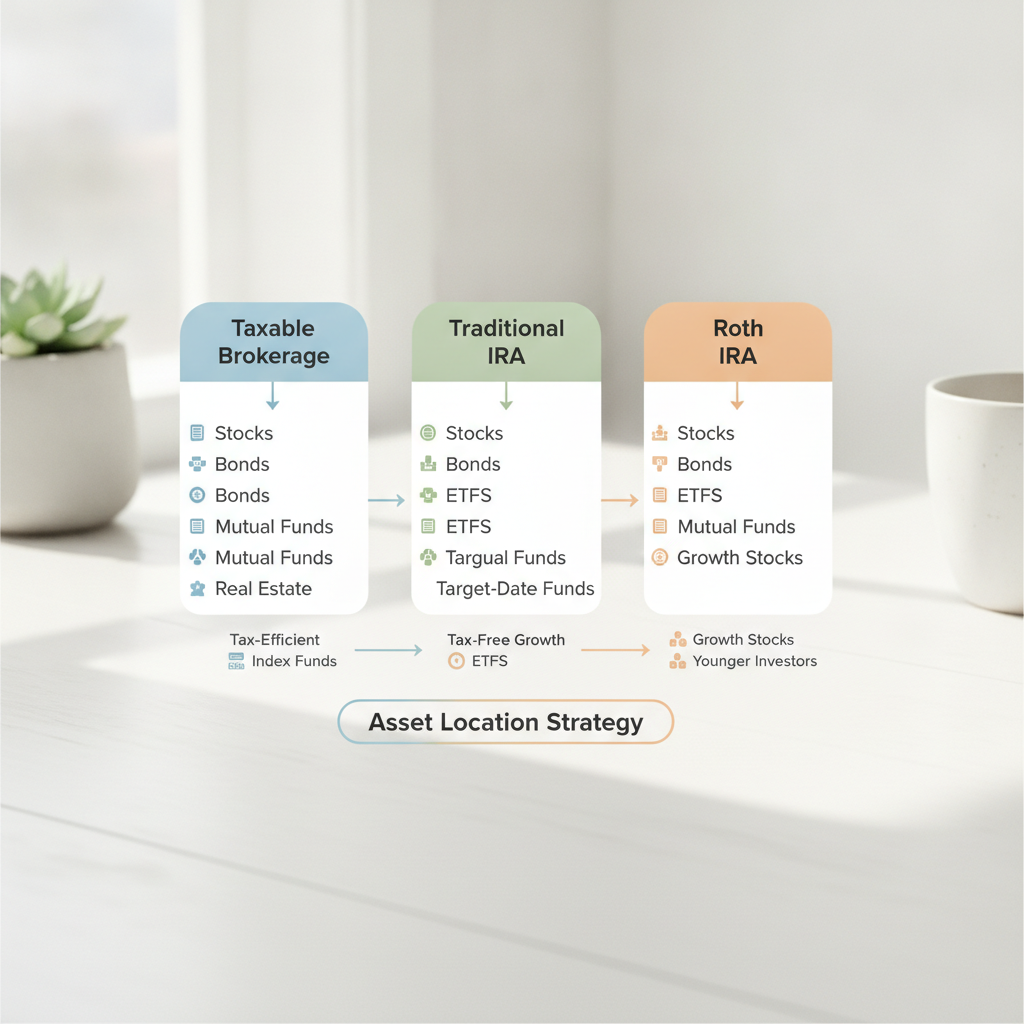
The Three Account Buckets: A Framework for Asset Location
Before diving into strategy, you need a clear mental model of how the three main account types are taxed. Each has a distinct tax character, and that character should drive which investments you place inside.
Taxable Accounts: Where Tax Efficiency Matters Most
A taxable brokerage account offers no special tax shelter. Every dividend, interest payment, and realized gain is reported on your 1040 in the year it occurs. For investors in the top federal brackets, qualified dividends and long-term capital gains are taxed at 20%, with an additional 3.8% Net Investment Income Tax (NIIT) for high earners — bringing the effective rate to 23.8% on investment income above NIIT thresholds.
This account type is best suited for assets that are inherently tax-efficient: broad-market index funds, ETFs with low turnover, municipal bonds (for some investors), and individual stocks you intend to hold long-term. It is also the account that benefits most from tax-loss harvesting opportunities, step-up in basis at death, and qualified opportunity zone investments.
Traditional IRAs and 401(k)s: The Tax-Deferred Bucket
Contributions to a traditional IRA or 401(k) generally reduce your taxable income today. Growth is tax-deferred, meaning no annual tax on dividends, interest, or gains — but all withdrawals in retirement are taxed as ordinary income.
This makes traditional accounts ideal for assets that generate high levels of ordinary income: taxable bonds, REITs, high-yield funds, actively managed funds with high turnover, and other investments that would otherwise generate significant short-term gains or interest income taxed at your top marginal rate.
Roth Accounts: The Tax-Free Growth Engine
Roth IRAs and Roth 401(k)s provide no upfront deduction, but qualified withdrawals in retirement are completely income-tax-free. There are no required minimum distributions (RMDs) during your lifetime for a Roth IRA, making it a powerful multi-generational wealth tool as well.
The Roth bucket is most valuable for your highest-growth-potential assets — small-cap equities, emerging market funds, individual growth stocks, and other investments where you expect significant appreciation over time. Sheltering that appreciation from all future taxation is the most efficient use of Roth space.
Asset Location Strategy: What Goes Where
Understanding the buckets is the foundation. The real value comes from applying that framework to your specific holdings with discipline and consistency.
Strategy 1 — Place Bonds and REITs in Tax-Deferred Accounts
Taxable bonds generate interest income taxed as ordinary income — the highest federal rate. If you hold a $500,000 bond allocation in a taxable account and you’re in the 37% bracket, you’re losing more than a third of your interest income to taxes annually. Moving that same allocation into a traditional IRA eliminates that annual tax bill entirely until withdrawal.
Real estate investment trusts (REITs) are similarly tax-inefficient in taxable accounts. REIT dividends are largely classified as ordinary income rather than qualified dividends, making them an ideal candidate for the tax-deferred bucket.
Key point: Bonds and REITs belong in traditional IRAs and 401(k)s for most high-net-worth investors with diversified multi-account portfolios.
Strategy 2 — Keep Broad-Market Equities in Taxable Accounts
Total market index funds and large-cap ETFs are naturally tax-efficient. They generate minimal capital gains distributions due to low portfolio turnover, their dividends are often qualified (taxed at preferential rates), and they benefit from the step-up in basis provision — meaning if you hold them until death, your heirs inherit them at the current market value with no embedded capital gains tax liability.
Holding these funds in a taxable account preserves your limited IRA and Roth space for less tax-efficient assets while still capturing the long-term equity return with minimal tax friction.
Strategy 3 — Reserve Roth Accounts for Your Highest-Growth Assets
If you hold both domestic large-cap equities and small-cap growth equities, the small-cap position carries a higher expected return over the long term — and therefore a larger expected tax liability if held in a taxable account. Placing that higher-octane exposure inside a Roth IRA means all future appreciation compounds tax-free.
This principle extends to individual stocks you believe have significant upside. If you have a concentrated stock position in an employer’s equity grant, a startup investment, or a sector you have high conviction in, the Roth account is the most tax-efficient home for that potential growth — provided you have the Roth space available.
Strategy 4 — Use Asset Location as Part of a Roth Conversion Plan
For many affluent investors — particularly those in a transitional income year between retirement and RMD onset — a Roth conversion ladder creates meaningful long-term tax savings. But asset location intersects with Roth conversions in an often-overlooked way: the assets you hold in your traditional IRA at the time of conversion determine how valuable that conversion is.
If your traditional IRA holds primarily bonds (tax-inefficient in a taxable account), converting those to Roth while the balances are lower — and then purchasing high-growth equities inside the new Roth account — gives you the double benefit of reducing your future RMD burden and sheltering your best-performing assets from all future taxation.
Consult a qualified tax professional to model the IRMAA implications of Roth conversions, as higher income in conversion years can trigger Medicare premium surcharges two years later. This is a nuanced calculation that requires your complete financial picture.
Strategy 5 — Consider Municipal Bonds for High-Income Taxable Accounts
For investors in the top federal tax brackets, municipal bonds — which generate interest income exempt from federal income tax — can be a compelling addition to a taxable account. The after-tax yield comparison between a taxable bond and a comparable municipal bond favors munis more dramatically the higher your marginal rate.
That said, munis held in a tax-deferred account like a traditional IRA waste their tax-exempt status entirely, since all IRA withdrawals are taxed as ordinary income regardless of the source of growth. Municipal bonds belong specifically in the taxable bucket — one of the clearest examples of asset location discipline in practice.

Asset Location vs. Asset Allocation: Understanding the Difference
These two terms sound similar but address entirely different questions. Confusing them — or treating them as interchangeable — leads to significant planning gaps.
| Dimension | Asset Allocation | Asset Location |
|---|---|---|
| Core Question | What should I own? | Where should I own it? |
| Primary Goal | Balance risk and return | Reduce annual tax drag |
| Who It Matters For | Every investor | Investors with multiple account types ($500K+) |
| Decision Frequency | Reviewed periodically, adjusted for life stage | Reviewed annually with tax picture |
| Key Variables | Time horizon, goals, income needs | Marginal tax bracket, account balances, asset type |
| Common Mistake | Ignoring sequence-of-returns risk | Holding identical funds in every account |
Most investors — including those working with large national brokerage firms — receive sophisticated asset allocation guidance but little or no asset location analysis. That gap is exactly where significant after-tax value is created or destroyed.
Why This Is Different for High-Net-Worth Families
A household with $150,000 in a single 401(k) has no asset location decision to make. But a household with $500,000 in a taxable brokerage account, $800,000 in a rollover IRA, and $300,000 in a Roth IRA has three distinct tax environments — and every year those assets are mislocated represents a real cost.
For a family with $5M+ across multiple accounts, in the top federal bracket, with significant taxable bond holdings, the annual tax savings from proper asset location can easily exceed $40,000 to $80,000 per year. Compounded over 15 years, that difference is transformational.
This is one of the clearest illustrations of why high-net-worth families need different advice than mass-market investors. At most national firms, portfolio construction is standardized across millions of accounts with minimal regard for your specific account structure, tax bracket, or estate planning goals. A fee-based fiduciary working exclusively with affluent clients has both the capacity and the incentive to do this work properly.
Common Asset Location Mistakes — and How to Avoid Them
Mistake 1: Holding the Same Fund in Every Account
Many investors maintain a “balanced” allocation in every account — 60% equities and 40% bonds, for instance — regardless of account type. This feels intuitive but is tax-inefficient at the portfolio level.
The correct approach is to view your entire portfolio as one unified pool and locate each asset type in its optimal account — while maintaining your target allocation in aggregate. This is called household-level asset location and requires viewing all accounts together rather than in isolation.
Mistake 2: Ignoring the Impact of Rebalancing
Rebalancing in a taxable account generates capital gains. Rebalancing inside a traditional IRA or Roth account generates no immediate tax liability. Directing new contributions and required rebalancing trades toward tax-deferred and tax-free accounts — rather than the taxable account — reduces unnecessary gain recognition without changing your overall allocation.
Mistake 3: Failing to Update Asset Location After Major Life Events
A Roth conversion, an inheritance, a business sale, a large charitable gift, or a change in your marginal bracket can all shift the optimal asset location strategy. This is not a one-time analysis — it requires annual review in the context of your complete financial and tax picture.
Mistake 4: Overlooking State Income Tax in the Location Decision
Florida has no state income tax, which meaningfully changes some asset location calculations compared to investors in high-tax states like California or New York. Florida residents with significant bond allocations may find that municipal bonds from other states offer less compelling after-tax yields than taxable bonds held in a traditional IRA. This is a Florida-specific nuance worth modeling with your advisor.

Asset Location and Estate Planning: The Step-Up Advantage
How the Step-Up in Basis Interacts with Asset Location
One of the most valuable — and least discussed — estate planning tools is the step-up in basis. When a taxable account asset passes to an heir at death, the cost basis is reset to the fair market value on the date of death. Any embedded capital gain accumulated during the original owner’s lifetime is eliminated for tax purposes.
This makes the taxable account potentially the most valuable account to hold for multi-generational transfer — particularly for highly appreciated positions. Placing long-held, highly appreciated equities in a taxable account intentionally preserves the step-up benefit. Holding those same assets in a traditional IRA eliminates the step-up and converts future appreciation into ordinary income for your heirs.
Coordinating Asset Location with Trust Structures
For families with irrevocable trusts, charitable remainder trusts (CRTs), or donor-advised funds (DAFs) in their planning structure, asset location becomes more complex and more consequential. Trusts reach the top federal income tax bracket at a much lower income threshold than individuals, which affects which assets should be contributed to or retained in trust structures versus held in personal accounts.
This is sophisticated territory that requires coordination between your financial advisor, estate planning attorney, and CPA. For our comprehensive wealth management services clients, this coordination is a central part of how we serve multi-generational planning needs.
How Davies Wealth Management Approaches Asset Location
At Davies Wealth Management, we serve executives, professional athletes, business owners, and high-net-worth families from our office in Stuart, Florida. When we review a new client’s existing portfolio, one of the first analyses we conduct is an asset location audit — mapping every holding to its account type and quantifying the estimated annual tax cost of the current structure.
In my experience working with clients who come from large national firms, asset location is almost universally underdeveloped. Portfolios are often constructed at the individual account level rather than the household level, leaving meaningful after-tax value uncaptured year after year.
As a fee-based fiduciary investment adviser registered with the State of Florida, we provide advice in your interest when delivering investment advisory services — and we disclose any compensation arrangements, including insurance-related commissions, transparently. Our incentive is to optimize your complete financial picture, including the often-overlooked tax efficiency of where your assets are held.
If you’d like to understand how your current portfolio is positioned from an asset location standpoint, we’d welcome the conversation. You can schedule a discovery conversation to get started.
Free Download
The Complete Florida Retirement Guide
A comprehensive, plain-English guide to retirement planning in Florida — income strategies, tax considerations, Social Security timing, and healthcare planning for Treasure Coast retirees.
Frequently Asked Questions About Asset Location
What is asset location in simple terms?
Asset location is the strategy of placing specific types of investments in the account types — taxable, tax-deferred, or tax-free — where they will be taxed most favorably. The goal is to reduce the annual tax drag on your overall portfolio without changing your target investment mix.
How much can asset location save a high-net-worth investor?
The savings depend on your portfolio size, account structure, asset mix, and marginal tax bracket. Research from sources including Vanguard’s Advisor’s Alpha framework and Morningstar’s tax-efficiency studies estimates that tax-smart strategies including asset location can add 0.5% to 1.5% in annual after-tax returns for investors with diversified multi-account portfolios — a significant figure at the $1M+ level.
Does asset location change when I retire?
Yes, meaningfully. Your marginal tax bracket, RMD obligations, Social Security taxation, and IRMAA exposure all shift at retirement, which changes the relative value of different account types. Asset location should be revisited as part of your retirement income plan, ideally coordinated with a Roth conversion analysis and a withdrawal sequence strategy. Consult a qualified financial and tax professional for your specific situation.
Is asset location the same as tax-loss harvesting?
No — they are complementary but distinct strategies. Tax-loss harvesting involves selling investments that have declined in value to realize a capital loss, which offsets taxable gains. Asset location is about where you hold investments to minimize ongoing tax friction. Both strategies belong in a comprehensive tax-efficient investing plan, but they operate differently. Learn more from the IRS guidance on capital gains and losses.
How do I get started with asset location for my portfolio?
Begin by cataloging every investment account you hold and the assets inside each — along with the tax character of each account type. Then compare your current placement against the general principles described in this article. For portfolios above $500,000, the analysis benefits significantly from professional guidance that accounts for your full tax picture, estate plan, and income needs. Resources from Fidelity’s asset location overview can also help frame the decision.
Take the Next Step Toward a More Tax-Efficient Portfolio
Asset location is one of the most powerful and consistently overlooked levers available to high-net-worth investors. It doesn’t require changing what you own or taking more investment risk — it simply requires being intentional about where each investment lives within your overall account structure.
For a $2M+ portfolio spread across multiple account types, getting this right is worth the effort many times over. The investors who close this gap — and revisit it annually as their tax picture evolves — compound wealth more efficiently than those who focus on investment selection alone.
If you’d like a clearer picture of how your current portfolio is positioned for tax efficiency, start by taking our Financial Wellness Quiz — it helps identify planning gaps across your complete financial picture, including tax efficiency, investment strategy, and retirement readiness.
→ Take our Financial Wellness Quiz
Or, if you’re ready to talk through your specific situation with a fee-based fiduciary, we’d welcome a conversation.
→ Book a complimentary phone call with Davies Wealth Management
This article is for educational purposes only and does not constitute personalized investment, tax, or legal advice. Consult a qualified financial, tax, and legal professional for guidance specific to your situation.
This content is for general educational purposes only and does not constitute individualized investment advice. Past performance does not guarantee future results. Investment-advisory services are offered by Davies Wealth Management, LLC, an investment adviser registered with the State of Florida. Registration does not imply a certain level of skill or training. Please consult appropriately qualified financial, tax, or legal professionals regarding your specific circumstances.
Listen & Watch
Prefer audio or video? We’ve got you covered.
Leave a Reply