

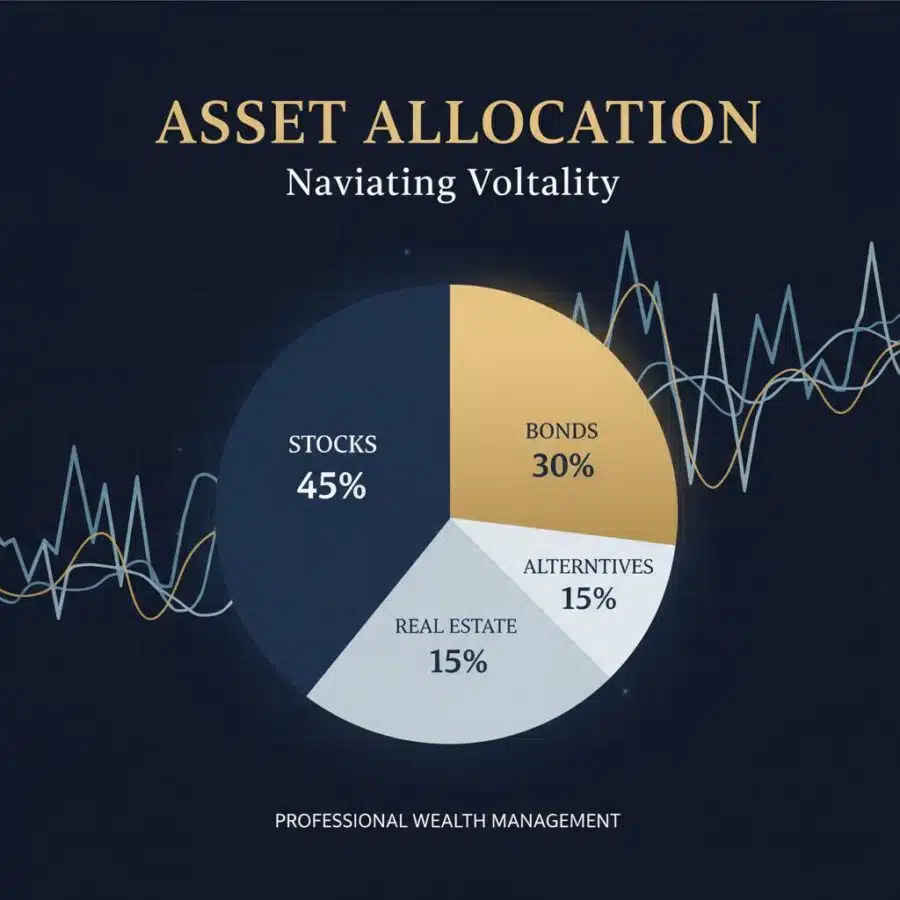
Understanding Asset Allocation in Today’s Volatile Market Environment
The importance of strategic asset allocation has never been more evident than in today’s turbulent financial markets. With the VIX recently spiking to 25.87 in March 2026—representing a 12.39% increase—investors are experiencing firsthand how market volatility can impact their wealth preservation strategies. As a fee-based fiduciary registered investment adviser serving high-net-worth clients in Stuart, Florida, Davies Wealth Management understands that effective asset allocation serves as the cornerstone of prudent professional wealth management during uncertain times.
The dramatic market events of March 2, 2026, following coordinated U.S.-Israeli military activity, resulted in historic VIX levels that reminded investors why proper diversification matters. While headlines often focus on individual stock picks or market timing strategies, the foundational research by Brinson, Hood, and Beebower demonstrates that asset allocation explains approximately 90% of return variability in investment portfolios—making it the single most critical decision investors face.
The Mathematical Foundation of Portfolio Diversification
Modern portfolio theory, developed by Nobel laureate Harry Markowitz, establishes the mathematical framework for understanding how different asset classes interact within a portfolio. The SEC’s guidance on asset allocation emphasizes that diversification across uncorrelated assets can potentially reduce portfolio risk without necessarily sacrificing expected returns.
Recent market data illustrates this principle in action. During the early 2025 market downturn, traditional 60/40 portfolios declined only 7% while the S&P 500 suffered an 18% decline. This 11 percentage point difference in performance highlights how strategic asset allocation can provide meaningful downside protection during volatile periods.
Evolving Correlation Patterns in Modern Markets
One of the most significant challenges facing today’s investors is the shifting correlation between traditional asset classes. Historically, bonds provided an effective hedge against equity volatility, but recent market dynamics have altered this relationship. The stock-bond correlation has shifted meaningfully, requiring sophisticated investors to reconsider their approach to multi-asset diversification.
This evolution in correlation patterns has prompted institutional investors to expand their asset allocation beyond traditional stocks and bonds. Many are now incorporating hedge funds, infrastructure investments, and private credit into their portfolios, seeking sources of return that remain less correlated with public market movements.
Strategic Asset Allocation vs. Tactical Adjustments
Defining Your Core Portfolio Structure
Effective wealth management begins with establishing a strategic asset allocation that aligns with your long-term financial objectives, risk tolerance, and investing timeline. This foundational allocation represents your portfolio’s “home base”—the target weights for different asset classes that you maintain regardless of short-term market fluctuations.
At Davies Wealth Management, we work closely with clients to develop personalized asset allocation models that consider their unique circumstances. Our comprehensive wealth management services include detailed analysis of how different allocation strategies might perform under various market scenarios, ensuring that your portfolio structure supports your long-term goals.
When and How to Make Tactical Adjustments
While strategic asset allocation provides the foundation, tactical adjustments allow for measured responses to changing market conditions. Wellington Management’s current positioning—moderately overweight global equities for 2026—exemplifies how professional managers make tactical decisions within their strategic framework.
The key to successful tactical asset allocation lies in maintaining discipline and avoiding emotional decision-making. Research consistently shows that investors who frequently adjust their allocations based on market sentiment often underperform those who maintain consistent, well-designed strategies.
Rebalancing: The Discipline of Contrarian Investing
Regular rebalancing represents one of the most important aspects of maintaining your target asset allocation. This systematic approach requires selling portions of outperforming assets and purchasing underperforming ones—essentially forcing you to “sell high and buy low.”
The frequency and methodology of rebalancing can significantly impact long-term returns. Some investors prefer calendar-based rebalancing (quarterly or annually), while others use threshold-based approaches that trigger rebalancing when allocations drift beyond predetermined ranges.
Asset Class Behavior During Market Stress
| Asset Class | Volatile Markets | Calm Markets | Primary Role in Portfolio |
|---|---|---|---|
| Large-Cap Equities | High volatility, potential for significant drawdowns | Steady growth, dividend income | Long-term growth engine |
| International Developed | Currency hedging becomes critical | Geographic diversification benefits | Diversification, exposure to global growth |
| Emerging Markets | Extreme volatility, flight to quality | Higher growth potential | Growth acceleration, diversification |
| Government Bonds | Traditional safe haven (when correlations normalize) | Steady income, lower volatility | Stability, income, deflation hedge |
| Real Estate (REITs) | Interest rate sensitive, liquidity concerns | Inflation hedge, dividend income | Diversification, inflation protection |
| Commodities | Extreme price swings, supply disruptions | Moderate correlation with other assets | Inflation hedge, diversification |
Understanding Risk-Return Profiles Across Market Cycles
Different asset classes exhibit varying risk-return characteristics depending on market conditions. During periods of elevated volatility, traditional safe-haven assets may not perform as expected due to changing correlation patterns. This reality underscores the importance of sophisticated asset allocation strategies that account for regime changes in market behavior.
The recent VIX spike to 25.87 following geopolitical events demonstrates how quickly market dynamics can shift. Investors with well-diversified portfolios that include alternative investments and international exposure were better positioned to weather this volatility than those concentrated in domestic equities.
The Role of Alternative Investments in Modern Portfolios
Institutional investors have increasingly turned to alternative investments to enhance their asset allocation strategies. Private credit, infrastructure, and hedge funds offer potential diversification benefits that traditional asset classes may not provide during periods of market stress.
However, alternative investments come with their own considerations, including liquidity constraints, higher fees, and complex structures. High-net-worth investors must carefully evaluate whether these investments align with their overall wealth management objectives and portfolio risk tolerance.
Behavioral Finance and Asset Allocation Decisions
Overcoming Emotional Investment Biases
One of the greatest challenges in maintaining appropriate asset allocation lies in overcoming natural human biases that can lead to poor investment decisions. During volatile periods, investors often experience loss aversion, recency bias, and herding behavior that can prompt them to abandon well-designed allocation strategies at precisely the wrong time.
Professional wealth management provides valuable behavioral coaching that helps investors maintain discipline during turbulent markets. Research on asset allocation strategies consistently shows that investors who maintain consistent approaches over long time periods achieve better outcomes than those who frequently adjust their strategies based on market sentiment.
The Psychology of Rebalancing During Downturns
Rebalancing requires investors to purchase assets that have recently declined in value—a psychologically difficult action that goes against natural instincts. During the March 2026 volatility spike, disciplined investors who rebalanced their portfolios were effectively buying assets at discounted prices, positioning themselves for potential recovery.
This contrarian approach to asset allocation requires significant emotional discipline and often benefits from professional guidance. Many successful investors establish systematic rebalancing rules that remove emotion from the decision-making process.
Tax-Efficient Asset Allocation Strategies
Asset Location Optimization
Sophisticated asset allocation extends beyond simply deciding which assets to own—it also encompasses where to hold different investments for maximum tax efficiency. IRS guidelines for retirement plans provide opportunities to optimize asset location across taxable, tax-deferred, and tax-free accounts.
For example, holding tax-inefficient assets like REITs or high-yield bonds in tax-advantaged accounts can significantly improve after-tax returns over time. This asset location strategy works in conjunction with your overall asset allocation to maximize wealth accumulation and preservation.
Managing Capital Gains Through Strategic Rebalancing
Tax-aware rebalancing strategies can help minimize the impact of capital gains taxes while maintaining your target asset allocation. Techniques such as tax-loss harvesting, donor-advised fund contributions, and careful timing of rebalancing activities can significantly improve after-tax returns for high-net-worth investors.
These strategies require careful coordination between investment management and tax planning, highlighting the value of comprehensive wealth management services that address both areas simultaneously.
Technology and Modern Asset Allocation
Quantitative Models and Risk Management
Modern asset allocation strategies benefit from sophisticated quantitative models that can analyze thousands of scenarios and optimize portfolio construction. These tools help identify potential risks and opportunities that might not be apparent through traditional analysis methods.
Advanced portfolio analytics platforms enable wealth managers to stress-test different allocation strategies against various market scenarios, providing clients with greater confidence in their investment approach.
Dynamic Asset Allocation Through Technology
Technology has enabled more dynamic approaches to asset allocation, allowing for real-time monitoring of portfolio drift and automated rebalancing when appropriate. However, these technological capabilities must be balanced with the discipline of long-term strategic thinking to avoid over-trading or market timing mistakes.
Building Your Personalized Asset Allocation Strategy
Assessment of Individual Risk Tolerance and Capacity
Developing an appropriate asset allocation begins with a thorough assessment of your risk tolerance, risk capacity, and investment objectives. Risk tolerance reflects your emotional ability to withstand portfolio volatility, while risk capacity represents your financial ability to absorb potential losses without compromising your long-term goals.
These assessments must consider your complete financial picture, including income sources, spending needs, estate planning objectives, and time horizon. Model portfolio frameworks provide useful starting points, but customization is essential for optimal results.
Regular Portfolio Reviews and Adjustments
Asset allocation is not a “set it and forget it” strategy. Regular portfolio reviews ensure that your allocation remains aligned with your evolving circumstances and market conditions. These reviews should consider changes in personal situations, market valuations, and the economic environment.
Professional wealth managers provide ongoing monitoring and guidance to help ensure your asset allocation strategy continues to serve your long-term objectives effectively. This ongoing relationship becomes particularly valuable during periods of market stress when emotional decision-making can derail long-term plans.
Frequently Asked Questions About Asset Allocation
What percentage of my portfolio should be in stocks versus bonds?
The appropriate stock-to-bond allocation depends on your individual circumstances, including age, risk tolerance, investment timeline, and financial goals. Traditional rules of thumb, such as holding your age in bonds, may not be suitable for today’s market environment with longer life expectancies and changing correlation patterns. A comprehensive analysis of your situation is essential for determining the optimal allocation.
How often should I rebalance my asset allocation?
Most financial experts recommend rebalancing quarterly or annually, though some prefer threshold-based approaches that trigger rebalancing when allocations drift beyond 5-10% of target weights. The optimal frequency depends on your portfolio size, tax situation, and transaction costs. More frequent rebalancing can improve risk management but may increase trading costs and tax implications.
Should I change my asset allocation during market volatility?
Generally, investors should maintain their strategic asset allocation during volatile periods rather than making emotional adjustments. However, systematic rebalancing during volatility can be beneficial, as it forces you to buy assets at lower prices. Any changes to your core allocation should be based on fundamental shifts in your circumstances rather than short-term market movements.
How do alternative investments fit into asset allocation?
Alternative investments can provide diversification benefits and potentially reduce overall portfolio volatility when used appropriately. However, they typically require higher minimum investments, have limited liquidity, and involve more complex structures. For qualified investors, allocations to alternatives typically range from 5-20% of total portfolio value, depending on individual circumstances and objectives.
What role does international diversification play in asset allocation?
International diversification can provide access to different economic cycles, currencies, and growth opportunities while potentially reducing overall portfolio risk. However, globalization has increased correlations between international markets during crisis periods. Most financial advisors recommend international equity allocations of 20-40% of total equity holdings, with consideration for both developed and emerging markets.
Conclusion: Asset Allocation as Your Wealth Preservation Foundation
The volatile market environment of 2026, characterized by VIX spikes and geopolitical uncertainty, reinforces the critical importance of thoughtful asset allocation in wealth management. As we’ve seen from recent market data, well-diversified portfolios with appropriate asset allocation strategies provided significantly better downside protection during turbulent periods.
The fundamental principle that asset allocation explains approximately 90% of return variability remains as relevant today as when first established by academic research. However, the implementation of these principles has become more sophisticated, requiring consideration of changing correlations, alternative investments, tax efficiency, and behavioral factors.
For high-net-worth investors and executives, developing and maintaining an appropriate asset allocation strategy requires ongoing professional guidance and discipline. The complexity of modern markets, combined with the psychological challenges of investing during volatile periods, makes professional wealth management more valuable than ever.
At Davies Wealth Management, we understand that effective asset allocation forms the foundation of successful wealth preservation and growth strategies. Our fee-based, fiduciary approach ensures that our recommendations are always aligned with your best interests, providing you with the confidence and expertise needed to navigate challenging market environments. A key part of this approach includes helping clients plan for retirement by converting accumulated savings into sustainable income streams.
If you’re concerned about how your current asset allocation might perform during continued market volatility, we invite you to contact our team for a comprehensive portfolio review. Together, we can evaluate your current strategy and make any necessary adjustments to help protect and grow your wealth through all market conditions.
This content is developed from sources believed to be providing accurate information. The information in this material is not intended as tax or legal advice. It may not be used for the purpose of avoiding any federal tax penalties. Please consult legal or tax professionals for specific information regarding your individual situation. The opinions expressed and material provided are for general information and should not be considered a solicitation for the purchase or sale of any security. Investment advisory services offered through Davies Wealth Management, a registered investment adviser.
This content is for educational purposes only and does not constitute investment advice. Past performance is not indicative of future results. Advisory services offered through Davies Wealth Management, a Registered Investment Adviser. Please consult a qualified financial, tax, or legal professional regarding your specific situation.
Leave a Reply