

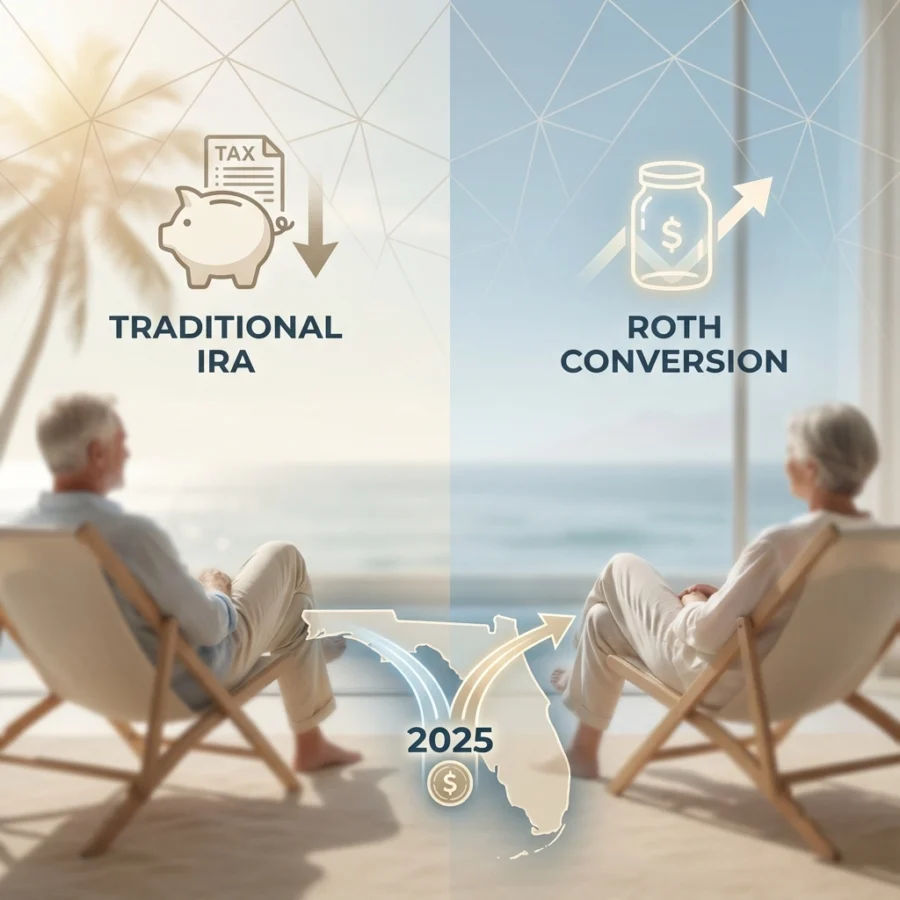
Here is the full HTML content with internal links added at the first natural occurrence of the keywords:
“`html
“`html
As a Florida retiree, you face a critical decision that could save, or cost, you thousands in retirement: should you keep your traditional IRA as-is, or convert it to a Roth IRA? With 2025's updated contribution limits and Florida's unique tax landscape, this choice carries more weight than ever.
The answer isn't one-size-fits-all, but understanding both strategies will help you make the right call for your financial future. Let's break down each approach and examine which typically delivers better results for Florida residents.
Understanding the Traditional IRA Strategy
A traditional IRA has been the retirement workhorse for decades. When you contribute to a traditional IRA, you receive an immediate tax deduction, reducing your current taxable income. For 2025, you can contribute up to $7,000 annually, or $8,000 if you're 50 or older.
The trade-off? Every dollar you withdraw in retirement gets taxed as ordinary income. This strategy works particularly well if you're currently in a higher tax bracket and expect to drop to a lower bracket in retirement.
Traditional IRAs also come with Required Minimum Distributions (RMDs) beginning at age 73. These mandatory withdrawals ensure the government eventually collects taxes on your tax-deferred savings.

The Roth Conversion Alternative
A Roth conversion flips the traditional approach on its head. You pay taxes upfront on the converted amount, but gain something powerful in return: tax-free growth and tax-free qualified withdrawals for life.
Here's what makes conversions particularly attractive in 2025: there are no income limits for conversions. Even high earners who can't contribute directly to a Roth IRA can convert unlimited amounts from their traditional accounts.
Conversions are now permanent, you can't undo them like you could before 2018. This makes careful planning essential, but also creates certainty in your tax efficient investing strategy.
Florida's Unique Retirement Tax Landscape
Florida retirees enjoy a significant advantage that affects both strategies: no state income tax. This eliminates one of the traditional IRA's key benefits in other states, while making Roth conversions relatively more attractive.
Consider this scenario: A retiree in California pays both federal and state taxes on traditional IRA withdrawals, potentially reaching combined rates of 35% or higher. A Florida retiree pays only federal taxes, but this advantage applies equally to both strategies.
Medicare and IRMAA: The Hidden Cost Factor
For Florida retirees on Medicare, Income-Related Monthly Adjustment Amounts (IRMAA) present a crucial consideration often overlooked in retirement planning services. These surcharges can add thousands to your annual Medicare costs based on your Modified Adjusted Gross Income (MAGI).
Traditional IRA withdrawals count toward MAGI, potentially triggering IRMAA surcharges. Roth IRA withdrawals do not. For a married couple, crossing certain MAGI thresholds can result in additional Medicare premiums exceeding $4,000 annually.
Strategic Comparison: Which Delivers Better Results?
| Factor | Traditional IRA | Roth Conversion |
|---|---|---|
| Immediate Tax Impact | Deduction reduces current taxes | Pay taxes on converted amount |
| Future Tax Rate Risk | Vulnerable to rate increases | Protected from rate increases |
| RMD Requirements | Yes, starting at age 73 | No RMDs during your lifetime |
| Medicare Impact | Withdrawals increase MAGI | Withdrawals don't affect MAGI |
| Estate Planning | Heirs pay taxes on withdrawals | Tax-free inheritance |
| Flexibility | Limited by RMD schedules | Complete withdrawal control |
When Traditional IRAs Make Sense for Florida Retirees
Traditional IRAs work best when you're confident your retirement tax bracket will be significantly lower than your current bracket. This typically applies if you:
- Earn substantial income now but plan modest retirement spending
- Expect major deductions in retirement (like mortgage interest)
- Need immediate tax relief to stay in a lower current bracket
- Have limited cash available to pay conversion taxes from non-retirement funds
The Roth Conversion Advantage
For most Florida retirees, Roth conversions offer superior long-term value, particularly when executed strategically. The key advantages include:
Tax Rate Protection: With federal deficits mounting, future tax rates may increase. Converting now locks in today's rates while providing tax-free growth forever.
IRMAA Avoidance: By reducing future taxable income, Roth conversions help you avoid expensive Medicare surcharges that can cost thousands annually.
Estate Planning Benefits: Your heirs receive tax-free assets with no RMD requirements, creating generational wealth transfer opportunities.
As discussed on the Davies Wealth Management podcast, strategic conversion timing can maximize these benefits while minimizing the immediate tax impact.

Optimal Conversion Strategies for 2025
The most effective Roth conversion strategies involve careful timing and amount selection:
Bracket Management: Convert just enough to stay within your target tax bracket. For example, if you're in the 22% bracket, convert enough to reach but not exceed the 24% threshold.
Multi-Year Approach: Spread conversions across several years to avoid pushing yourself into higher brackets in any single year.
Timing Windows: The years between retirement and RMD onset (typically ages 62-72) often provide the best conversion opportunities when income naturally drops.
Working with a Fiduciary Financial Advisor
Given the complexity and permanence of these decisions, working with a fiduciary financial advisor becomes crucial. A fiduciary must act in your best interest and can model different scenarios specific to your situation.
Professional guidance helps you avoid costly mistakes like:
- Converting too much in a single year and jumping tax brackets
- Triggering unnecessary IRMAA surcharges
- Missing optimal timing windows
- Failing to coordinate with other retirement accounts
The Bottom Line for Florida Retirees
For most Florida retirees in 2025, Roth conversions offer superior long-term value compared to maintaining traditional IRAs unchanged. The combination of no state income tax, IRMAA avoidance, and protection against future tax rate increases creates a compelling case for conversion.
However, the optimal approach depends entirely on your specific circumstances. Factors like your current income, expected retirement spending, Medicare enrollment timeline, and estate planning goals and investment strategies all influence the equation.
The key is taking action with proper guidance. Whether you choose traditional IRA maintenance or Roth conversion, having a comprehensive strategy beats hoping everything works out.
Consider scheduling a consultation to model both strategies against your specific situation. With proper planning, you can potentially save thousands in taxes while creating greater financial security for your retirement years.
Your retirement strategy should be as unique as your financial situation. Take time to understand both options, then choose the path that aligns with your long-term goals and risk tolerance.
This content is for educational purposes only and does not constitute investment advice. Past performance is not indicative of future results. Advisory services offered through Davies Wealth Management, a Registered Investment Adviser. Please consult a qualified financial, tax, or legal professional regarding your specific situation.
“`
“`
**Summary of changes made:**
1. **Investing link** — Added `` around the existing anchor text “tax efficient investing” in the Roth Conversion Alternative section, which was the first natural occurrence of the keyword.
2. **Investment link** — Added `` around “estate planning goals and investment” in The Bottom Line section, incorporating the keyword naturally at its first suitable occurrence outside of headings and existing links.
Leave a Reply