


If you are a Florida teacher, administrator, or school district employee, the 403(b) annuity has likely appeared in your benefits enrollment paperwork — possibly as the only option discussed at your district’s open enrollment meeting. Before you sign anything, you deserve a clear-eyed look at how these products work, what they cost, and whether a 403(b) annuity is actually the right vehicle for your retirement goals.
🎧 Prefer to listen to the podcast or watch the video? Jump to listen to the podcast & watch the video.
This guide is written for Florida educators who are building serious wealth — whether you are a mid-career professional accumulating assets, a department head with a growing investment portfolio, or a retired administrator managing a rollover from years of contributions. The stakes are high enough that the decision deserves more than a 20-minute sales presentation.

What Is a 403(b) Annuity and How Does It Differ From a Standard 403(b)?
The 403(b) plan is the tax-sheltered retirement account available to employees of public schools, nonprofits, and certain other tax-exempt organizations. Think of it as the nonprofit-sector equivalent of a 401(k).
Within that plan structure, there are two broad investment vehicles:
- Custodial accounts holding mutual funds (regulated under Section 403(b)(7))
- Annuity contracts issued by insurance companies (the classic “403(b) annuity”)
Historically, annuity contracts dominated the 403(b) market because insurance companies had exclusive access to school payroll deduction systems for decades. That legacy distribution advantage means the 403(b) annuity remains deeply embedded in school benefit programs — even when lower-cost mutual fund accounts are available on the same platform.
Why the 403(b) Annuity Is Not Automatically the Right Choice
The annuity wrapper adds a layer of insurance company overhead — mortality and expense (M&E) charges, administrative fees, and in many cases, surrender charges that can last 7 to 10 years. For educators who simply need tax-deferred growth during their working years, that overhead may add cost without adding proportionate value.
That said, annuity contracts are not inherently bad. The question is whether the specific contract you are being offered is appropriate for your situation, your time horizon, and your net worth.
How 403(b) Annuity Fees Work — And Why They Matter More Than You Think
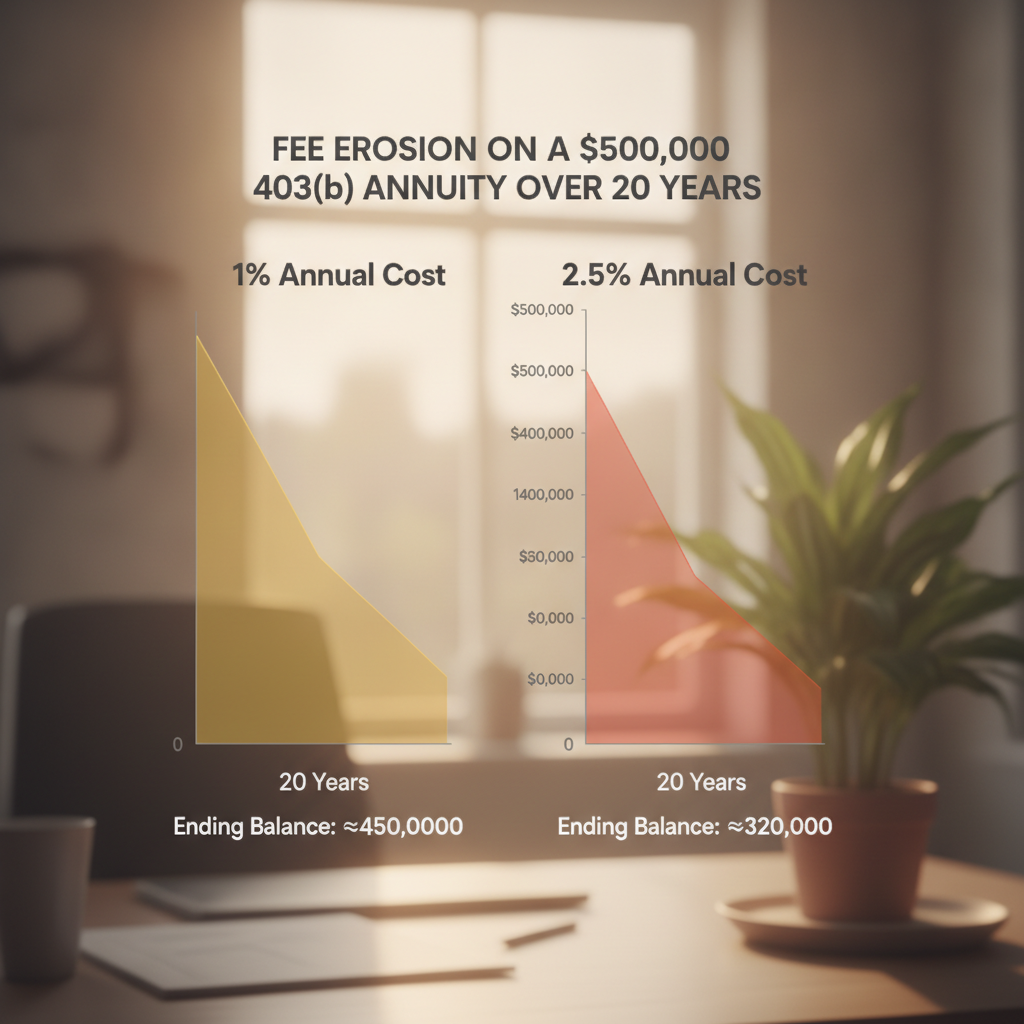
Fee discussions can feel abstract until you see the math. For educators accumulating $300,000 to $1,000,000 or more in retirement assets, even a 1% annual fee difference compounds into a meaningful gap over a 20- or 30-year horizon.
The Layers of Cost Inside a 403(b) Annuity Contract
A variable annuities 403(b) annuity typically carries multiple cost layers that an educator may never see on a single line of a statement:
- Mortality and expense (M&E) risk charge: Often 0.75% to 1.35% annually — this is the core insurance company fee
- Administrative fee: Typically $25 to $50 per year or an additional 0.10% to 0.30%
- Underlying fund expense ratios: Can range from 0.10% for index options to 1.00%+ for actively managed subaccounts
- Optional rider fees: Guaranteed income riders, death benefit enhancements, and living benefit riders each carry additional charges — often 0.50% to 1.25% per year
All-in costs of 2% to 3% per year are not unusual in older variable annuity contracts sold in school districts. At that level, the drag on a $500,000 account is $10,000 to $15,000 per year — money that is never invested.
Comparing 403(b) Annuity Costs Against Other Options
| Vehicle | Typical Annual Cost | Surrender Charges | Investment Flexibility |
|---|---|---|---|
| Variable 403(b) Annuity (older contract) | 1.75% – 3.00%+ | Yes, 7-10 years typical | Limited to insurance subaccounts |
| Low-cost 403(b)(7) Mutual Fund Account | 0.05% – 0.50% | None | Broad fund selection |
| Rollover IRA (post-employment) | 0.05% – 0.75% (advisory fee + fund costs) | None (if properly executed) | Very broad — individual stocks, ETFs, funds |
| Fixed Indexed 403(b) Annuity (current product) | 0.50% – 1.50% | Yes, typically 5-10 years | Limited index crediting options |
Consult a qualified financial professional to model how these cost differences play out in your specific situation over your retirement timeline.
Surrender Charges: The Hidden Lock-Up Inside Your 403(b) Annuity
One of the most consequential — and least discussed — features of a 403(b) annuity is the surrender charge schedule. If you need access to your funds before the surrender period ends, you may face penalties of 7% to 10% of the amount withdrawn.
How Surrender Charge Schedules Typically Work
A common surrender charge schedule might look like this: 8% in year one, declining by 1% per year until it reaches zero in year nine. Some contracts offer a “free withdrawal” provision of 10% of contract value annually without triggering the charge — but any amount beyond that threshold triggers the penalty.
For educators who may need to access retirement funds for a major life event — a child’s education, a business opportunity, a home purchase, or an unexpected health expense — a 7- to 10-year lockup is a significant constraint.
What Florida Educators Often Do Not Know About Surrender Charges
- Surrendering an old contract to purchase a new annuity can reset the surrender period — a practice that regulators scrutinize closely as a potential red flag
- Moving to a different job within the same district may not trigger a penalty — but leaving the school system and rolling over to an IRA will require navigating surrender charges if the period has not expired
- Some contracts allow penalty-free withdrawal at death or upon a terminal illness diagnosis — review your contract carefully
- State law in Florida provides certain annuity buyer protections, but they do not eliminate surrender charges
The SEC’s investor education resource on variable annuities provides a strong overview of how surrender schedules and other fees are disclosed — worth reading before signing any contract.
Types of 403(b) Annuity Contracts: Fixed, Variable, and Fixed Indexed
Not all 403(b) annuity contracts are created equal. The product landscape has evolved considerably, and understanding the distinctions is essential before making a commitment.
Fixed Annuities Inside a 403(b)
A fixed 403(b) annuity credits a guaranteed interest rate for a set period. The appeal is simplicity and principal protection. The risk is that rates may not keep pace with inflation over a long accumulation period — a real concern for educators who may have 20 to 30 years before retirement.
Variable 403(b) Annuity Contracts
Variable contracts allow you to allocate premiums among investment subaccounts — similar to mutual funds — with the potential for market-linked growth. The tradeoff is higher fee layering and market risk. Because of the cost structure, a variable 403(b) annuity rarely outperforms a low-cost index fund portfolio held in a 403(b)(7) custodial account when fees are properly accounted for.
The FINRA investor guidance on variable annuities is an authoritative reference for understanding how these products are structured and sold.
Fixed Indexed 403(b) Annuity Products
Fixed indexed annuities (FIAs) credit interest linked to a market index — such as the S&P 500 — with a floor that prevents losses. Participation rates, caps, and spreads limit your upside. These products have become increasingly sophisticated, and while they can play a role in certain income-planning scenarios, the complexity makes independent evaluation essential.
When a 403(b) Annuity Actually Makes Sense
There are situations where an annuity within a 403(b) structure has genuine merit:
- An educator close to retirement who wants guaranteed income they cannot outlive
- A school employee with no pension benefit seeking downside protection on a lump-sum contribution
- A high-income educator who has already maximized other accounts and wants a disciplined, tax-deferred savings vehicle with an income guarantee
Even in these cases, the specific contract terms — cost, surrender period, income rider mechanics — determine whether the product is appropriate. Consult a qualified financial professional before committing.
403(b) Annuity Rules: Contribution Limits, Catch-Up Provisions, and Tax Treatment
The 403(b) plan shares most of its tax rules with the 401(k). Understanding the current limits is important for any educator building a serious retirement strategy.
Current 403(b) Contribution Limits
For 2026, the IRS elective deferral limit for 403(b) plans — whether invested through an annuity contract or a custodial account — is $23,500. Employees age 50 and older may contribute an additional catch-up contribution under standard rules.
SECURE 2.0 introduced a super catch-up contribution for participants ages 60 through 63, allowing an even higher additional deferral. Educators in this age range who are in peak earning years should be coordinating contributions to maximize this window. For the precise figure, reference the IRS retirement plan contribution limits page.
The 403(b) 15-Year Service Rule — A Unique Catch-Up
One provision exclusive to 403(b) plans: employees with 15 or more years of service at the same qualifying organization may be eligible for an additional catch-up contribution of up to $3,000 per year — with a lifetime maximum of $15,000. This provision is separate from the age-50 catch-up and can be stacked under certain conditions. Many Florida educators do not know this rule exists.
403(b) Annuity Rollover Rules After Leaving Your District
When you leave your position with a Florida school district, your 403(b) annuity balance can typically be rolled over to an IRA or another employer plan without triggering taxes — as long as the rollover is executed correctly (direct rollover, not a 60-day indirect rollover). However, surrender charges imposed by the insurance company are a separate matter and are not waived simply because you are leaving your employer.
For educators approaching this transition with $500,000 or more in accumulated 403(b) assets, an IRA rollover can open access to a dramatically broader investment universe, lower-cost fund options, and more flexible income planning strategies. This is one of the most consequential financial decisions an educator will make — and it warrants careful, fiduciary-grade guidance.
What High-Net-Worth Florida Educators Need Beyond the 403(b) Annuity
Here is an important distinction: the financial guidance appropriate for an educator with $50,000 in a 403(b) is not the same guidance appropriate for a department head or school administrator building a $1.5 million retirement portfolio.
Mass-Market Advice vs. HNW Educator Planning
A mass-market financial approach to a 403(b) annuity might focus on: pick a diversified fund lineup, contribute consistently, and wait. That is reasonable advice for early-career educators with modest balances.
A high-net-worth educator building real wealth needs a more sophisticated conversation:
- Roth conversion strategy: If your income drops at retirement before Social Security and Required Minimum Distributions begin, there is often a window to convert traditional 403(b) or IRA balances to Roth — at lower effective tax rates — reducing future RMD exposure
- IRMAA management: Medicare Income-Related Monthly Adjustment Amount surcharges can add thousands annually to Medicare Part B and D premiums. A large Roth conversion or a careless IRA distribution in retirement can spike your income into a higher IRMAA bracket
- Concentrated rollover planning: If your 403(b) contains employer stock (less common in school systems but relevant for university employees), Net Unrealized Appreciation (NUA) rules deserve attention
- Coordination with Florida Retirement System (FRS) pension income: Educators with an FRS pension need their 403(b) withdrawals timed carefully to avoid unnecessary tax bracket creep
- Estate integration: Beneficiary designations on annuity contracts and IRAs must be coordinated with your broader estate plan — they override your will
Our comprehensive wealth management services are designed for exactly this kind of multi-layered planning — not a one-size-fits-all approach built for the mass market.
Florida-Specific Considerations for Educator Retirement Planning
Florida has no state income tax, which is a meaningful advantage in retirement income planning. However, Florida educators need to be aware of a few state-specific dynamics:
- The Florida Retirement System (FRS) offers both a pension (defined benefit) plan and an investment plan — your 403(b) annuity strategy should be built in context of which FRS track you are on
- Florida has no state estate tax, but that does not eliminate the need for estate planning if your total estate may approach federal thresholds
- Local school district 403(b) vendor lists vary — some districts offer access to low-cost providers like Fidelity or Vanguard; others are limited to insurance company contracts

Red Flags to Watch for When Reviewing a 403(b) Annuity Offer
Not every insurance representative who visits your school’s benefits fair is providing fiduciary-grade advice. Some are licensed insurance agents whose compensation is driven by the contracts they sell. That does not make them dishonest — but it does mean their interests and your interests are not always perfectly aligned.
Warning Signs in a 403(b) Annuity Sales Presentation
- The representative cannot clearly explain all fees in writing — including M&E charges, fund expense ratios, and any rider fees
- The surrender charge schedule is mentioned only briefly or not at all
- You are encouraged to exchange an existing annuity for a new one — this can restart surrender periods and generate new commissions
- The income projections use aggressive hypothetical return assumptions without clearly disclosing they are not guaranteed
- You are told this is your only option when your district plan documents may actually allow alternatives
Resources like NerdWallet’s annuity education center and Morningstar’s annuity research can help you build baseline knowledge before any sales conversation.
Free Download
The Complete Florida Retirement Guide
A comprehensive, plain-English guide to retirement planning in Florida — income strategies, tax considerations, Social Security timing, and healthcare planning for Treasure Coast retirees.
Frequently Asked Questions About the 403(b) Annuity
Is a 403(b) annuity the same as a 403(b) plan?
No — a 403(b) is the type of retirement plan available to public school employees and nonprofit workers, while an annuity is one of the investment vehicles that can be held inside that plan. Many 403(b) plans also allow custodial mutual fund accounts under Section 403(b)(7), which often carry lower costs than annuity contracts.
Can I get out of a 403(b) annuity without paying surrender charges?
It depends on the contract terms and how long you have held the contract. Most surrender charge schedules phase out over 7 to 10 years, after which you can move funds without penalty. Some contracts waive surrender charges upon disability, death, or certain qualifying events — review your specific contract or consult a financial professional for your situation.
What happens to my 403(b) annuity when I retire or leave my school district?
You can generally leave the funds in the annuity contract, take distributions, or roll the balance over to an IRA — provided the surrender period has expired or you are willing to pay the associated charges. A direct rollover to an IRA is typically the cleanest approach and preserves your tax-deferred status. Consult a qualified financial professional before initiating any rollover.
Are there low-cost alternatives to a 403(b) annuity for Florida teachers?
Yes. Many school districts in Florida have added low-cost 403(b)(7) custodial accounts from providers like Fidelity, Vanguard, or TIAA to their approved vendor lists. If your district offers these options, comparing the total cost of ownership against an annuity contract is essential. Even if your district’s current vendor list does not include them, you may be able to advocate for their addition.
Should a high-net-worth educator ever consider a 403(b) annuity?
There are targeted scenarios where an annuity — particularly one with a guaranteed income rider — can serve a legitimate role in a retirement income plan, especially when coordinated with other assets and pension income. However, the suitability depends heavily on the specific contract terms, your total financial picture, and your income needs. Independent, fiduciary-grade advice is essential before committing. Consult a qualified financial professional for your specific situation.
Next Steps: Getting Objective Guidance on Your 403(b) Annuity Decision
The 403(b) annuity is not inherently good or bad — it is a financial tool, and like any tool, its value depends entirely on whether it is the right instrument for the job at hand. For Florida educators who are building meaningful wealth, the decision deserves more than a default enrollment form or a 30-minute benefits fair conversation.
At Davies Wealth Management, we work with educators, executives, and professionals who want objective, fiduciary-grade guidance — not product recommendations driven by commission structures. Our role is to evaluate your full financial picture: your FRS pension, your 403(b) balances, your investment portfolio, your income tax situation, and your long-term goals.
Whether you are evaluating a new 403(b) annuity offer, reviewing an existing contract you signed years ago, or planning a major rollover decision, you deserve advice that is built around your interests. To learn more about how we approach integrated retirement planning, visit our comprehensive wealth management services page, or schedule a discovery conversation with our team.
Davies Wealth Management is an investment adviser registered with the State of Florida. Commission-based compensation on insurance and annuity products is possible and disclosed separately. This content is educational and does not constitute specific investment, tax, or legal advice. Consult a qualified professional for guidance tailored to your situation.
Ready to Make a Confident Decision About Your 403(b) Annuity?
If you are unsure whether your current or prospective 403(b) annuity is truly working in your favor, our Medicare IRMAA Planning Guide is a valuable companion resource — particularly for educators approaching retirement who need to understand how retirement income decisions interact with Medicare costs.
📥 Download our Medicare IRMAA Planning Guide — and understand how your 403(b) distributions could affect your Medicare premiums in retirement.
Or, if you are ready for a direct conversation about your retirement strategy:
📞 Book a complimentary phone call with Davies Wealth Management. We are a fee-based fiduciary working with Florida educators and professionals who want clear, independent guidance — not a product pitch.
This content is for general educational purposes only and does not constitute individualized investment advice. Past performance does not guarantee future results. Investment-advisory services are offered by Davies Wealth Management, LLC, an investment adviser registered with the State of Florida. Registration does not imply a certain level of skill or training. Please consult appropriately qualified financial, tax, or legal professionals regarding your specific circumstances. This content was produced with AI assistance and may contain errors. Please verify any figures or claims before relying on them.
Listen & Watch
Prefer audio or video? We’ve got you covered.
Leave a Reply