


Building tax-efficient retirement income is one of the most impactful decisions you can make as you transition from your working years into retirement. Yet surprisingly, many retirees leave tens of thousands of dollars on the table each year by overlooking how when, where, and how they draw income affects their total tax burden.
If you live in Florida — a state with no personal income tax — you already have a meaningful head start. But that advantage alone doesn’t eliminate federal taxes, Medicare surcharges, or the hidden tax traps that catch even high-net-worth retirees off guard.
In this guide, we’ll walk through seven proven steps to construct a tax-efficient retirement income strategy designed to preserve your wealth, minimize your lifetime tax liability, and give you confidence that every withdrawal is working in your favor.
Why Tax-Efficient Retirement Income Matters More Than You Think
During your working years, tax planning is relatively straightforward: you earn a salary, withhold taxes, and perhaps maximize your 401(k) contributions. In retirement, the picture becomes far more complex.
You suddenly control the source of your income. You decide whether to pull from a traditional IRA, a Roth account, a brokerage account, or some combination — and each choice carries different tax consequences. The difference between a well-coordinated withdrawal strategy and a haphazard one can amount to $100,000 or more in avoidable taxes over a 25-year retirement, according to research from Morningstar.
Tax-efficient retirement income planning isn’t about avoiding taxes altogether. It’s about paying the least amount legally required — in the right years, from the right accounts, in the right order.
The Real Cost of Ignoring Tax Efficiency in Retirement
Consider a retiree with $2 million in combined traditional IRA and brokerage assets. Without a coordinated plan, they might withdraw heavily from their IRA in early retirement, pushing themselves into the 24% federal bracket and triggering Income-Related Monthly Adjustment Amounts (IRMAA) — Medicare premium surcharges that add hundreds of dollars per month.
Meanwhile, their brokerage account sits untouched, missing opportunities to harvest capital gains at the 0% rate. Over two decades, these seemingly small missteps compound dramatically.
Step 1: Understand Your Three Tax Buckets
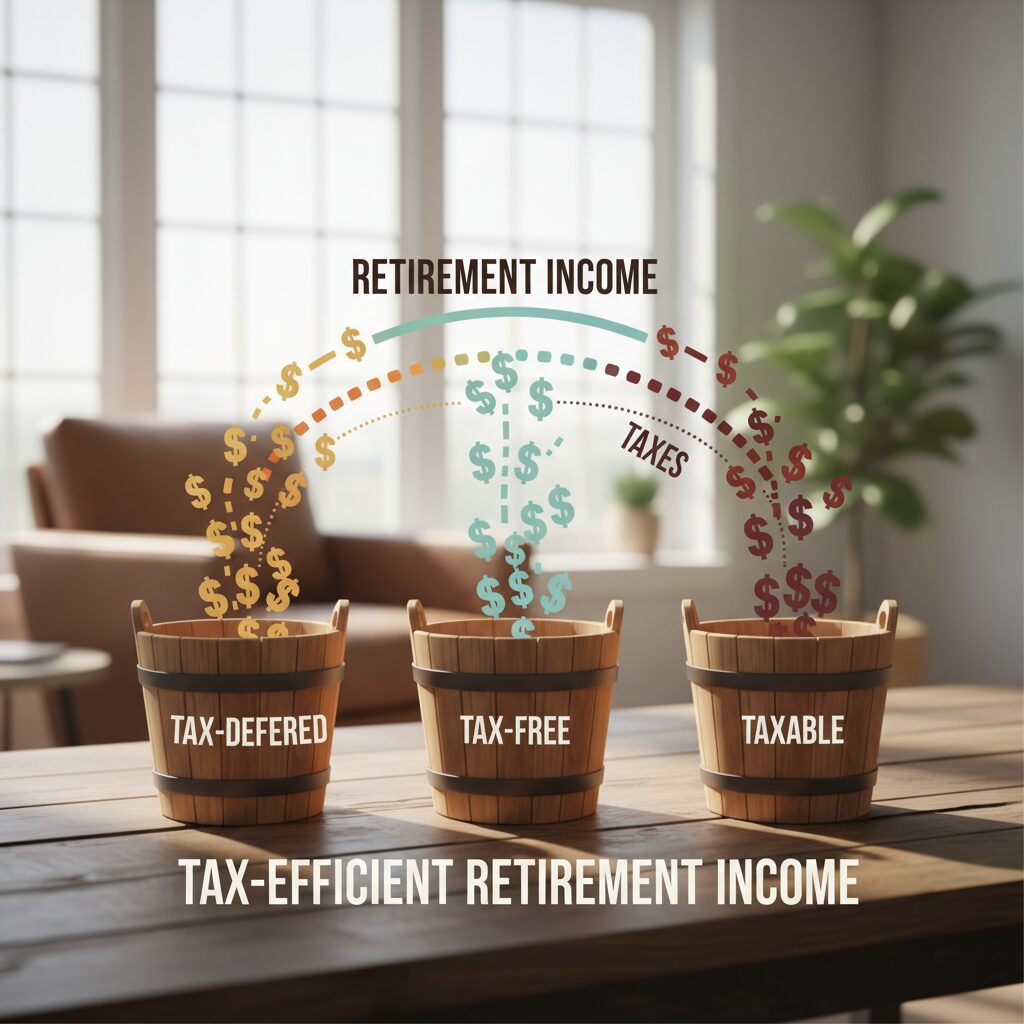
The foundation of any tax-efficient retirement income strategy is understanding the three types of accounts — or “tax buckets” — and how each one is taxed when you withdraw money.
Tax-Deferred Accounts (Traditional IRA, 401(k), 403(b))
Contributions were made pre-tax, so every dollar you withdraw is taxed as ordinary income. These accounts are also subject to Required Minimum Distributions (RMDs) starting at age 73 under current rules established by the IRS SECURE 2.0 Act provisions.
Tax-Free Accounts (Roth IRA, Roth 401(k))
Contributions were made with after-tax dollars. Qualified withdrawals — including all growth — come out completely tax-free. Roth IRAs also have no RMDs during the original owner’s lifetime, making them powerful estate planning tools.
Taxable Accounts (Brokerage, Savings, CDs)
These accounts offer no upfront tax deduction, but they provide favorable treatment on long-term capital gains and qualified dividends. For 2024, married couples filing jointly pay 0% on long-term capital gains if taxable income stays below $94,050.
| Account Type | Tax on Contributions | Tax on Growth | Tax on Withdrawals | RMDs Required? |
|---|---|---|---|---|
| Traditional IRA / 401(k) | Tax-deductible | Tax-deferred | Ordinary income rates | Yes, starting age 73 |
| Roth IRA | After-tax | Tax-free | Tax-free (if qualified) | No (owner’s lifetime) |
| Roth 401(k) | After-tax | Tax-free | Tax-free (if qualified) | No (after SECURE 2.0) |
| Taxable Brokerage | After-tax | Taxed annually (dividends/gains) | Capital gains rates | No |
The goal is to draw from these buckets in a coordinated sequence that keeps your marginal tax rate as low as possible — year after year.
Step 2: Use Strategic Withdrawal Sequencing for Tax-Efficient Retirement Income
The conventional advice is to spend taxable accounts first, then tax-deferred accounts, and save Roth for last. While that’s a reasonable starting point, a dynamic withdrawal strategy almost always outperforms a rigid sequence.
How Dynamic Withdrawal Sequencing Works
Rather than draining one bucket before touching another, you blend withdrawals across all three account types each year to “fill up” low tax brackets intentionally. Here’s a simplified example:
- Cover baseline expenses with taxable account withdrawals and Social Security. This keeps your ordinary income low.
- “Fill” the 12% bracket with traditional IRA distributions. For 2024, married couples filing jointly can have up to $94,300 in taxable income before crossing into the 22% bracket.
- Use Roth withdrawals for any remaining income needs. Since Roth distributions don’t appear on your tax return, they won’t push you into a higher bracket or trigger IRMAA.
This approach is especially powerful in early retirement — the years between stopping work and claiming Social Security or facing RMDs — when your taxable income naturally dips.
Why the “Spend Taxable First” Rule Often Fails
If you deplete your taxable account too quickly, you lose access to the favorable 0% long-term capital gains rate. You also eliminate a flexible source of income that doesn’t trigger the same tax consequences as IRA withdrawals. A blended approach preserves optionality.
Step 3: Leverage Roth Conversions to Build Tax-Efficient Retirement Income
Roth conversions are arguably the single most powerful tool for building tax-efficient retirement income over the long term. The concept is straightforward: you move money from a traditional IRA into a Roth IRA, pay ordinary income tax on the converted amount today, and never pay tax on that money — or its growth — again.
The Roth Conversion “Sweet Spot” Window
The ideal time for Roth conversions is typically between retirement and age 73, when your income is lower than it will be once Social Security and RMDs begin. In my experience working with clients, this window often represents the lowest marginal tax rates they’ll ever face.
Example: A retired couple in Stuart, Florida with $60,000 in taxable income could convert approximately $34,300 of traditional IRA assets to Roth — filling up the rest of the 12% bracket — and pay just $4,116 in federal tax on the conversion. That same money, left in a traditional IRA, might eventually be taxed at 22% or higher when RMDs force it out.
Consult a qualified tax professional for your specific situation, as conversion amounts should be carefully calibrated to avoid triggering IRMAA surcharges, the 3.8% Net Investment Income Tax, or other unintended consequences.
Multi-Year Roth Conversion Planning
The most effective Roth conversion strategies span five to ten years. By converting a manageable amount each year, you:
- Spread the tax bill over multiple years at lower rates
- Reduce future RMDs, which reduces future taxable income
- Create a larger pool of tax-free income for later retirement
- Potentially reduce taxes for your heirs under the SECURE Act’s 10-year distribution rule

Step 4: Coordinate Social Security Timing With Your Tax Plan
Social Security is a critical piece of the tax-efficient retirement income puzzle — and the timing of when you claim benefits has significant tax implications that extend well beyond the monthly check amount.
How Social Security Benefits Are Taxed
Up to 85% of your Social Security benefits can be subject to federal income tax depending on your “combined income” (adjusted gross income + nontaxable interest + half of Social Security benefits). For married couples filing jointly:
- Below $32,000: Benefits are not taxed
- $32,000 – $44,000: Up to 50% of benefits are taxable
- Above $44,000: Up to 85% of benefits are taxable
These thresholds have never been adjusted for inflation since 1993, which means more retirees cross into the 85% taxation zone every year.
Tax-Efficient Retirement Income and the Case for Delaying Benefits
Delaying Social Security to age 70 increases your benefit by approximately 8% per year beyond full retirement age. But there’s an often-overlooked tax benefit: those early years with no Social Security income create an ideal window for Roth conversions and low-bracket IRA distributions.
By strategically delaying Social Security, you can execute several years of tax-efficient conversions, shrink your traditional IRA balance, and ultimately receive a larger Social Security benefit — much of which may be shielded by your now-larger Roth holdings.
Step 5: Minimize Investment Taxes Inside Your Portfolio
Tax-efficient retirement income extends beyond withdrawal strategies to how your investments are structured within each account. This is known as asset location — placing the right investments in the right account types to minimize annual tax drag.
Asset Location Best Practices
- Tax-deferred accounts (IRA/401(k)): Hold bonds, REITs, and other high-income investments that generate ordinary income. Since you’ll pay ordinary income tax on all withdrawals regardless, there’s no penalty for holding tax-inefficient assets here.
- Taxable accounts: Hold broad-market index funds, tax-managed funds, and individual stocks. These generate mostly long-term capital gains and qualified dividends taxed at preferential rates.
- Roth accounts: Hold your highest-growth investments. Since all growth is tax-free, maximizing growth here produces the greatest tax benefit.
According to Vanguard research, proper asset location can add up to 0.75% in after-tax returns annually — a meaningful boost that compounds over decades.
Tax-Loss Harvesting in Retirement
Don’t overlook tax-loss harvesting in your taxable accounts, even in retirement. By selling positions at a loss and immediately reinvesting in a similar (but not substantially identical) fund, you can:
- Offset capital gains from rebalancing or other sales
- Deduct up to $3,000 per year in net losses against ordinary income
- Carry forward unused losses to future years indefinitely
This is one of the ongoing benefits of working with a firm that provides comprehensive wealth management services — systematic tax-loss harvesting requires year-round monitoring.

Step 6: Plan Around Medicare IRMAA and Stealth Taxes
One of the most common surprises retirees face is the Income-Related Monthly Adjustment Amount (IRMAA), which increases your Medicare Part B and Part D premiums based on your modified adjusted gross income (MAGI) from two years prior.
2024 IRMAA Thresholds and Surcharges
For 2024, if your 2022 MAGI exceeds $206,000 (married filing jointly), you’ll pay higher Medicare premiums. The surcharges rise in tiers, and at the highest level, an individual can pay over $560 per month for Part B alone — more than four times the standard premium.
This matters for tax-efficient retirement income because large IRA distributions, poorly timed Roth conversions, or even one-time capital gains events can spike your MAGI and trigger IRMAA surcharges that last an entire year.
Strategies to Manage IRMAA
- Smooth income across years to avoid crossing IRMAA thresholds in any single year.
- Use Roth withdrawals for large one-time expenses — Roth distributions don’t count toward MAGI.
- Time asset sales carefully. If you’re selling a rental property or business, coordinate with your tax advisor to manage the MAGI impact.
- File a life-changing event appeal (SSA-44) if your income drops due to retirement, divorce, or the death of a spouse.
Step 7: Take Advantage of Florida’s Tax-Friendly Environment
Florida’s absence of a state income tax is a significant structural advantage for building tax-efficient retirement income. But the benefit goes further than many retirees realize.
Why Florida Residency Amplifies Tax-Efficient Retirement Income
Because Florida has no state income tax, no state capital gains tax, and no state estate tax, every federal tax reduction strategy you implement delivers its full benefit without a state-level offset. In states like California or New York, a Roth conversion might save on federal taxes but still trigger a state income tax bill of 9% to 13%. In Florida, that entire conversion is taxed only at the federal level.
This makes Florida an ideal environment for:
- Aggressive multi-year Roth conversion strategies
- Harvesting long-term capital gains at the 0% federal rate
- Receiving pension or annuity income without state taxation
- Selling appreciated assets with lower overall tax friction
Establishing and Maintaining Florida Domicile
If you’ve recently relocated to Florida — or split time between Florida and a higher-tax state — it’s critical to establish clear legal domicile. This includes updating your driver’s license, voter registration, homestead exemption, and estate planning documents. A qualified legal professional can help ensure your domicile status withstands scrutiny from your former state’s tax authority.
Putting It All Together: Your Tax-Efficient Retirement Income Action Plan
Building a truly tax-efficient retirement income strategy requires integrating all seven of these steps into a cohesive, year-by-year plan. Here’s a summary framework:
- Map your three tax buckets and know the balance in each.
- Project your income and tax brackets for the next 10-15 years, including Social Security and RMDs.
- Identify your Roth conversion window and calculate optimal annual conversion amounts.
- Decide your Social Security claiming strategy in coordination with your tax plan.
- Optimize asset location across all account types.
- Monitor IRMAA thresholds and adjust withdrawals to stay below cliff points.
- Leverage Florida’s tax advantages by ensuring proper domicile and maximizing state-tax-free strategies.
This is not a set-it-and-forget-it exercise. Tax laws change, market returns vary, and your personal circumstances evolve. The most effective plans are reviewed and adjusted annually. In my experience working with high-net-worth retirees and executives, the clients who benefit most are those who treat tax planning as an ongoing discipline — not a one-time event.
Frequently Asked Questions About Tax-Efficient Retirement Income
What is the most tax-efficient order to withdraw retirement funds?
While the traditional rule of thumb is to spend taxable accounts first, then tax-deferred, then Roth, a dynamic approach that blends withdrawals from multiple account types each year typically produces better results. The goal is to “fill” lower tax brackets strategically while preserving Roth assets for high-income years or estate transfer.
How do Roth conversions create tax-efficient retirement income?
Roth conversions shift money from a tax-deferred account (where withdrawals are taxed as ordinary income) to a Roth account (where qualified withdrawals are tax-free). By converting during low-income years and paying tax at reduced rates, you create a pool of future income that won’t increase your tax bracket, trigger IRMAA, or generate RMDs.
Does living in Florida eliminate all retirement income taxes?
Florida eliminates state income taxes on all retirement income, including pensions, IRA distributions, Social Security, and capital gains. However, federal income taxes still apply. Florida residency enhances — but doesn’t replace — the need for careful federal tax planning. Consult a qualified tax professional for your specific situation.
How does Social Security affect my tax-efficient retirement income plan?
Up to 85% of Social Security benefits can be taxed at the federal level depending on your combined income. The timing of when you claim benefits directly impacts your tax picture, particularly during the years when you might otherwise execute Roth conversions or take low-bracket IRA distributions. Coordinating Social Security with your broader withdrawal plan is essential.
When should I start planning for tax-efficient retirement income?
Ideally, planning should begin five to ten years before retirement. This allows time to build Roth balances through conversions, adjust asset locations, and model different Social Security claiming scenarios. However, even retirees who are already taking distributions can benefit significantly from restructuring their withdrawal approach.
Take the Next Step Toward Tax-Efficient Retirement Income
Every year you delay implementing a tax-efficient retirement income strategy is a year of potential savings left on the table. Whether you’re approaching retirement or already living it, the strategies outlined above can meaningfully improve your after-tax wealth.
The key is personalization. Your optimal plan depends on your specific account balances, income sources, health considerations, estate goals, and risk tolerance. That’s why working with an advisor who integrates tax planning into every investment and withdrawal decision is so important.
If you’re ready to see where you stand, we invite you to download our free Retirement Readiness Checklist — a practical tool designed to help you identify gaps in your current plan and prioritize the strategies that will make the biggest difference.
Already know you’d like personalized guidance? Schedule a complimentary review with our team to discuss how a coordinated, tax-efficient retirement income strategy could work for your unique situation. As a fee-only fiduciary firm, we sit on the same side of the table as you — always.
This content is for educational purposes only and does not constitute investment advice. Past performance is not indicative of future results. Advisory services offered through Davies Wealth Management, a Registered Investment Adviser. Please consult a qualified financial, tax, or legal professional regarding your specific situation.
Leave a Reply