


Why NBA Career Finances Are a Race Against the Clock
When most people think about NBA career finances, they imagine limitless wealth — nine-figure contracts, endorsement empires, and lifetime security. The reality is far more complicated, and for most players, far more urgent. Understanding the financial window that professional basketball creates is the first step toward protecting it.
🎧 Prefer to listen to the podcast or watch the video? Jump to listen to the podcast & watch the video.
The average NBA career lasts fewer than five years, according to data tracked by the NBA Players Association. Even players who beat those odds retire in their mid-to-late thirties, leaving four to six decades of living expenses ahead of them — funded entirely by wealth accumulated during a compressed earning window.
At Davies Wealth Management, we work with professional athletes who face a financial challenge that is genuinely unlike anything a typical high-income earner experiences. This post lays out the key numbers, the tax realities, and the planning frameworks that separate athletes who build lasting wealth from those who don’t.

The Career Length Reality: What the Numbers Actually Show
Average NBA Career Length and What It Means for NBA Career Finances
The most important number in NBA career finances is not salary — it is duration. Studies consistently place the average NBA career between 4.5 and 5.5 years. That figure includes every player who ever appeared in a regular season game, from superstars who play 18 seasons to roster players who appear in 12 games before washing out.
For the median player — not the star, but the professional who earns a legitimate NBA salary — the financial window is often three to six years of significant income. That is it. After that, the clock stops ticking on new earnings, but expenses, taxes, family obligations, and lifestyle costs continue for decades.
Position and Draft Status Affect Career Duration
Career length is not random. Several factors consistently predict how long a player earns at the NBA level:
- Draft position: Lottery picks (top 14) average significantly longer careers than second-round or undrafted players.
- Position: Guards and small forwards often sustain careers longer than centers who rely on athleticism near the basket.
- Injury history: A single major injury — ACL, Achilles, back — can permanently alter earning trajectory.
- Role player vs. star: Stars with guaranteed max contracts have career security that role players on minimum deals do not.
The implication for planning: no player should build a financial plan assuming a long career. Every plan should be stress-tested against a scenario in which the income stops in year two or year three.
The Post-Career Income Gap
A player who retires at 30 will likely live until 80 or beyond. That is 50 years of post-career life to fund. Even a player who earns $20 million over a six-year career — a substantial figure — must support a 50-year lifestyle on assets that, after taxes, agent fees, and spending, may be considerably less than $10 million.
When you spread $8 million across 50 years, you get $160,000 per year before investment returns — barely enough to maintain a professional lifestyle in most major cities, let alone support family members, maintain real estate, or respond to unexpected needs.
The Tax Reality: Why Gross Salary Is a Misleading Number
How Federal and State Taxes Shape NBA Career Finances
One of the most under-discussed aspects of NBA career finances is the gap between gross contract value and actual take-home pay. A player on a $5 million annual salary does not have $5 million to invest. After federal income tax, state income tax (often in multiple states due to the jock tax), agent commissions, and union dues, the actual investable amount can be 40 to 50 percent lower than the gross figure.
Federal marginal rates for income above certain thresholds reach 37 percent in 2026. Many NBA players earn well above those thresholds, meaning the majority of every dollar earned is taxed at the highest federal rate. Consult a qualified tax professional for your specific situation, as individual circumstances vary significantly.
The Jock Tax: A Multi-State Complication
The “jock tax” refers to the obligation athletes have to pay income tax in every state where they perform. An NBA player who plays 41 away games in 20 different states files income tax returns in many of those states, each with its own rate and apportionment rules.
States like California, New York, and Illinois have top marginal rates that, when combined with federal taxes, can push the effective rate on income earned in those states above 50 percent. A player based in Florida — which has no state income tax — still owes taxes to other states for games played there.
This is a key reason why players should work with advisors who understand multi-state taxation. A national wirehouse broker may not have depth in this area. A fee-based fiduciary with experience serving professional athletes does.
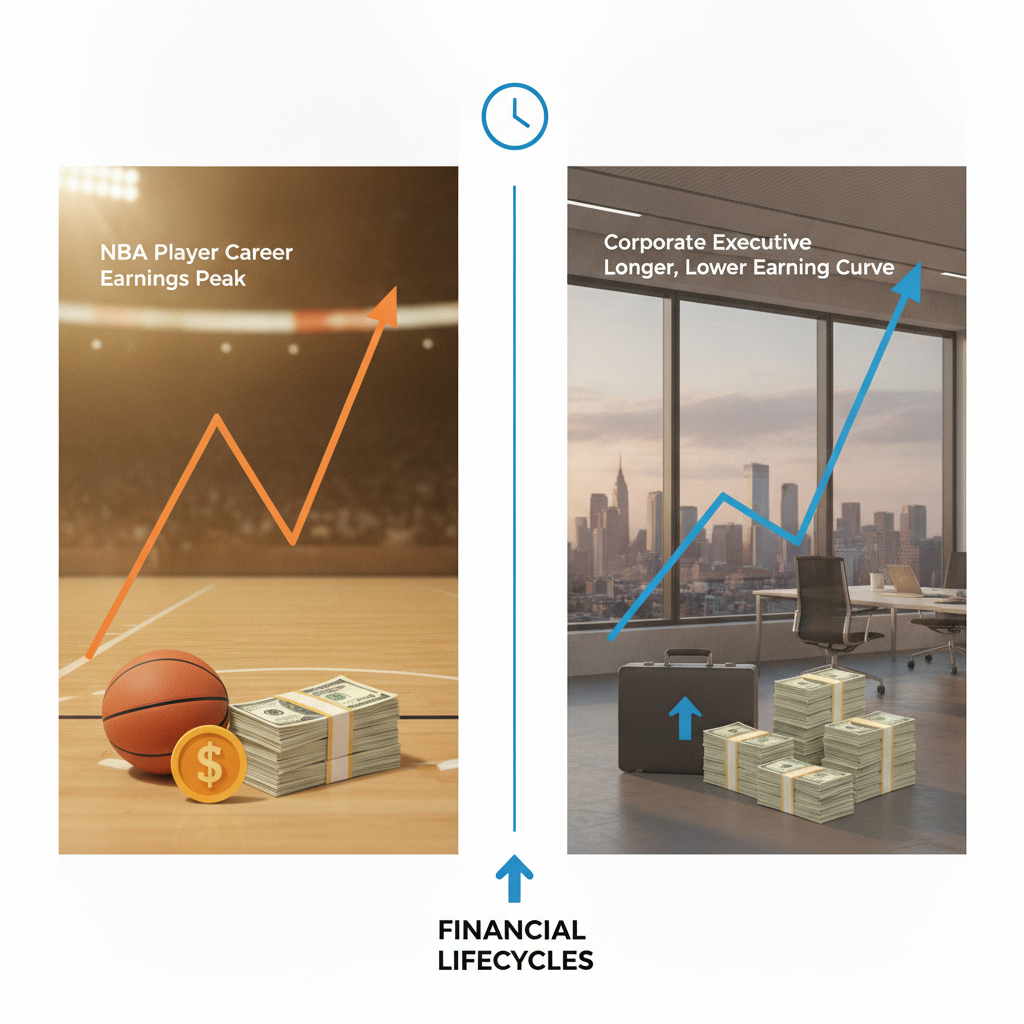
Comparing NBA Financial Complexity to a Typical High-Income Executive
| Factor | Senior Corporate Executive ($1M income) | NBA Player ($5M salary) |
|---|---|---|
| Career income window | 20–30 years | 3–8 years (median) |
| State tax returns filed | 1–2 per year | Up to 20+ per year |
| Income predictability | Stable, incremental raises | Volatile, injury-dependent |
| Retirement age | 60–65 typical | 28–35 typical |
| Primary tax strategy concern | Deferred comp, 401(k), IRMAA planning | Jock tax, income compression, multi-state filing |
| Estate planning complexity | Moderate (standard HNW) | High (early wealth, family expectations, NIL/brand) |
Wealth Accumulation Strategies for NBA Career Finances
Maximize Retirement Accounts Early — Every Year Counts
Players who maximize tax-advantaged accounts from their first contract give their wealth decades of compounding growth. The NBA provides access to a 401(k) plan, and players should contribute the IRS maximum each year. For 2026, the 401(k) employee contribution limit is $24,500, with a total plan limit of $72,000 including employer contributions, per IRS Notice 2025-67.
For a player earning $5 million per year, these limits represent a small fraction of income — but over a 40-year investment horizon, the tax-deferred compounding on even $70,000 per year becomes significant. The IRS retirement plan contribution guidance outlines current limits and catch-up provisions in detail.
Building Taxable Investment Portfolios That Last Decades
Because retirement accounts alone cannot hold the wealth an NBA player generates, taxable brokerage portfolios become the primary vehicle for long-term wealth. This creates important considerations around asset location, tax-loss harvesting, and investment structure.
Key principles for taxable portfolio construction in the context of NBA career finances:
- Asset allocation: Place tax-inefficient assets (bonds, REITs) inside tax-advantaged accounts when possible; hold tax-efficient equity index funds in taxable accounts.
- Tax-loss harvesting: Actively harvest losses to offset gains, reducing current-year tax liability during peak earning years.
- Long-term capital gains preference: Hold appreciated positions for more than 12 months to qualify for preferential tax rates rather than short-term ordinary income rates.
- Avoid unnecessary turnover: Each sale in a taxable account is a taxable event — active trading during high-income years is especially costly.
For guidance on portfolio construction principles, the Vanguard Investor Education Center provides useful foundational content on asset allocation and tax efficiency.
Roth Conversion Strategy for Post-Career Years
This is one of the most underutilized strategies in NBA career finances. When a player retires — potentially at 30 or 32 — their taxable income drops dramatically. If they have accumulated funds in pre-tax retirement accounts, the years immediately following retirement may offer a rare opportunity to convert those funds to Roth IRA status at relatively low marginal rates.
A player who retires with $500,000 in a 401(k) and no earned income might execute a Roth conversion ladder over five to seven years, converting $50,000 to $100,000 per year at moderate tax brackets. The result: tax-free growth for the remaining 40+ years of retirement. Consult a qualified tax professional to determine the optimal conversion amounts for your specific situation.
Real Estate, Business Investments, and Concentration Risk
Many NBA players — and many high-net-worth individuals generally — are drawn to real estate and direct business investments as wealth-building vehicles. These can be excellent tools, but they introduce risks that demand careful management:
- Concentration risk: A portfolio of three or four investment properties is highly concentrated compared to a diversified equity portfolio. A local real estate downturn or problematic tenants can destroy returns.
- Liquidity risk: Real estate and private businesses cannot be sold quickly if cash is needed — a significant concern for players whose income could stop abruptly.
- Operational risk: Businesses require active management. A player who is also managing a full practice and travel schedule may not have the bandwidth to oversee multiple ventures effectively.
The SEC’s investor education resources provide a useful framework for evaluating investment opportunities, including how to assess risk disclosures before committing capital.
Estate Planning and Wealth Protection in NBA Career Finances
Why Young Athletes Need Estate Plans Immediately
Estate planning is not just for retirees. An NBA player who signs a rookie contract at 19 has immediate estate planning needs. They may have a net worth of several million dollars within months of being drafted — without a will, powers of attorney, or beneficiary designations in place.
A 22-year-old with $4 million in assets and no estate plan is a serious legal and financial vulnerability. If something happens, state intestacy laws — not the player’s wishes — determine where the assets go.
The Planning Landscape After 2026 Permanent Exemption Changes
The One Big Beautiful Bill Act, signed in July 2025, permanently set the federal estate and gift tax exemption at $15 million per individual and $30 million per married couple, effective 2026, indexed for inflation. This removes the uncertainty that previously existed around planning timelines.
For most NBA players, the federal estate tax is not an immediate concern — but it is worth monitoring as wealth compounds over decades. More immediately relevant is the use of irrevocable trusts, dynasty trusts, and family gifting strategies to organize wealth, protect assets from creditors, and establish multigenerational planning structures.
State-level estate taxes remain in effect in several states. Players who maintain residences in multiple states should work with estate planning attorneys to clarify domicile and minimize exposure. Our comprehensive wealth management services include coordination with estate planning attorneys for exactly these situations.
Protecting Assets from External Pressure
Young players with sudden wealth face intense external pressure — from family, from entourages, from promoters, and from people presenting business opportunities. Asset protection planning is a legitimate component of NBA career finances:
- Domestic asset protection trusts (DAPTs) in favorable states can shield assets from future creditors while retaining certain beneficial rights.
- LLCs and family limited partnerships can hold investment real estate and other assets in a structure that provides liability separation.
- Prenuptial agreements, while personal, are a financial planning tool worth discussing with legal counsel when significant assets exist before marriage.
The Kiplinger estate planning resource center provides accessible explanations of many of these structures for readers who want to go deeper on the concepts.

The Role of a Fee-Based Fiduciary in NBA Career Finances
Why NBA Career Finances Demand a Different Kind of Advisor
The typical retail investor can rely on a target-date fund and a basic financial plan. A professional athlete cannot. NBA career finances involve compressed timelines, multi-state taxation, large irregular inflows, intense external pressure, and planning horizons that span five or more decades beyond the end of active play.
A commission-based broker at a national firm has a financial incentive to recommend products that generate commissions. A fee-based fiduciary — like Davies Wealth Management — is compensated by client fees and acts as a fiduciary when providing investment-advisory services, with any insurance commissions separately disclosed. The alignment is fundamentally different.
What Comprehensive Planning Looks Like for a Professional Athlete
A well-designed financial planning approach for an NBA player addresses:
- Cash flow management during the contract period — structuring living expenses, savings rates, and tax payments to avoid year-end surprises.
- Tax strategy coordination with a CPA experienced in multi-state athlete taxation.
- Investment portfolio construction for a multi-decade horizon with appropriate risk management.
- Insurance review — disability insurance is especially critical when earning capacity is entirely dependent on physical health.
- Estate planning coordination — wills, trusts, powers of attorney, beneficiary designation audits.
- Post-career income planning — building the investment base that will sustain lifestyle for 50+ years.
If you are a professional athlete — or advising one — and want to understand what this looks like in practice, we invite you to schedule a discovery conversation with our team.
Free Download
The Florida Relocation Guide
Everything to consider before making Florida your home state — residency and domicile rules, homestead benefits, and the financial checklist for relocating retirees and professionals.
Frequently Asked Questions About NBA Career Finances
How long does the average NBA career last in terms of NBA career finances planning?
The average NBA career lasts approximately 4.5 to 5.5 years, though this includes many players with very short stints. From an NBA career finances standpoint, every financial plan should be stress-tested against a scenario in which active income stops within three years. Building in that conservatism from day one of a first contract is one of the most important decisions a player and their advisor can make.
What is the jock tax and how does it affect NBA player take-home pay?
The jock tax requires athletes to pay state income tax in every state where they earn income by performing — including away game cities. Because NBA players play in many states throughout a season, they may file tax returns in 15 to 20 states. Combined with federal taxes, effective tax rates on income earned in high-tax states can exceed 50 percent, significantly reducing the actual investable income from a gross salary figure.
When should an NBA player start estate planning?
Immediately — ideally before or concurrent with signing their first professional contract. Any player with meaningful assets needs a will, beneficiary designations, and powers of attorney at minimum. As wealth grows, more sophisticated structures including trusts and family gifting strategies should be implemented. Waiting until retirement means years of unprotected wealth accumulation.
How should an NBA player invest their contract earnings for long-term security?
The foundation should be a diversified, tax-efficient investment portfolio built for a 50+ year horizon, not a 10-year one. Retirement accounts should be maximized annually. Taxable accounts should emphasize tax efficiency — broad index exposure, low turnover, and active tax-loss harvesting. Real estate and business investments can complement a core portfolio but should not replace diversified financial assets as the primary wealth base. Consult a qualified financial professional for guidance specific to your situation.
What makes NBA career finances different from planning for a high-income professional?
Three factors distinguish NBA career finances from standard high-income planning: the compressed earning window (years, not decades), the multi-state tax complexity (jock tax across 15–20 states annually), and the early retirement horizon (funding 50 years of retirement starting at age 30 or earlier). Each of these requires specialized planning strategies that mass-market financial advice does not address.
Building Wealth That Outlasts the Career
The players who build lasting wealth from NBA career finances are not necessarily the ones with the largest contracts. They are the ones who treat every dollar of after-tax income as a 50-year asset rather than a lifestyle resource. They save aggressively during the earning window, minimize tax leakage through smart planning, diversify their investment base, and work with advisors who are genuinely aligned with their interests.
The game ends. The financial decisions made during it echo for a lifetime. Getting those decisions right requires the kind of coordinated, comprehensive guidance that most national firms simply are not structured to provide for professional athletes.
At Davies Wealth Management, we serve high-net-worth individuals, executives, and professional athletes who have outgrown one-size-fits-all financial advice. Our fee-based, fiduciary approach ensures that your NBA career finances are managed with the same discipline and long-term thinking you bring to your performance on the court.
Take the Next Step
Understand your complete financial picture. Our Financial Wellness Quiz is designed for high-net-worth individuals and athletes who want a clear snapshot of where their planning stands — and where the gaps are.
Take our Financial Wellness Quiz →
Ready for personalized guidance from a fee-based fiduciary? Book a complimentary phone call with our team.
This content is for educational purposes only and does not constitute specific investment, tax, or legal advice. Davies Wealth Management acts as a fiduciary when providing investment-advisory services; insurance commissions are separately disclosed. Please consult a qualified financial, tax, and legal professional for advice specific to your situation.
This content is for general educational purposes only and does not constitute individualized investment advice. Past performance does not guarantee future results. Investment-advisory services are offered by Davies Wealth Management, LLC, an investment adviser registered with the State of Florida. Registration does not imply a certain level of skill or training. Please consult appropriately qualified financial, tax, or legal professionals regarding your specific circumstances.
Listen & Watch
Prefer audio or video? We’ve got you covered.
Leave a Reply