


If you are a retiree — or approaching retirement — with household income above $500,000, the medicare strategies retirees in your income tier need are fundamentally different from what most financial media covers. While popular articles discuss basic enrollment windows and plan comparisons, high-income retirees face a layered set of surcharges, tax traps, and planning decisions that can quietly cost $10,000 or more per year if left unaddressed.
This guide is written specifically for individuals and couples with substantial investable assets, significant retirement income, or both. The strategies here are not theoretical — they reflect the real planning work done for executives, business owners, and retirees whose financial complexity has grown beyond what a generalist broker or national firm is equipped to handle.
Why Medicare Is a Wealth Management Issue, Not Just a Healthcare Decision
Most people think of Medicare as a benefits enrollment question. For high-net-worth retirees, it is a tax and income planning challenge first.
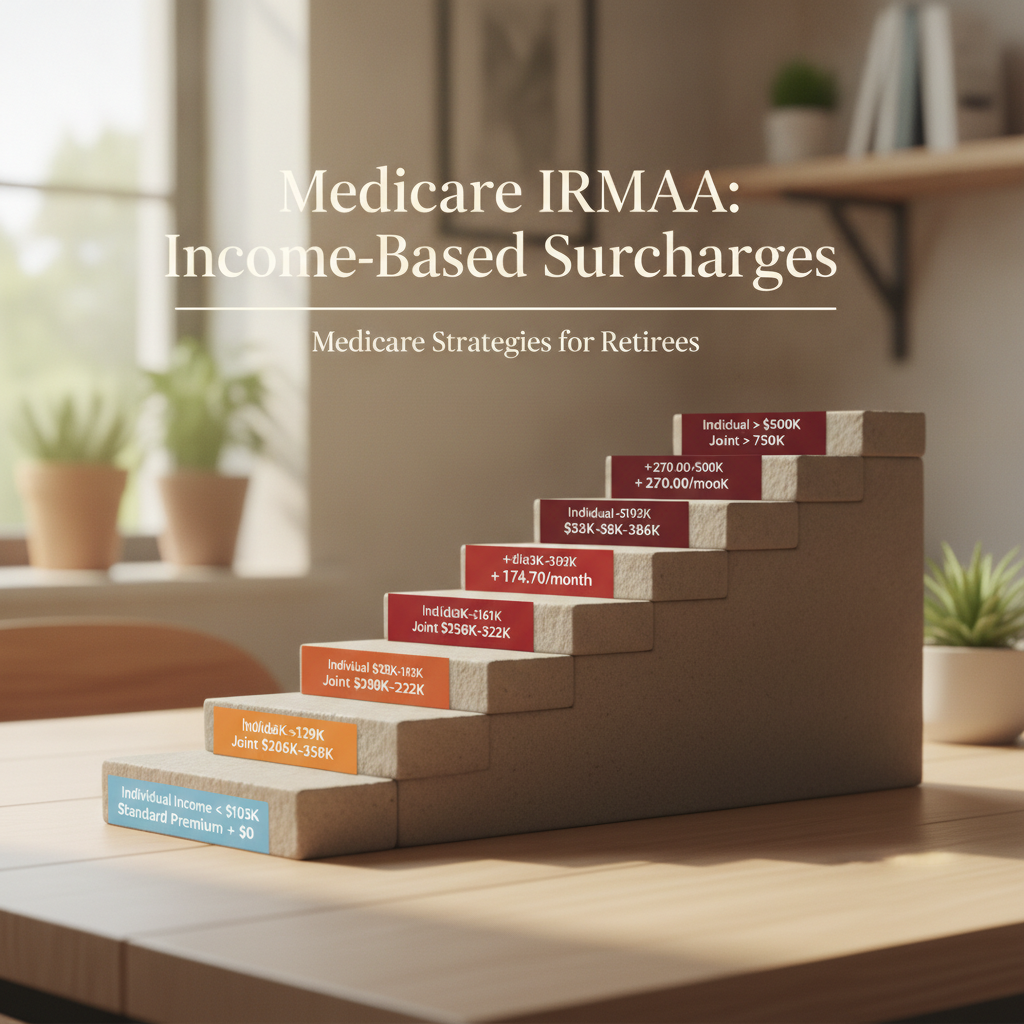
The core issue is IRMAA — the Income-Related Monthly Adjustment Amount. Medicare charges higher Part B and Part D premiums to beneficiaries whose income exceeds certain thresholds. At higher income levels, those surcharges are substantial, and they are determined by your tax return from two years prior — a detail that catches many retirees completely off guard.
How IRMAA Works for High-Income Medicare Beneficiaries
Medicare uses your Modified Adjusted Gross Income (MAGI) from your tax return filed two years before the current year to determine your premium tier. In 2026, that means your 2024 income determines what you pay today.
IRMAA applies to both Part B (outpatient coverage) and Part D (prescription drug coverage). The surcharges are assessed per person, which means a married couple both on Medicare can pay double the individual surcharge at every tier.
For individuals with income above $500,000 and couples above roughly $750,000 or more, the IRMAA surcharges represent the highest premium tier — a meaningful annual expense that deserves serious planning attention. Consult a qualified financial professional for your specific current-year thresholds and how your income is likely to be assessed.
The Two-Year Lookback: A Hidden Planning Lever
Because Medicare looks back two years, decisions you make today about income recognition affect your premiums years from now. This creates both a risk — an unusually high-income year triggering elevated premiums down the road — and an opportunity to plan proactively.
For example, a business sale in 2025 that generates a large capital gain will affect your 2027 Medicare premiums. Knowing this in advance allows your advisor to build income smoothing strategies into the transaction planning — rather than discovering the surcharge after the fact.
7 Proven Medicare Strategies Retirees With High Income Should Deploy
1. Use a Life-Changing Event Appeal to Reduce Surcharges Immediately
Social Security Administration (SSA) allows Medicare beneficiaries to appeal their IRMAA determination if they have experienced a “life-changing event.” These include:
- Retirement or reduction of work hours
- Death of a spouse
- Divorce or annulment
- Loss of income-producing property due to a disaster
- Reduction in or loss of pension income
If your income has dropped significantly since the year Medicare is using to calculate your surcharge — which is common in the first year or two of retirement — you can file Form SSA-44 to request a reassessment based on more recent income. This is one of the most underused medicare strategies retirees have access to, and it can reduce or eliminate surcharges immediately rather than waiting for the two-year cycle to reset.
Learn more about the IRMAA appeal process directly from the Social Security Administration’s official Medicare IRMAA page.
2. Manage MAGI With Precise Roth Conversion Planning
Roth conversions are one of the most powerful long-term tax tools available to high-net-worth retirees — but they directly increase your MAGI in the year of conversion. An unplanned or oversized Roth conversion can push you into a higher IRMAA tier two years later, increasing your Medicare costs more than the conversion saves in taxes.
The solution is IRMAA-aware Roth conversion laddering: executing conversions in annual amounts that keep your MAGI just below a tier boundary, rather than converting as much as possible in a single year.
This requires coordinating projected income from all sources — Social Security, required minimum distributions (RMDs), investment income, part-time work, rental income — and modeling the Medicare impact alongside the tax impact. Consult a qualified tax and financial planning professional for your specific situation.
3. Leverage Qualified Charitable Distributions (QCDs) to Reduce MAGI
For retirees age 70½ or older with charitable intentions, Qualified Charitable Distributions (QCDs) are one of the most efficient tools in the high-income Medicare planning toolkit. A QCD allows you to transfer up to a specific annual limit directly from your IRA to a qualified charity — and that amount is excluded from your taxable income entirely.
The key advantage for IRMAA planning: because a QCD satisfies your RMD requirement without the distribution appearing as taxable income, it directly reduces your MAGI. For a retiree with large IRA balances generating substantial RMDs, QCD stacking across multiple years can meaningfully lower Medicare premium tiers. This is a strategy that simply does not exist for investors with smaller retirement accounts.
You can review QCD rules and current limits at IRS.gov’s official retirement topics page on QCDs.
4. Coordinate Capital Gains Harvesting and Realization Timing
Unrealized capital gains in a taxable brokerage account represent a major MAGI planning variable. Realizing a large gain — whether through rebalancing, a securities sale, or a business transaction — can spike income into a higher IRMAA tier two years forward.
Sophisticated medicare strategies retirees with large portfolios should consider include:
- Spreading large gain realizations over two or more tax years to avoid crossing IRMAA tier thresholds
- Tax-loss harvesting to offset capital gains and reduce net MAGI impact
- Charitable remainder trusts (CRTs) to defer and spread income from highly appreciated assets
- Installment sales on business or real estate assets to smooth income over multiple years
Each of these strategies requires coordination between your investment advisor, tax professional, and Medicare planning — which is exactly why integrated wealth management matters for high-income retirees. Our comprehensive wealth management services are designed to connect these planning layers for clients at this level of complexity.

5. Optimize Health Savings Account (HSA) Strategy Before Medicare Enrollment
Once you enroll in Medicare, you can no longer contribute to a Health Savings Account (HSA). But HSA funds accumulated before enrollment can be used tax-free for qualified medical expenses — including Medicare premiums for Parts A, B, C, and D — in retirement.
For high-income executives or business owners who delayed Medicare enrollment while still working and covered by a qualifying high-deductible health plan, a well-funded HSA can serve as a powerful Medicare cost offset in retirement. Distributions used for qualified medical expenses are entirely tax-free, meaning they do not add to MAGI and do not affect IRMAA calculations.
This is one reason maximizing HSA contributions in working years is a priority for high earners who anticipate significant Medicare costs later. The IRS provides guidance on HSA eligibility and qualified expenses at IRS Publication 969.
6. Evaluate Medicare Advantage vs. Original Medicare Based on Your Full Financial Picture
The choice between Original Medicare (with a Medigap supplement) and Medicare Advantage is not just a healthcare network question — it has financial planning implications for high-income retirees.
IRMAA surcharges apply regardless of which path you choose for your base coverage. However, your out-of-pocket exposure, plan flexibility, and access to specialists can differ substantially. High-net-worth retirees who travel frequently, maintain homes in multiple states, or have complex medical needs often find that Original Medicare with a comprehensive Medigap policy provides more predictable and flexible coverage — even at a higher monthly premium.
The comparison below illustrates key differences relevant to high-income beneficiaries:
| Feature | Original Medicare + Medigap | Medicare Advantage |
|---|---|---|
| Multi-state / travel coverage | Nationwide, any Medicare-accepting provider | Network-based, limited out-of-network coverage |
| Out-of-pocket predictability | Highly predictable with Medigap Plan G or N | Variable; annual out-of-pocket maximum applies |
| Specialist access | No referral required; broad access | May require referrals and prior authorization |
| Monthly premium cost | Higher (Part B + Medigap + Part D) | Often lower base premium; may include Part D |
| IRMAA impact | Part B and D IRMAA applies to both paths | Part B and D IRMAA applies to both paths |
For most high-income retirees with complex lives and the ability to absorb a higher monthly premium for certainty, Original Medicare with a comprehensive supplement is frequently the better structural choice. That said, every situation is different — consult a qualified Medicare planning professional before making this decision.
7. Plan for Delayed Enrollment Strategically If Still Working
If you or your spouse are still employed past age 65 and covered by a qualifying employer health plan, you may be able to delay Medicare enrollment without incurring late enrollment penalties. This creates an opportunity to continue HSA contributions and potentially compress the number of years subject to high IRMAA tiers if income will drop upon retirement.
However, the rules around creditable coverage are specific, and errors — particularly for retirees with self-funded COBRA coverage or retiree health benefits — can result in permanent late-enrollment penalties and coverage gaps. This is one of the most consequential decisions in the Medicare strategies retirees with complex employment situations face. Get the guidance right the first time.
How High-Net-Worth Medicare Planning Differs From Mass-Market Advice
Most Medicare guidance is built for the median retiree. It addresses the basics: when to enroll, how to choose a plan, and what Part D covers. That advice is not wrong — it simply does not apply to the challenges faced by retirees with substantial income and assets.
The Critical Difference: Income Complexity
A retiree with a single pension and modest Social Security has relatively predictable MAGI. Their IRMAA tier changes rarely. By contrast, a high-net-worth retiree drawing from multiple income sources — IRA distributions, brokerage gains, Social Security, rental income, business income, trust distributions — has income that can fluctuate significantly from year to year.
That income volatility is both the risk and the opportunity. Without active management, it produces unpredictable IRMAA costs. With skilled planning, those same income levers can be pulled strategically to minimize surcharges, reduce total tax burden, and maximize after-tax wealth.
Why Medicare Strategies Retirees Need Are Integrated With Broader Planning
The most effective medicare strategies retirees with $500K+ income deploy are not standalone Medicare decisions. They are integrated with:
- Roth conversion planning — sizing conversions to stay within IRMAA tiers
- RMD management — using QCDs to reduce taxable distributions
- Portfolio rebalancing — timing gain realization to minimize two-year IRMAA impact
- Estate and gifting strategy — reducing future asset values that generate income
- Social Security timing — coordinating benefit start dates with income projections
This level of integration is what separates a true fiduciary wealth management relationship from a product-focused broker or a benefits-only Medicare advisor. You can schedule a discovery conversation to explore what this kind of coordinated planning looks like for your specific situation.

Common Medicare Planning Mistakes High-Income Retirees Make
Ignoring IRMAA Until It Hits
Many high-income retirees discover IRMAA only when their first Medicare bill arrives. At that point, the income year that triggered the surcharge is already closed — there is nothing to do except pay it. Proactive planning requires modeling MAGI two years ahead, which most retirees simply do not do without a dedicated advisor.
Failing to Appeal After a Life-Changing Event
Retirement itself is a life-changing event that qualifies for IRMAA reconsideration. Yet thousands of newly retired executives continue paying surcharges based on their high working income for years, simply because they did not know to file Form SSA-44. This is a straightforward correction that can save $3,000 to $8,000 or more per person in annual premium costs. Consult a qualified financial professional to determine if you qualify.
Overlooking the Spouse’s Medicare Costs
IRMAA is assessed per person. A couple in the highest income tier can face Medicare surcharges that total tens of thousands of dollars annually — on top of standard premiums. Medicare strategies retirees use must account for both spouses’ premiums, coverage needs, and income contribution to MAGI. This is especially important in situations where one spouse has significantly higher income than the other.
Frequently Asked Questions: Medicare Strategies Retirees With High Income Ask
What income triggers the highest IRMAA tier for Medicare in 2026?
IRMAA is structured in multiple income tiers, with the highest surcharge applying to individuals and couples above the top income threshold set by Medicare for each year. Because these thresholds are adjusted annually and your premiums are based on income from two years prior, consult a qualified financial professional or visit Medicare.gov for the most current figures specific to your situation.
Can I reduce my Medicare premiums if my income dropped after retirement?
Yes. If your income has declined due to a qualifying life-changing event — including retirement — you can file Form SSA-44 with Social Security to request reassessment based on more recent income. This is one of the most effective immediate medicare strategies retirees have to reduce surcharges when they transition from high earned income to lower retirement income.
Do Roth IRA withdrawals affect my Medicare premiums?
No. Qualified Roth IRA withdrawals are not included in MAGI and do not affect IRMAA calculations. This is one of the primary long-term planning benefits of Roth conversion — building a pool of assets that can be accessed in retirement without increasing Medicare costs. Consult a qualified tax professional to confirm your specific Roth distributions qualify.
How do QCDs help with Medicare IRMAA planning?
A Qualified Charitable Distribution (QCD) satisfies your RMD requirement without the distributed amount appearing as taxable income on your return. Because QCDs reduce MAGI dollar-for-dollar, they can help keep you in a lower IRMAA tier — particularly valuable for retirees with large IRA balances generating substantial mandatory distributions. This is a strategy that rewards having worked with a fiduciary advisor years before the QCD becomes available at age 70½.
Should I choose Medicare Advantage or Original Medicare as a high-income retiree?
The right choice depends on your health needs, geographic lifestyle, and financial priorities — not just monthly premium cost. High-income retirees who value provider flexibility, nationwide coverage, and cost predictability often prefer Original Medicare with a comprehensive Medigap supplement, despite the higher base premium. IRMAA surcharges apply equally under both paths, so the surcharge management strategies remain the same regardless of your coverage choice.
Building a Medicare Strategy That Works for Your Level of Wealth
The best medicare strategies retirees at the $500K+ income level can use are not found in a Medicare handbook or a general financial planning article. They emerge from the intersection of tax planning, income management, portfolio strategy, and proactive Medicare awareness — all working together under a single coordinated plan.
In my experience working with high-income retirees and executives, the ones who pay the least in unnecessary Medicare surcharges are those who began planning two to three years before retirement, not two to three months. The two-year lookback rule alone makes early coordination essential.
If your income, assets, or financial complexity have grown to a point where standard retirement advice no longer fits, it may be time to work with a fiduciary advisor who specializes in this tier of planning. The difference in outcomes — measured in thousands of dollars of annual Medicare savings, better tax efficiency, and greater financial clarity — is significant and lasting.
Effective medicare strategies retirees with substantial wealth need require the kind of integrated, ongoing guidance that a fee-based fiduciary RIA is uniquely positioned to provide — without the product conflicts or sales incentives that come with commission-based advisors.
Take the Next Step
Concerned about IRMAA surcharges eating into your retirement income? Our Medicare IRMAA Planning Guide walks through the income tiers, planning strategies, and timing decisions that matter most for high-income retirees.
📥 Download our Medicare IRMAA Planning Guide — and start managing your Medicare costs with the same precision you apply to your investments.
Ready for personalized guidance from a fee-based fiduciary? Book a complimentary phone call with Davies Wealth Management and let’s review your specific Medicare and income planning situation together.
This content is for educational purposes only and does not constitute investment advice. Past performance is not indicative of future results. Advisory services offered through Davies Wealth Management, a Registered Investment Adviser. Please consult a qualified financial, tax, or legal professional regarding your specific situation.
Leave a Reply