


Why High-Income Retirees Need Specialized Medicare Part D Strategies
If you’re a retiree with $500K or more in annual income, your medicare part d strategies need to go far beyond choosing the right prescription drug plan. The real cost driver for affluent retirees isn’t the base premium — it’s the Income-Related Monthly Adjustment Amount (IRMAA) surcharge that Medicare applies to both Part B and Part D premiums when your income exceeds certain thresholds.
In 2026, these surcharges can add more than $10,000 per person annually to your combined Part B and Part D costs. For a married couple both on Medicare, that’s potentially over $20,000 in additional premiums — money that could be preserved, invested, or redirected to charitable giving with proper planning.
This is where high-net-worth retirees diverge sharply from mass-market investors. A retiree living on $60,000 of Social Security and modest IRA withdrawals faces a fundamentally different Medicare landscape than someone managing a $3M portfolio with capital gains, Roth conversions, and business income. The strategies that matter for you are the ones most advisors never discuss, because most advisors don’t work with clients at your income level.
Understanding IRMAA: The Hidden Tax on Affluent Retirees
How IRMAA Surcharges Impact Medicare Part D Costs
IRMAA is essentially a wealth tax on Medicare premiums. The Social Security Administration uses your Modified Adjusted Gross Income (MAGI) from two years prior to determine your current-year surcharge. For 2026 premiums, the SSA looks at your 2024 tax return.
This two-year lookback creates both challenges and opportunities. A single large capital gain, Roth conversion, or business sale in one year can trigger elevated premiums two years later — even if your income has since normalized.
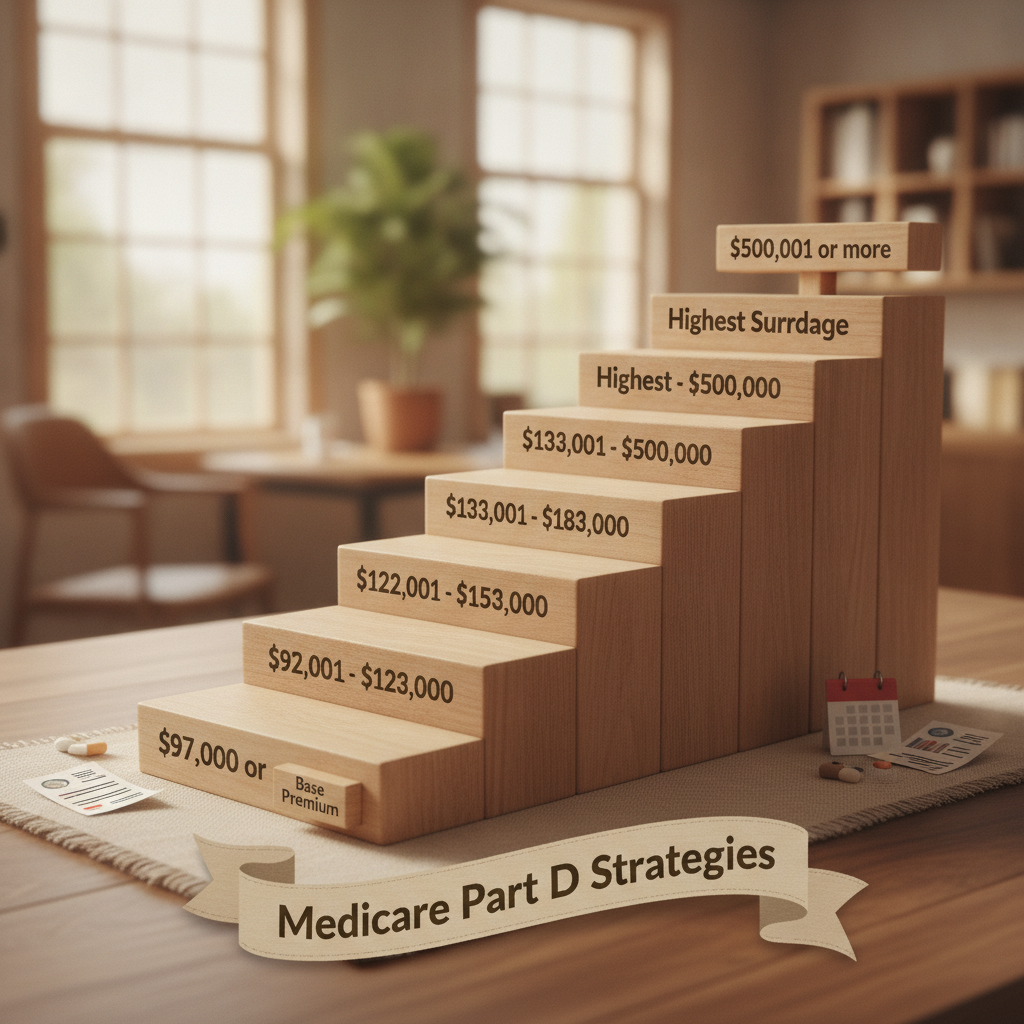
2026 IRMAA Brackets and Premium Impact for Medicare Part D
Understanding the exact thresholds is critical for planning. Here are the approximate 2026 IRMAA tiers for Medicare Part B and Part D (based on 2024 MAGI, with brackets adjusted for inflation):
| Filing Status: Single / Married Filing Jointly | Part B Monthly Surcharge (per person) | Part D Monthly Surcharge (per person) | Total Annual Added Cost (per person) |
|---|---|---|---|
| ≤ $109,000 / ≤ $218,000 | $0 (standard premium) | $0 (standard premium) | $0 |
| $109,001–$133,500 / $218,001–$267,000 | +$81.20/mo | +$13.70/mo | ~$1,127 |
| $133,501–$167,000 / $267,001–$334,000 | +$203.00/mo | +$35.30/mo | ~$2,857 |
| $167,001–$200,000 / $334,001–$400,000 | +$324.90/mo | +$57.00/mo | ~$4,583 |
| $200,001–$500,000 / $400,001–$750,000 | +$446.70/mo | +$78.60/mo | ~$6,304 |
| > $500,000 / > $750,000 | +$487.00/mo | +$91.00/mo | ~$6,936 |
Key insight: At the highest tier, a married couple pays roughly $12,122 more per year in combined Part B and Part D premiums than a couple at the standard rate. Over a 25-year retirement, that’s more than $300,000 in avoidable costs — before adjusting for inflation. Note that IRMAA brackets are indexed and may shift slightly; consult a qualified financial professional and review the latest SSA Medicare premium schedule for current figures.
7 Proven Medicare Part D Strategies to Reduce IRMAA Exposure
Effective medicare part d strategies for high-income retirees focus on one central objective: managing your MAGI in the years that matter. Here are seven approaches we see work consistently for clients in the $500K+ income range.
Strategy 1: Roth Conversion Laddering Before Medicare Enrollment
Roth conversions are one of the most powerful tools in the high-net-worth planning toolkit — but the timing matters enormously for IRMAA purposes. Converting traditional IRA assets to Roth in your early 60s, before Medicare enrollment at 65, allows you to:
- Pay taxes on the conversion at potentially lower rates during a gap year between retirement and Medicare
- Reduce future Required Minimum Distributions (RMDs) that inflate your MAGI
- Create tax-free income in retirement that does not count toward IRMAA calculations
The critical detail: Roth IRA distributions are not included in MAGI for IRMAA purposes. A retiree drawing $200,000 from a Roth account has zero IRMAA impact from that income, while the same withdrawal from a traditional IRA could push them into the highest surcharge tier.
For someone with a $2M traditional IRA, a systematic Roth conversion strategy spanning ages 60–64 can significantly reduce lifetime IRMAA costs. Consult a qualified tax professional to model the optimal conversion amounts for your bracket.
Strategy 2: Charitable Giving With Qualified Charitable Distributions (QCDs)
If you’re 70½ or older and charitably inclined, Qualified Charitable Distributions allow you to direct up to $105,000 per person (2026 limit, indexed for inflation) from your traditional IRA directly to a qualifying charity. The distribution satisfies your RMD but is excluded from your gross income.
For high-income retirees, QCDs serve double duty as part of your medicare part d strategies:
- They reduce your AGI, potentially lowering your IRMAA tier
- They satisfy RMD requirements without adding taxable income
- They may be more tax-efficient than itemizing charitable deductions at higher income levels
A married couple both over 70½ could redirect up to $210,000 in RMDs to charity, meaningfully lowering their MAGI for IRMAA lookback purposes. The IRS provides detailed QCD rules in their RMD FAQ.
Strategy 3: Managing Capital Gains Through Tax-Loss Harvesting
For retirees with taxable investment portfolios exceeding $1M, a single year of significant realized gains can push MAGI into a higher IRMAA bracket two years later. Systematic tax-loss harvesting — selling positions at a loss to offset gains — is an essential medicare part d strategy.
Key considerations for HNW portfolios:
- Concentrated stock positions: Executives and business owners often hold large, low-basis equity positions. A planned diversification strategy that harvests losses elsewhere can offset gains from selling concentrated holdings.
- Asset location: Holding tax-inefficient assets (REITs, high-yield bonds, actively managed funds) in tax-deferred accounts reduces the MAGI impact of investment income.
- Gain timing: Spreading large gains across multiple tax years can prevent IRMAA bracket jumps. Taking $150,000 in gains over three years may cost far less in IRMAA surcharges than $450,000 in a single year.

Strategy 4: Strategic Use of Municipal Bonds and Tax-Exempt Income
Important caveat: While municipal bond interest is exempt from federal income tax, it is included in the MAGI calculation for IRMAA purposes. This catches many affluent retirees off guard.
However, municipal bonds can still play a role in your medicare part d strategies when used thoughtfully:
- They reduce your federal tax liability even though they increase MAGI
- In a state like Florida with no income tax, the combined benefit can be meaningful
- When comparing total after-tax, after-IRMAA returns, munis may still outperform taxable alternatives for certain brackets
The takeaway: don’t assume tax-exempt means IRMAA-exempt. Work with an advisor who understands the full picture. Our comprehensive wealth management services include this level of multi-dimensional tax analysis.
Strategy 5: Donor-Advised Funds and Charitable Remainder Trusts
For retirees with income well above the highest IRMAA threshold, charitable strategies can meaningfully reduce MAGI while achieving philanthropic goals:
- Donor-Advised Funds (DAFs): “Front-loading” several years of charitable giving into a DAF in a single year creates a large deduction that can offset income from a Roth conversion, business sale, or capital gains event. You then distribute grants to charities over time.
- Charitable Remainder Trusts (CRTs): A CRT can accept highly appreciated assets, sell them without immediate capital gains recognition, and provide you with an income stream. The partial charitable deduction reduces current-year MAGI, and the trust’s diversified portfolio avoids the concentrated gain event that triggers IRMAA.
These structures are particularly relevant for retirees with $5M+ in assets where annual charitable giving exceeds $50,000. Consult a qualified tax and estate planning attorney before establishing a CRT.
Strategy 6: Business Income Timing and Entity Structuring
Retired business owners who maintain consulting income, board seats, or rental portfolios generating $200K+ have unique IRMAA exposure. Effective medicare part d strategies for this group include:
- S-Corp reasonable compensation planning: Ensuring your compensation is set correctly can affect how income flows to your personal return
- Installment sale agreements: Spreading the gain from a business sale over multiple years rather than recognizing it all at once
- Rental property depreciation: Accelerating depreciation through cost segregation studies to offset rental income
These approaches require coordination between your CPA, attorney, and financial advisor. A silo approach — where each professional works independently — often leads to missed IRMAA savings.
Strategy 7: Life-Changing Event Appeals (SSA-44 Filing)
If your income has dropped significantly due to retirement, the sale of a business, divorce, or other qualifying life-changing event, you can file Form SSA-44 to request that the SSA use your current year’s income instead of the two-year lookback.
Qualifying events include:
- Marriage, divorce, or death of a spouse
- Work stoppage or work reduction
- Loss of income from income-producing property
- Loss of pension income
- Receipt of settlement from an employer due to closure or bankruptcy
This is often overlooked by retirees who had a high-income final working year but have since transitioned to a significantly lower retirement income. The appeal can save thousands in the first years of Medicare enrollment. Details are available on the SSA-44 page at ssa.gov.
The Difference Between Mass-Market and HNW Medicare Planning
Most Medicare guidance you’ll find online — even from reputable sources — is written for retirees with $50,000–$150,000 in annual income. At that level, IRMAA either doesn’t apply or is a minor annoyance. The advice typically boils down to: “pick the right Part D plan during open enrollment.”
For a retiree with $500K+ in income and a multi-million-dollar portfolio, medicare part d strategies are inseparable from your broader wealth plan. Consider the differences:
- Mass-market retiree: Compares Part D plan formularies and premiums. IRMAA is irrelevant.
- HNW retiree: Must coordinate Roth conversions, capital gains timing, charitable giving, RMD strategy, and income sourcing — all with a two-year IRMAA lookback window in mind.
A national brokerage firm managing your portfolio likely isn’t modeling how a recommended equity sale affects your Medicare premiums 24 months later. A fiduciary advisor who serves high-net-worth clients integrates these variables into every recommendation.

Building a Multi-Year IRMAA Reduction Plan
Step 1: Map Your Income Sources for the Next Five Years
Start by projecting your MAGI for each of the next five years, identifying every income component:
- Social Security benefits (85% may be taxable at your income level)
- Required Minimum Distributions (which increase annually as you age)
- Capital gains from portfolio rebalancing or concentrated stock sales
- Rental income, consulting fees, board compensation
- Pension or annuity income
- Municipal bond interest (included in MAGI for IRMAA)
Step 2: Identify IRMAA Cliff Points in Each Year
Look at where your projected MAGI falls relative to the IRMAA brackets. Even a few thousand dollars over a threshold can trigger the next surcharge tier. In many cases, reducing income by $5,000–$10,000 in the right year saves $1,500–$3,000 in annual IRMAA surcharges per person.
This “cliff effect” makes IRMAA planning unusually high-leverage compared to other tax strategies. The return on a small income adjustment is disproportionately large.
Step 3: Coordinate Roth Conversions With IRMAA Brackets
Rather than converting the maximum amount possible each year, calibrate your Roth conversions to “fill up” a specific IRMAA bracket without spilling into the next tier. For example, if your baseline MAGI is $300,000 (married filing jointly), you might convert enough to reach $334,000 — staying within the third IRMAA tier rather than crossing into the fourth.
This nuanced approach to medicare part d strategies balances long-term tax savings from Roth conversion against short-term IRMAA costs.
Step 4: Integrate Charitable Strategies With Income Planning
Align your giving with your highest-income years. If you know 2026 will include a large capital gain from a real estate sale, that’s the year to make a substantial DAF contribution or execute QCDs. The charitable deduction or exclusion offsets the income spike that would otherwise inflate your 2028 IRMAA surcharge.
Step 5: Review and Adjust Annually
IRMAA brackets, RMD tables, and tax law change regularly. The Kiplinger tax resource center is a reliable source for tracking legislative updates. A plan built in 2026 may need adjustment by 2028 if brackets shift or new legislation changes the MAGI calculation.
Medicare Part D Strategies: Specific Plan Considerations for HNW Retirees
Why Plan Selection Still Matters at High Income Levels
Even though IRMAA dominates the cost picture for affluent retirees, the actual Part D plan you choose has financial implications:
- Formulary coverage: Ensure your specific medications are covered at a preferred tier
- Network pharmacies: Some plans offer significant discounts at preferred pharmacies
- The coverage gap: Under the Inflation Reduction Act, the Part D out-of-pocket cap is now $2,000 annually (as of 2025), which benefits all enrollees including high-income individuals
The $2,000 annual cap on out-of-pocket Part D spending was a significant change. For retirees on expensive specialty medications, this cap provides meaningful savings regardless of income level.
Medicare Part D Strategies and Medicare Advantage vs. Original Medicare
High-net-worth retirees often gravitate toward Original Medicare with a Medigap supplement for its broader provider access and nationwide coverage. If you choose this route, you’ll need a standalone Part D plan.
Alternatively, Medicare Advantage plans often bundle Part D coverage, but may restrict your provider network. For retirees who travel frequently, maintain residences in multiple states, or want access to top specialists, Original Medicare plus standalone Part D typically provides more flexibility.
IRMAA surcharges apply regardless of whether you choose Original Medicare or Medicare Advantage — so your income management strategies remain essential either way.
Frequently Asked Questions About Medicare Part D Strategies
Do Roth IRA withdrawals count toward IRMAA income calculations?
No. Qualified Roth IRA distributions are not included in Modified Adjusted Gross Income for IRMAA purposes. This is why Roth conversion strategies — especially when executed before age 65 — are among the most effective medicare part d strategies for reducing long-term premium costs. However, the Roth conversion itself does count as income in the year it occurs.
Can I appeal my IRMAA surcharge if my income has dropped?
Yes. If you’ve experienced a qualifying life-changing event — such as retirement, work reduction, marriage, divorce, or death of a spouse — you can file Form SSA-44 requesting that the SSA use your current-year income instead of the two-year lookback. This can result in immediate premium reduction.
How far in advance should I start planning for Medicare IRMAA?
Ideally, you should begin IRMAA-conscious planning at least three to five years before Medicare enrollment at age 65. Because the SSA uses a two-year lookback, decisions you make at age 62 or 63 directly impact your initial Medicare premiums. Early planning also allows time for Roth conversion laddering.
Does selling my business trigger IRMAA surcharges on Medicare Part D?
Yes, in most cases. A business sale typically generates substantial capital gains or ordinary income that significantly increases your MAGI. Without mitigation strategies — such as installment sales, charitable giving, or SSA-44 appeals — the income from a business sale can push you into the highest IRMAA tier for two or more years. This makes pre-sale planning essential.
Is it worth paying higher IRMAA now to do Roth conversions?
In many cases, yes — but it depends on your specific numbers. For a retiree with a $2M+ traditional IRA, the long-term tax savings and IRMAA reduction from systematic Roth conversions often far exceed the short-term IRMAA cost. A breakeven analysis comparing conversion costs against projected lifetime IRMAA and tax savings is essential. Consult a qualified financial professional to model your scenario.
Taking Action on Your Medicare Part D Strategies
For retirees with $500K+ in income and multi-million-dollar portfolios, medicare part d strategies are not a once-a-year open enrollment exercise. They’re a year-round, multi-year discipline that touches your investment management, tax planning, charitable giving, and estate plan.
The retirees who save the most are those who integrate IRMAA planning into every financial decision — from when to sell appreciated stock, to how much to convert to Roth, to how to structure charitable gifts. These are not decisions you can make in isolation, and they’re not decisions most cookie-cutter advisory firms are equipped to help with.
If you’d like to see how your current income plan interacts with Medicare premiums, or if you’re approaching 65 and want to build a proactive IRMAA reduction strategy, we encourage you to start with a clear picture of where you stand.
Download our Medicare IRMAA Planning Guide for a detailed walkthrough of the strategies covered here, including worksheets to project your MAGI across IRMAA brackets.
Already know you need a coordinated approach? Book a complimentary phone call with our team. As a fee-based fiduciary, we provide personalized medicare part d strategies integrated with your full wealth plan — not a product pitch. You can also explore our comprehensive wealth management services or schedule a discovery conversation to learn how we work with high-net-worth retirees in Stuart, Florida and nationwide.
This content is for educational purposes only and does not constitute investment advice. Past performance is not indicative of future results. Advisory services offered through Davies Wealth Management, a Registered Investment Adviser. Please consult a qualified financial, tax, or legal professional regarding your specific situation.
Leave a Reply