

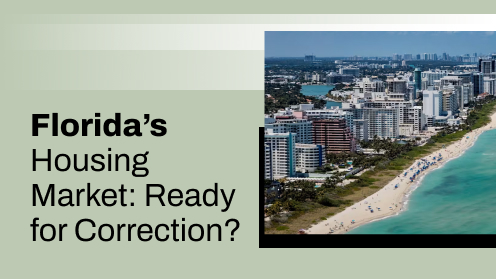
Florida’s Housing Market: Ready for Correction?
Florida’s real estate market has been one of the most closely watched in the nation over the past several years. A surge of new residents, remote workers, and retirees relocating from higher-cost states fueled a dramatic run-up in home prices across much of the Sunshine State. But as with any rapid expansion, questions naturally arise about sustainability — and now, data is beginning to signal that certain Florida counties may be approaching a meaningful shift.
7 counties in Florida are identified as high risk of housing market corrections, including Charlotte, Hernando, Lake, Marion, Pasco, Polk, and St. Lucie counties. Rapid population growth has led to potential overbuilding and affordability concerns in key Florida regions.
Which Counties Are Flagged — and Why It Matters
Seven Florida counties have been identified as carrying elevated risk of a housing market correction: Charlotte, Hernando, Lake, Marion, Pasco, Polk, and St. Lucie. For residents of the Treasure Coast, that last name will stand out immediately. St. Lucie County sits just south of Martin County, making this a directly relevant concern for many families and investors in the broader Stuart area.
A housing market “correction” does not necessarily mean a crash. In plain terms, a correction is a meaningful pullback in home prices or sales activity after a period of outsized growth — a market finding its natural equilibrium. For homeowners, buyers, and investors alike, understanding why these counties are flagged is just as important as knowing which ones made the list.
The Two Core Drivers: Overbuilding and Affordability
Rapid population growth has led to potential overbuilding and affordability concerns in key Florida regions. These two forces often work in tandem, and they deserve a closer look.
Overbuilding
When a region grows quickly, developers respond by building — new subdivisions, townhome communities, and apartment complexes all race to meet demand. In the short term, this activity supports local employment and tax revenue. Over time, however, if construction outpaces actual household formation, supply can exceed demand. When that happens, sellers compete more aggressively for a shrinking pool of buyers, and prices tend to soften. Many of the flagged counties experienced exactly this kind of accelerated construction during the peak migration years, and the pipeline of new inventory may still be working its way through the market.
Affordability Concerns
Rising home prices, when combined with higher mortgage rates, can push ownership out of reach for a significant portion of local residents. When the pool of qualified buyers contracts, demand weakens — and prices must eventually adjust to reflect what the local workforce can actually support. In counties like Polk, Marion, and Hernando, median household incomes tend to be more modest relative to the home prices that took hold during the boom years. That gap between what homes cost and what residents earn is a key metric analysts watch when assessing correction risk.
What a Correction Could Mean for Homeowners and Investors
If you own property in one of these seven counties — or are considering a purchase — a measured, informed perspective is more useful than alarm. Here are several practical dimensions to consider:
For Current Homeowners
- Equity cushion matters. Homeowners who purchased well before the recent price run-up likely still hold meaningful equity even if values moderate. Understanding your current loan-to-value ratio gives you a clearer picture of your actual financial position.
- Time horizon is everything. Real estate has historically rewarded patient, long-term owners. A correction that plays out over a period of months or years looks very different depending on whether you plan to sell soon or stay in your home for a decade or more.
- Insurance and carrying costs deserve attention. Florida homeowners have faced rising property insurance premiums alongside property value appreciation. A softening market does not automatically reduce these carrying costs, so a full accounting of ongoing expenses is essential.
For Prospective Buyers
- A correction can create opportunity. Buyers who were priced out during peak demand may find that a market adjustment opens doors that were previously closed. That said, timing any market — housing included — is notoriously difficult, and purchasing a home primarily as a financial speculation carries its own risks.
- Focus on fundamentals. Location quality, structural condition, neighborhood trajectory, and the strength of local employment all matter more over the long run than catching a precise market bottom.
- Get pre-qualified with realistic numbers. Work with a lender before you shop, so you have a clear picture of what you can comfortably carry — not just what you qualify for on paper.
For Real Estate Investors
- Cash flow versus appreciation. In a market that may be shifting from appreciation-driven to income-driven, properties that generate positive cash flow at current rents take on greater importance relative to those bought on the assumption of continued price gains.
- Portfolio context. Real estate holdings don’t exist in isolation. How a property fits within your broader financial plan — including liquidity needs, tax situation, and overall asset allocation — is a conversation worth having with your financial adviser.
The Broader Florida Picture
It is worth noting that Florida is not a monolithic market. While the seven flagged counties face elevated correction risk, other parts of the state — including areas with tighter supply, stronger job markets, or more affluent buyer pools — may follow a different trajectory. Martin County and the broader Treasure Coast have their own supply-and-demand dynamics that don’t necessarily mirror inland or faster-growing corridors.
Florida’s long-term fundamentals — a business-friendly tax environment, continued in-migration, and a year-round climate that attracts retirees — have not disappeared. What has changed is the pace of growth and the affordability equation, both of which warrant a more careful, eyes-open approach to real estate decisions than the frenzy of recent years may have encouraged.
How This Connects to Your Overall Financial Plan
For many Florida families, real estate represents a substantial portion of their total net worth. That concentration of wealth in a single asset class — one that is illiquid, location-specific, and subject to local market forces — is itself a financial planning consideration. A fee-based fiduciary adviser can help you evaluate how your real estate holdings interact with your investment portfolio, retirement timeline, insurance coverage, and estate planning goals.
At Davies Wealth Management, we work with clients throughout the Treasure Coast and Stuart area to bring that kind of integrated perspective to their financial lives. Whether you own property in one of the flagged counties, are thinking about buying, or simply want to understand how housing market dynamics might affect your broader financial plan, a candid, personalized conversation is the right starting point.
Key Takeaway
Seven Florida counties — including St. Lucie, right next door to the Treasure Coast — have been flagged for elevated housing correction risk, driven by overbuilding and affordability concerns that followed a period of rapid population growth. A correction is not the same as a collapse, but it does call for a thoughtful reassessment of how real estate fits within your overall financial picture. Understanding the dynamics at play, keeping a long-term perspective, and connecting your property decisions to your broader financial goals is the most practical path forward.
This content is for educational purposes only and does not constitute investment advice. Past performance is not indicative of future results. Advisory services offered through Davies Wealth Management, a Registered Investment Adviser. Please consult a qualified financial, tax, or legal professional regarding your specific situation.
Leave a Reply