


Estate planning is one of the most consequential — and most frequently underestimated — disciplines in personal finance. For families with $5 million or more in investable assets, a basic will and a revocable living trust are not a plan. They are a starting point. The gap between what most people have in place and what they actually need can mean hundreds of thousands — or even millions — of dollars lost to unnecessary taxes, probate delays, and family disputes.
This guide is written specifically for executives, business owners, and retirees with complex estates. If your situation includes concentrated stock positions, a closely held business, real estate holdings, charitable intentions, or multi-generational goals, this is the estate planning conversation you need to be having.
Why $5M+ Estates Face a Different Set of Challenges
The Estate Tax Landscape Every High-Net-Worth Family Should Understand
The federal estate tax exemption is one of the most important numbers in estate planning today. The One Big Beautiful Bill Act, signed into law on July 4, 2025, made the increased exemption permanent. For 2026, the per-person federal exemption is $15,000,000, with inflation indexing resuming in 2027 (using 2025 as the base year). There is no sunset, no reversion, and no expiration of this amount.
For a married couple, that means a combined exemption of $30,000,000 — but only if portability is properly elected. Estates above that threshold face a 40% federal estate tax on every dollar over the limit. For a family with a $40 million estate, proper planning can substantially reduce or eliminate that exposure. Even for estates well below the federal threshold, state-level estate taxes and income tax considerations make advanced planning worthwhile.
Consult a qualified estate planning attorney and tax professional for your specific situation, as tax law is always subject to future legislative change.
How HNW Estate Planning Differs from Mass-Market Planning
Most financial content about estate planning is written for households with $500,000 or less in total assets. That advice — get a will, name beneficiaries, create a power of attorney — is necessary but insufficient for affluent families. Here is a direct comparison:
| Planning Element | Mass-Market Approach | HNW $5M+ Approach |
|---|---|---|
| Core Documents | Will, POA, healthcare directive | Revocable trust, ILIT, GRAT, dynasty trust |
| Tax Strategy | Beneficiary designations, simple gifting | Annual exclusion gifting, 529 superfunding, QPRTs, SLATs |
| Charitable Planning | Direct bequests to charity in will | CRTs, CLTs, DAFs, private foundations |
| Business Interests | Named in will, no transfer planning | Buy-sell agreements, FLPs, installment sales to grantor trusts |
| Primary Risk | Probate, family conflict | 40% estate tax, generation-skipping tax, liquidity crisis |
The strategies in the right column are not exotic. They are standard tools for any estate planning attorney working with affluent families. Yet they remain largely unknown to individuals who have outgrown the advice they received when their wealth was still accumulating.

Strategy 1: The Irrevocable Life Insurance Trust (ILIT)
Using Life Insurance to Solve the Liquidity Problem in Estate Planning
One of the most overlooked challenges in estate planning for illiquid estates — those with concentrated stock, real estate, or a business — is the liquidity problem. When an estate owes taxes, the IRS does not wait for assets to sell at favorable prices. Heirs may be forced to liquidate at the wrong time or at a discount.
An Irrevocable Life Insurance Trust (ILIT) holds a life insurance policy outside of your taxable estate. The death benefit passes to heirs income-tax-free and estate-tax-free, providing immediate liquidity to cover estate taxes or equalize inheritances among children who receive different asset types.
For a $10 million estate, a properly structured ILIT could provide $2–4 million in tax-free liquidity without reducing the assets transferred to heirs. The key is that the trust — not you — must own and apply for the policy. Consult a qualified insurance and estate planning professional before implementing.
Strategy 2: Grantor Retained Annuity Trusts (GRATs)
How GRATs Shift Appreciation Out of Your Taxable Estate
A Grantor Retained Annuity Trust (GRAT) is one of the most effective estate planning tools available for transferring appreciation to the next generation with little or no gift tax cost. Here is how it works in plain terms:
- You transfer assets — often appreciated stock or a business interest — into an irrevocable trust.
- You receive an annuity payment back each year for a set term (typically 2–10 years).
- At the end of the term, any growth above the IRS hurdle rate (called the 7520 rate) passes to your heirs gift-tax-free.
In a higher interest rate environment, the 7520 rate increases, making GRATs somewhat less efficient — but they remain valuable for assets expected to appreciate significantly. Short-term, rolling GRATs are a common strategy used by executives with concentrated positions in company stock following a vesting event or liquidity event.
According to IRS guidance on GRATs and annuity trusts, the rules governing these structures require careful attention to annuity payment timing and valuation. Work with a qualified estate planning attorney on implementation.
Strategy 3: Spousal Lifetime Access Trusts (SLATs)
Using Your Exemption Strategically Through a SLAT
With the current federal exemption at $15,000,000 per person, families with estates approaching or exceeding that level have meaningful planning opportunities. A Spousal Lifetime Access Trust (SLAT) allows one spouse to make a gift to an irrevocable trust that benefits the other spouse — effectively removing that amount from both spouses’ taxable estates while the beneficiary spouse retains indirect access to the assets.
The primary benefit: you use your exemption proactively, sheltering assets from future appreciation that could otherwise push your estate above the threshold. Gifts properly made into a SLAT are protected even if future law changes the exemption amount.
The primary risk: if the marriage ends in divorce, the beneficiary spouse retains trust benefits while the grantor spouse does not. This is why SLATs require careful drafting and are not appropriate for every family. Consult a qualified estate planning attorney before proceeding.
Dynasty Trusts: Multi-Generational Estate Planning
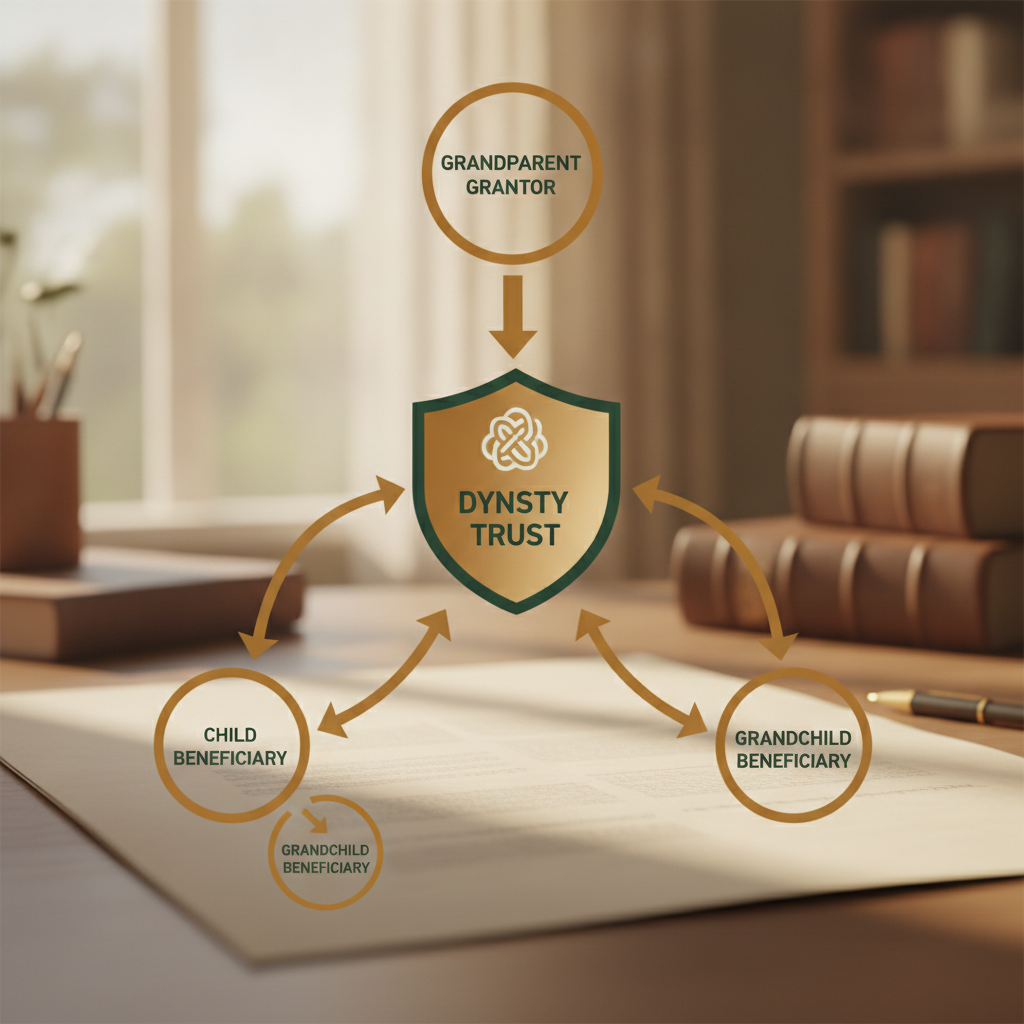
Florida is one of the most favorable states in the country for dynasty trusts — irrevocable trusts designed to hold assets for multiple generations, potentially 360 years or more under current Florida law. Assets inside a properly structured dynasty trust can avoid estate taxes at each generational transfer, compounding the tax savings dramatically over time.
For families with significant wealth and a goal of multi-generational impact, a dynasty trust combined with annual gifting, business interests, or life insurance can create a family wealth structure that preserves capital across decades. Our comprehensive wealth management services include coordination with estate planning attorneys who specialize in these structures.
Strategy 4: Charitable Planning Tools for High-Net-Worth Donors
Charitable Remainder Trusts as an Estate Planning and Income Tool
A Charitable Remainder Trust (CRT) is one of the most powerful — and most underused — tools in estate planning for wealthy donors. A CRT allows you to:
- Transfer appreciated assets into a trust, avoiding immediate capital gains tax on the sale
- Receive an income stream (annuity or unitrust payment) for your lifetime or a specified term
- Receive a partial charitable income tax deduction in the year of the gift
- Pass the remainder to one or more qualified charities at death
For a client with a $3 million block of highly appreciated stock — with a cost basis of $200,000 — a CRT can be transformational. Rather than selling the stock and paying capital gains tax of 23.8% (federal long-term rate plus net investment income tax), the trust sells the stock tax-free and reinvests the full proceeds, generating a larger income stream over time.
The IRS provides detailed guidance on charitable remainder trusts, including minimum payout requirements and permissible asset types. Fidelity’s charitable planning resources also offer a useful overview of how CRTs compare to donor-advised funds.
Donor-Advised Funds and Private Foundations for Legacy Planning
For donors who want flexibility without the irrevocability of a CRT, a Donor-Advised Fund (DAF) is an accessible and highly effective estate planning complement. You contribute assets — including appreciated stock or real estate — take an immediate deduction, and recommend grants to charities over time.
For families with more than $5–10 million in charitable intent, a private foundation offers greater control, the ability to employ family members, and the capacity to build a named philanthropic legacy. The tradeoff is administrative cost and regulatory oversight. A DAF is typically the right starting point; a private foundation makes sense when philanthropic activity is substantial and ongoing.
Strategy 5: Business Succession and Family Limited Partnerships
Estate Planning for Business Owners with Illiquid Interests
For business owners, estate planning and business succession planning are inseparable. A closely held business that represents 60–80% of your net worth creates enormous estate tax exposure and a potential forced sale if no succession structure is in place.
Common tools for business owners include:
- Buy-sell agreements funded with life insurance, ensuring a market exists for the business interest at death
- Installment sales to grantor trusts (IDGTs), allowing the business to be sold to a trust without recognizing capital gains immediately
- Family Limited Partnerships (FLPs), which can provide valuation discounts of 20–40% for estate tax purposes while consolidating family assets under professional management
- Employee Stock Ownership Plans (ESOPs), which can provide liquidity while offering significant tax benefits under IRS Section 1042 rules
The valuation discount available through an FLP or Family Limited Liability Company (FLLC) is one of the most significant estate planning advantages available to business owners. A $5 million business interest might be valued at $3.5 million for gift tax purposes when transferred through a properly structured entity — a $1.5 million reduction in taxable transfer with no out-of-pocket cost.
Strategy 6: Advanced Tax Planning Integrated with Estate Planning
Roth Conversion Ladders and Estate Planning for Inherited IRAs
The SECURE Act 2.0 changed the inherited IRA landscape permanently. Most non-spouse beneficiaries must now distribute an inherited IRA within 10 years — compressing what used to be a “stretch IRA” strategy into a decade. For heirs in high tax brackets, this can mean enormous income tax acceleration.
One powerful response is a multi-year Roth conversion strategy executed during your lifetime. By systematically converting traditional IRA assets to Roth, you:
- Pay income taxes now, at known rates, rather than forcing heirs to pay at unknown future rates
- Remove future required minimum distributions (RMDs) from your taxable income, reducing Medicare IRMAA exposure
- Transfer a tax-free asset to heirs who can take tax-free distributions over 10 years
For a client with a $3 million IRA, converting $200,000–$400,000 per year over a decade can shift the tax burden to a period of known, controllable rates. Consult a qualified tax professional before executing Roth conversions, as they increase taxable income in the conversion year and may affect IRMAA thresholds, Medicare premiums, and other income-tested benefits.
IRMAA Awareness in Estate Planning Distributions
Medicare’s Income-Related Monthly Adjustment Amount (IRMAA) surcharges apply to individuals with Modified Adjusted Gross Income (MAGI) above $109,000 (single) or $218,000 (married filing jointly) in 2026. Large IRA distributions — whether voluntary or from required minimum distributions — can push retirees into higher IRMAA tiers, adding thousands of dollars annually to Medicare Part B and D premiums.
Thoughtful estate planning that accounts for distribution sequencing, Roth conversion timing, and charitable giving (including Qualified Charitable Distributions for those over 70½) can significantly reduce this exposure over a multi-year retirement horizon.

Strategy 7: Coordinating Estate Planning with Your Overall Wealth Plan
Why Estate Planning Should Not Be a One-Time Event
One of the most common mistakes high-net-worth families make is treating estate planning as a checklist item rather than an ongoing discipline. Tax law changes, family circumstances evolve, asset values shift, and the strategies that were optimal five years ago may be suboptimal — or even counterproductive — today.
An effective estate plan for a $5M+ portfolio should be reviewed at minimum every three years, and immediately following:
- Major liquidity events (business sale, IPO, large inheritance)
- Changes in tax law
- Marriage, divorce, or the birth of grandchildren
- A move to a new state (especially relevant for Florida residents, who benefit from no state income tax and no state estate tax)
- Significant changes in investment portfolio value or asset composition
The Role of a Fee-Based Fiduciary in Estate Planning Coordination
Estate planning involves multiple professionals: an estate planning attorney, a CPA, and a financial advisor. The critical factor is whether these professionals are communicating with each other and coordinating strategy — or operating in silos.
With complex estates, the most expensive mistakes rarely come from bad individual advice. They come from a lack of coordination between advisors. An attorney drafts a trust without knowing the IRA beneficiary designations will override it. A CPA recommends a Roth conversion without knowing the client’s SLAT was funded with enough taxable assets to cover the tax. A broker holds concentrated stock without knowing the estate plan depends on a step-up in basis at death.
A fee-based fiduciary — one who is legally obligated to act in your interest and is not compensated by product sales — is uniquely positioned to serve as the coordinating hub of your estate plan. If you are ready to schedule a discovery conversation, we would welcome the opportunity to evaluate whether your estate plan and wealth management strategy are truly aligned.
For additional perspective on how leading estate planning strategies are evolving, Kiplinger’s estate planning coverage is a valuable ongoing resource.
Frequently Asked Questions About Estate Planning for High-Net-Worth Families
What is the federal estate tax exemption for 2026?
The federal estate tax exemption for 2026 is $15,000,000 per individual, or $30,000,000 for married couples using portability. This amount was made permanent by the One Big Beautiful Bill Act, signed July 4, 2025, with inflation indexing resuming in 2027. Estates above this threshold are subject to a 40% federal estate tax on the excess. Consult a qualified estate planning attorney for your specific situation.
Do I need estate planning if my estate is below the federal exemption?
Yes. Estate planning is about far more than minimizing federal estate taxes. It governs who manages your affairs if you are incapacitated, how your assets are distributed without probate, who cares for minor children, and how business interests are transferred. Even estates well below the federal threshold benefit substantially from proper trust and beneficiary planning.
What is the difference between a revocable trust and an irrevocable trust in estate planning?
A revocable trust can be changed or dissolved by the grantor at any time and does not provide estate tax protection — assets in a revocable trust are still part of your taxable estate. An irrevocable trust, once funded, generally cannot be changed and removes assets from your taxable estate, which is why structures like ILITs, SLATs, and GRATs use irrevocable trusts as their foundation.
How does estate planning interact with retirement accounts like IRAs and 401(k)s?
Retirement accounts pass by beneficiary designation, not by will or trust — making those designations among the most important documents in your estate plan. Under SECURE Act 2.0 rules, most non-spouse beneficiaries must deplete inherited IRAs within 10 years, which can create significant income tax acceleration for heirs. Roth conversion strategies and careful beneficiary designation planning are essential components of estate planning for anyone with a significant retirement account balance.
Is Florida a good state for estate planning?
Florida is exceptionally favorable for estate planning. The state has no state income tax, no state estate tax, and no state inheritance tax. Florida also allows dynasty trusts with very long trust terms, offers strong homestead protections, and has a favorable creditor protection environment for certain trust structures. For high-net-worth individuals, Florida residency combined with proactive federal estate planning creates one of the most tax-efficient wealth transfer environments in the country.
Taking the Next Step in Your Estate Planning
If your estate exceeds $5 million — or is on a trajectory to do so — the strategies covered here represent the difference between a plan and a hope. Proper estate planning at this level is not a one-time legal exercise. It is an ongoing, coordinated discipline that integrates tax strategy, investment management, charitable intent, and family legacy into a coherent whole.
The families who transfer wealth most effectively are not necessarily those who earned the most. They are the ones who planned with intention, worked with fiduciary advisors, and revisited their strategies as circumstances evolved. That conversation starts now.
📋 Take Our Financial Wellness Quiz
Not sure if your current estate plan is keeping pace with your wealth? Our Financial Wellness Quiz helps identify gaps in your planning — including estate, tax, and investment coordination — in under five minutes.
Ready for personalized guidance from a fee-based fiduciary?
Davies Wealth Management serves high-net-worth individuals, executives, and business owners in Stuart, Florida and beyond. We welcome a complimentary phone call to explore whether our approach is a fit for your situation.
This content is for educational purposes only and does not constitute investment advice. Past performance is not indicative of future results. Advisory services offered through Davies Wealth Management, a Registered Investment Adviser. Please consult a qualified financial, tax, or legal professional regarding your specific situation.
Leave a Reply