


When you see a line on your investment statement labeled “advisory fee,” most people glance past it. But if you have a portfolio of $1 million, $5 million, or more, understanding asset management pay — what it actually buys you, and whether you’re getting full value — may be one of the most financially consequential decisions you make. A 1% annual fee on a $5 million portfolio is $50,000 per year. Over 20 years, that compounds into real money. The question is never whether you pay; the question is whether what you receive is worth it.
This post breaks down what sophisticated investors are actually purchasing when they hire a wealth manager, why the fee structure matters as much as the fee amount, and how to tell whether your current arrangement is genuinely serving your financial life — or simply managing your investment in a spreadsheet.
What Does “Asset Management Pay” Actually Mean?
The term asset management pay typically refers to the compensation a firm or advisor receives in exchange for managing your investments and financial life. It’s the collective cost of professional wealth oversight, and it takes several forms depending on how your advisor is structured.
The Three Primary Fee Structures
- AUM-based fees: A percentage of assets under management, commonly ranging from 0.50% to 1.25% annually for HNW clients, often declining at higher thresholds.
- Flat or retainer fees: A fixed annual dollar amount regardless of portfolio size — increasingly common for very large or complex relationships.
- Hourly or project-based fees: Charged for specific engagements such as financial plan creation or estate plan review.
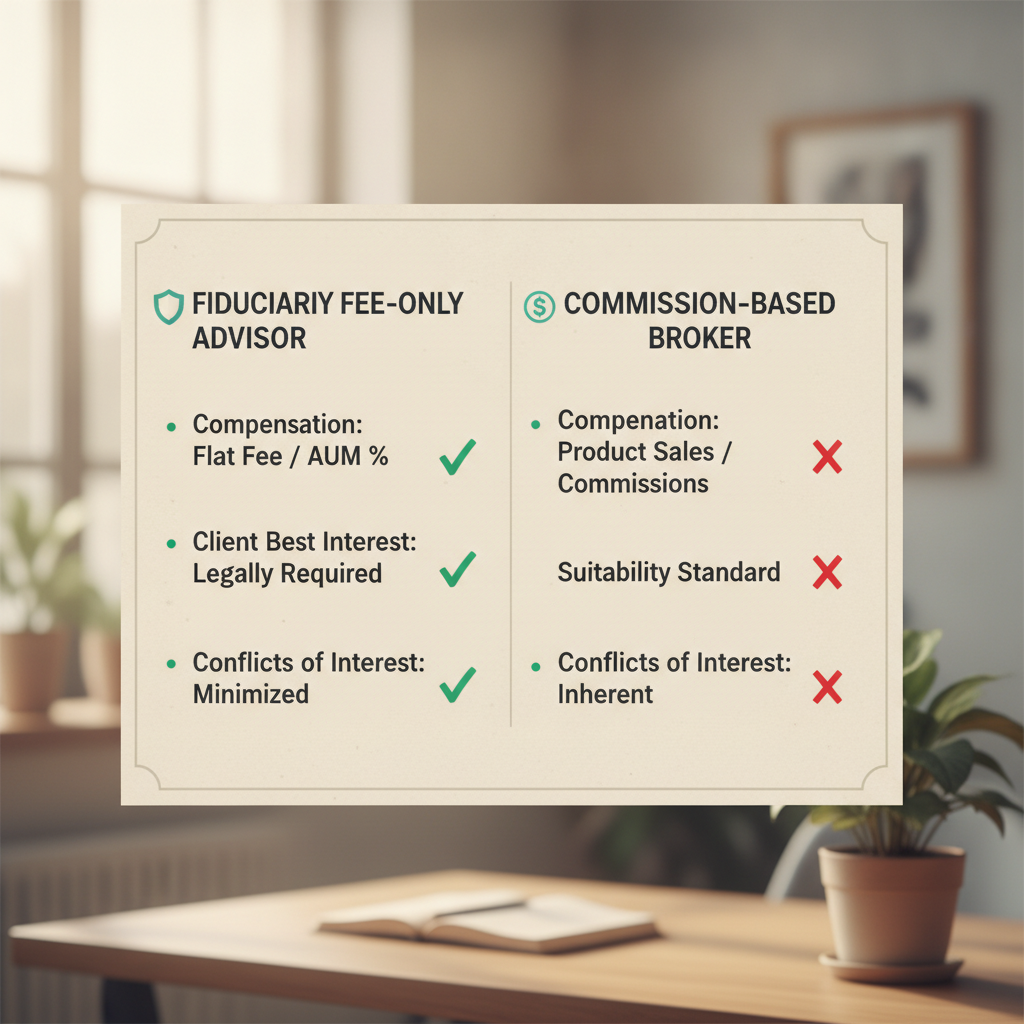
What you almost never want to pay: commissions embedded inside products. This is the hallmark of a broker or insurance agent, not a fiduciary. When compensation is tied to what gets sold to you, conflicts of interest are structurally inevitable.
Why Asset Management Pay Is Different for High-Net-Worth Investors
A mass-market investor with a $150,000 IRA has relatively straightforward needs: diversified funds, periodic rebalancing, and basic retirement projections. The math and the advice are mostly the same regardless of who provides it.
An executive with $4 million in a concentrated stock position, a nonqualified deferred compensation plan, restricted stock units, a business interest, and two states of potential residency is an entirely different situation. The complexity multiplies at higher wealth levels — and so does the value of getting it right (and the cost of getting it wrong).

Layer 1: Investment Management — The Visible Part of Asset Management Pay
Most clients think of investment management when they think about what they’re paying for. It is the most visible component of asset management pay, but it is often not the most valuable one.
What Quality Investment Management Includes
- Constructing and maintaining a diversified, risk-appropriate portfolio across asset classes
- Rebalancing systematically without triggering unnecessary taxable events
- Monitoring factor exposures, liquidity, and downside risk across the full balance sheet
- Access to institutional share classes, alternative investments, or direct indexing strategies typically unavailable to retail investors
For a $3 million portfolio, the difference between institutional pricing and retail mutual fund expense ratios can easily save 0.30–0.50% annually — which partially offsets the advisory fee itself.
Direct Indexing: A Strategy Only Worth Discussing at Scale
Direct indexing — owning individual securities in an index rather than a fund — enables highly customized tax-loss harvesting at the individual stock level. It is generally not practical below $500,000, and the benefits accelerate significantly above $1 million. This is an example of a strategy where asset management pay at the HNW level can generate tax alpha that genuinely exceeds the advisory fee.
According to Morningstar research, tax-loss harvesting strategies can add meaningful after-tax value for investors in high marginal brackets — a category that includes most of our clients.
Layer 2: Tax Planning — Where Asset Management Pay Often Pays for Itself
This is where the value gap between a fiduciary wealth manager and a basic brokerage account becomes undeniable. Tax planning is not something your 401(k) provider does for you. It is not something a transactional broker prioritizes. But for a high-income earner or retiree with $2 million or more, proactive tax strategy is often worth multiples of the advisory fee.
Roth Conversion Ladders and IRMAA Avoidance
A retired executive with $3 million in traditional IRA assets faces a future of potentially enormous required minimum distributions. Without planning, those RMDs could push income well into the highest brackets and trigger Medicare IRMAA surcharges — which in 2026 can add thousands of dollars per year to Medicare Part B and D premiums for individuals above certain income thresholds.
A structured Roth conversion strategy, executed carefully over multiple years in coordination with other income sources, can meaningfully reduce lifetime tax exposure. This is not theoretical — it is an active, ongoing service that a qualified fiduciary performs.
Learn more about how Medicare income thresholds interact with your investment decisions from the IRS and our detailed breakdown of IRMAA planning strategies.
Tax-Loss Harvesting, Charitable Giving, and QCD Stacking
For investors 70½ and older, Qualified Charitable Distributions (QCDs) allow up to $105,000 per year (indexed for inflation) to be transferred directly from an IRA to a qualified charity — satisfying RMD requirements without the income being recognized. For someone in a high bracket making regular charitable contributions, this alone can save a meaningful amount annually.
Combine that with strategic tax-loss harvesting, charitable remainder trusts, and donor-advised fund contributions, and you have a coordinated tax reduction strategy that a generalist broker simply cannot deliver.
Layer 3: Financial Planning — The Architecture Behind the Numbers
Asset management pay at a true fiduciary firm buys you more than portfolio management. It buys you a comprehensive financial planning process that integrates every dimension of your financial life.
What a Real Financial Plan Covers at the HNW Level
- Cash flow modeling: Multi-year projections that account for variable income, RSU vesting, business distributions, and spending patterns
- Insurance analysis: Identifying gaps or redundancies in life, disability, umbrella, and long-term care coverage
- Social Security optimization: Determining the ideal claiming age given longevity, other income, and spousal benefits
- Business owner planning: Evaluating exit strategies, buyout structures, qualified retirement plan design, and succession timing
- Concentrated stock management: Using options overlays, exchange funds, or charitable strategies to reduce single-stock risk without a catastrophic tax event
Our comprehensive wealth management services integrate all of these planning dimensions under one coordinated strategy — not as separate engagements you have to stitch together yourself.

Layer 4: Estate and Legacy Planning — Permanent Certainty in 2026
One of the most significant developments in estate planning is the permanence now afforded by current law. The federal estate and gift tax exemption has been made permanent at $15 million per individual and $30 million per married couple, indexed for inflation going forward. This is settled law — there is no scheduled sunset, no deadline to act before a reversion, and no manufactured urgency.
Why Estate Planning Still Matters Without a Deadline
The permanence of the exemption is genuinely good news. But it does not mean estate planning has become optional. Families with significant wealth still face important decisions:
- State-level estate taxes: Many states have their own estate taxes with much lower exemptions. Florida has none — one reason we see significant relocation interest from clients in high-tax states.
- Step-up in basis planning: Deciding which assets to hold until death (to receive a step-up) versus gift during life (carrying over your cost basis) is a nuanced calculation that varies by family.
- Trust structures: Dynasty trusts, spousal lifetime access trusts (SLATs), and irrevocable life insurance trusts (ILITs) remain powerful tools for multi-generational wealth transfer, asset protection, and income shifting.
- Portability elections: Surviving spouses must file an estate tax return to preserve the deceased spouse’s unused exemption — even when no tax is owed. Missing this deadline is an irreversible error.
The SEC and financial planning best practices both recognize that estate planning is a continuous process, not a one-time event triggered by a tax deadline.
Asset Management Pay and Estate Coordination
A fiduciary wealth manager who earns their asset management pay coordinates directly with your estate attorney and CPA. They ensure that beneficiary designations align with your trust documents, that titling is correct, and that gifting strategies are executed in a tax-efficient sequence. This coordination work — often invisible — is where significant value lives.
Layer 5: Behavioral Coaching — The Unglamorous Value Driver
Decades of investor behavior research, including work from Vanguard’s Advisor’s Alpha studies, suggest that behavioral coaching from an advisor can add meaningful value by preventing costly emotional decisions — panic selling in a downturn, over-concentration in a hot sector, or excessive conservatism in early retirement.
What Behavioral Coaching Looks Like in Practice
For HNW investors, behavioral mistakes are larger in absolute dollar terms. A $5 million investor who moves to cash in a market correction and misses a recovery has made a decision that could cost hundreds of thousands of dollars in long-term value. An advisor who provides a rational, evidence-based framework during volatile periods may more than justify an entire year’s asset management pay in a single conversation.
This is not about hand-holding. It is about having a trusted professional who knows your full financial picture, your goals, your timeline, and your risk tolerance — and who can speak to all of them clearly when markets are uncomfortable.
What the Fee Table Actually Looks Like: A Comparison
To make this concrete, here is how asset management pay varies across different advisor types and what each model typically delivers:
| Advisor Type | Typical Fee Structure | Fiduciary? | Tax Planning Included? | Best For |
|---|---|---|---|---|
| National Brokerage / Wirehouse | 1.0–1.5% AUM + embedded product fees | Not always | Rarely | Mass-affluent ($250K–$750K) |
| Robo-Advisor | 0.25–0.50% AUM | Technically yes | Basic tax-loss harvesting only | Accumulators, simple portfolios |
| Commission-Based Broker | Commissions on trades/products | No | No | Transactional investors |
| Fee-Based Fiduciary RIA | 0.50–1.0% AUM (declining tiers) | Yes — legally required | Yes — integrated | HNW families $1M–$10M+ |
| Family Office / Ultra-HNW | Flat retainer or custom | Yes | Comprehensive — full team | $25M+ families |
The key takeaway: asset management pay at a fee-based fiduciary RIA is structured to align with your outcomes, not with product sales. That alignment is the foundational difference.
How to Evaluate Whether Your Asset Management Pay Is Justified
Asking whether you’re getting value for your advisory fees is not just fair — it’s financially responsible. Here are the questions every HNW investor should be able to answer.
The 5 Questions to Ask Your Advisor
- Are you a fiduciary, always — not just sometimes? Some advisors hold dual registrations that allow them to switch between fiduciary and suitability standards. Know which standard applies when.
- How are you compensated, and by whom? If the answer involves product commissions, referral fees, or revenue sharing, that is relevant information.
- What tax strategies have you implemented for me in the last 12 months? If your advisor cannot answer this specifically, tax planning may not be happening.
- How does my plan account for my specific income sources, entity structures, and estate goals? Generic plans are not worth premium asset management pay.
- What would change about my plan if I moved to Florida, retired early, or sold my business? A real fiduciary should have a ready answer.
What “Comprehensive” Should Actually Mean
In my experience working with executives and business owners, the clients who feel most confident about their asset management pay are those receiving genuinely integrated advice — not separate conversations with a financial advisor, a CPA, and an estate attorney who have never spoken to each other. Coordination is a deliverable, not an accident.
If you’re ready to evaluate your current arrangement or explore what truly integrated wealth management looks like, schedule a discovery conversation with our team.
Frequently Asked Questions About Asset Management Pay
What is a reasonable asset management pay rate for a $2 million portfolio?
For a $2 million portfolio with a fee-based fiduciary RIA, a reasonable asset management pay rate typically falls between 0.75% and 1.0% annually, depending on the complexity of services included. At this level, you should expect comprehensive financial planning, proactive tax strategy, and estate coordination — not just investment management. Always confirm what services are explicitly included in your fee agreement.
How does asset management pay differ between a fiduciary and a broker?
A fiduciary is legally required to act in your best interest at all times, and their asset management pay is transparent and disclosed. A broker operates under a suitability standard, meaning recommendations only need to be suitable for you — not necessarily optimal — and compensation may include embedded commissions that are harder to see. For high-net-worth investors, this distinction has significant long-term financial implications.
Is asset management pay tax deductible?
Under current law, investment advisory fees paid on taxable accounts are generally not deductible for federal income tax purposes following changes made in recent years. Fees attributable to tax advice or planning within certain structures may have different treatment. Consult a qualified tax professional for your specific situation, as deductibility depends on how fees are structured and what services they cover.
Can asset management pay actually generate a positive return on investment?
Yes — when advisory fees are applied to comprehensive planning rather than just investment management. Tax alpha from strategies like Roth conversions, direct indexing, QCDs, and loss harvesting can meaningfully exceed the advisory fee for investors in high tax brackets. Research from Vanguard and others suggests that behavioral coaching alone can add value by preventing costly emotional decisions during market volatility.
How do I know if my current asset management pay is competitive?
Compare not just the percentage but what the fee includes — investment management only, or full financial and tax planning? Ask your advisor to itemize the services your fee covers, then benchmark that against what a fee-based fiduciary RIA offers at a similar price point. If your current arrangement is investment-only with limited planning, you may be paying for less than you realize.
The Bottom Line: Asset Management Pay Is an Investment, Not Just an Expense
The most successful clients we work with stopped thinking of advisory fees as a cost line and started thinking of them as a strategic investment in their financial architecture. Asset management pay at a fiduciary RIA is not simply compensation for managing a portfolio. It is payment for proactive tax planning, behavioral discipline, estate coordination, insurance analysis, cash flow modeling, and the kind of integrated advice that prevents expensive mistakes.
For investors with $1 million, $5 million, or $10 million or more, the quality of that advice — and the structure of the fee relationship behind it — compounds over time just as surely as your portfolio does. Choosing the right fiduciary partner is not a minor decision. It is, in many cases, one of the highest-return choices available to you.
If you want to understand exactly what your current asset management pay is purchasing — and whether there is a better arrangement available — we’re here to help you think it through clearly, without pressure, and with any compensation fully disclosed.
Take the Next Step
Not sure if your current advisory fees are delivering full value? Take our Financial Wellness Quiz to assess the completeness of your current financial plan — and identify any gaps in your strategy that may be costing you.
Ready for personalized guidance from a fee-based fiduciary? Book a complimentary phone call with Davies Wealth Management today. We serve high-net-worth individuals, executives, professional athletes, and business owners from our Stuart, Florida offices and virtually nationwide.
This content is for general educational purposes only and does not constitute individualized investment advice. Past performance does not guarantee future results. Investment-advisory services are offered by Davies Wealth Management, LLC, an investment adviser registered with the State of Florida. Registration does not imply a certain level of skill or training. Please consult appropriately qualified financial, tax, or legal professionals regarding your specific circumstances.
Davies Wealth Management does not provide legal advice or tax-return-preparation services. Tax and estate-planning information is provided for general educational purposes and may become outdated. Figures and rules are current only as of the article’s stated review date. Verify current information with authoritative sources and consult a qualified tax professional or estate-planning attorney before acting.
Leave a Reply