


Why High-Net-Worth Investors Are Asking About Fixed Annuities Again
Are fixed annuities a good investment for retirement income — or just a product salespeople push? It’s a question worth examining carefully, especially for investors with $1 million or more in investable assets navigating today’s interest rate landscape.
🎧 Prefer to listen to the podcast or watch the video? Jump to listen to the podcast & watch the video.
After years of near-zero rates that made fixed annuities largely unattractive, the environment has shifted meaningfully. Crediting rates on multi-year guaranteed annuities (MYGAs) have climbed significantly, and sophisticated investors are paying attention. But higher rates don’t automatically make a product right for your situation.
This post offers a clear-eyed, education-first look at what fixed annuities are, how they work, where they fit in a high-net-worth portfolio, and — critically — where they fall short. The goal is to help you make an informed decision, not to sell you anything.

What Is a Fixed Annuity? A Plain-Language Explanation
The Core Mechanics of a Fixed Annuity
A fixed annuity is a contract between you and an insurance company. You deposit a lump sum — or a series of payments — and in return, the insurer credits your account with a guaranteed interest rate for a specified period. At the end of that period, you can renew, annuitize (convert to income), or withdraw your funds according to the contract terms.
Unlike variable annuities, where returns fluctuate with the market, a fixed annuity’s credited rate is locked in. Unlike indexed annuities, there is no participation in an equity index. The rate is what it is — predictable, contractually guaranteed, and backed by the claims-paying ability of the issuing insurance company.
Multi-Year Guaranteed Annuities (MYGAs): The CD Alternative
The most straightforward fixed annuity for HNW investors is the multi-year guaranteed annuity (MYGA). It functions similarly to a bank certificate of deposit: you lock in a rate for two to ten years, interest accumulates tax-deferred, and you receive your principal plus interest at maturity.
The key distinction from a CD is tax treatment. In a non-qualified (after-tax) MYGA, interest accumulates without annual taxation, which can be meaningful when you’re compounding $500,000 or more. With a CD, interest is taxable each year — even if you don’t withdraw it.
Immediate and Deferred Income Annuities
Beyond MYGAs, two other fixed annuity structures matter for retirement income planning:
- Single Premium Immediate Annuities (SPIAs): You deposit a lump sum and receive a guaranteed income stream starting within 12 months. Useful for covering non-negotiable expenses in retirement.
- Deferred Income Annuities (DIAs): Also called “longevity annuities,” these begin payments at a future date — often age 80 or 85 — providing insurance against outliving your assets.
Are Fixed Annuities a Good Investment in Today’s Rate Environment?
The Case for Fixed Annuities Has Strengthened
Asking whether fixed annuities are a good investment requires understanding that the answer changes with interest rates. When 10-year Treasury yields were near 1%, MYGAs were offering crediting rates in the 2-3% range — barely competitive with high-yield savings accounts. Today’s environment is different.
Competitive MYGA rates have risen substantially, in many cases exceeding what investors can find from FDIC-insured bank products of similar duration. For HNW investors who would otherwise hold a portion of their portfolio in fixed income or cash equivalents, a MYGA deserves a seat at the comparison table.
Tax-Deferred Compounding: The Math Advantage
For affluent investors in higher marginal tax brackets, tax deferral is not a minor footnote — it’s a material advantage. Consider the difference between a taxable CD and a MYGA when both carry similar rates:
- An investor in the 37% federal bracket who holds $500,000 in a 5-year CD at 5% pays taxes annually on approximately $25,000 of interest each year.
- The same investor in a MYGA defers that tax, allowing the full interest to compound — and controls when the income is recognized, potentially in a lower-bracket year.
Over five years, the compounding difference is not trivial. Tax deferral is most valuable when your current bracket is higher than your anticipated future bracket — a common situation for executives transitioning to retirement or business owners who have recently sold their companies.
Where Fixed Annuities Fall Short for High-Net-Worth Investors
Honest evaluation requires acknowledging the limitations. For investors with $1M+ in investable assets, several constraints matter:
- Liquidity restrictions: Most fixed annuities impose surrender charges — often 5-10% declining over 5-10 years. Tying up a significant portion of liquid capital has real opportunity cost.
- Inflation risk: A guaranteed 5% rate sounds attractive today. If inflation averages 4% over that period, your real return is modest. Fixed annuities offer no inflation adjustment unless specifically structured as inflation-linked products.
- Insurer credit risk: Unlike bank deposits, annuities are not FDIC-insured. They are backed by state guaranty associations (typically up to $250,000 per insurer in most states) and the insurer’s own claims-paying ability. HNW investors with $1M+ to place should spread exposure across multiple highly-rated carriers.
- Estate planning complexity: Death benefit provisions vary widely. Annuities do not receive a step-up in cost basis at death, which matters for HNW estates.
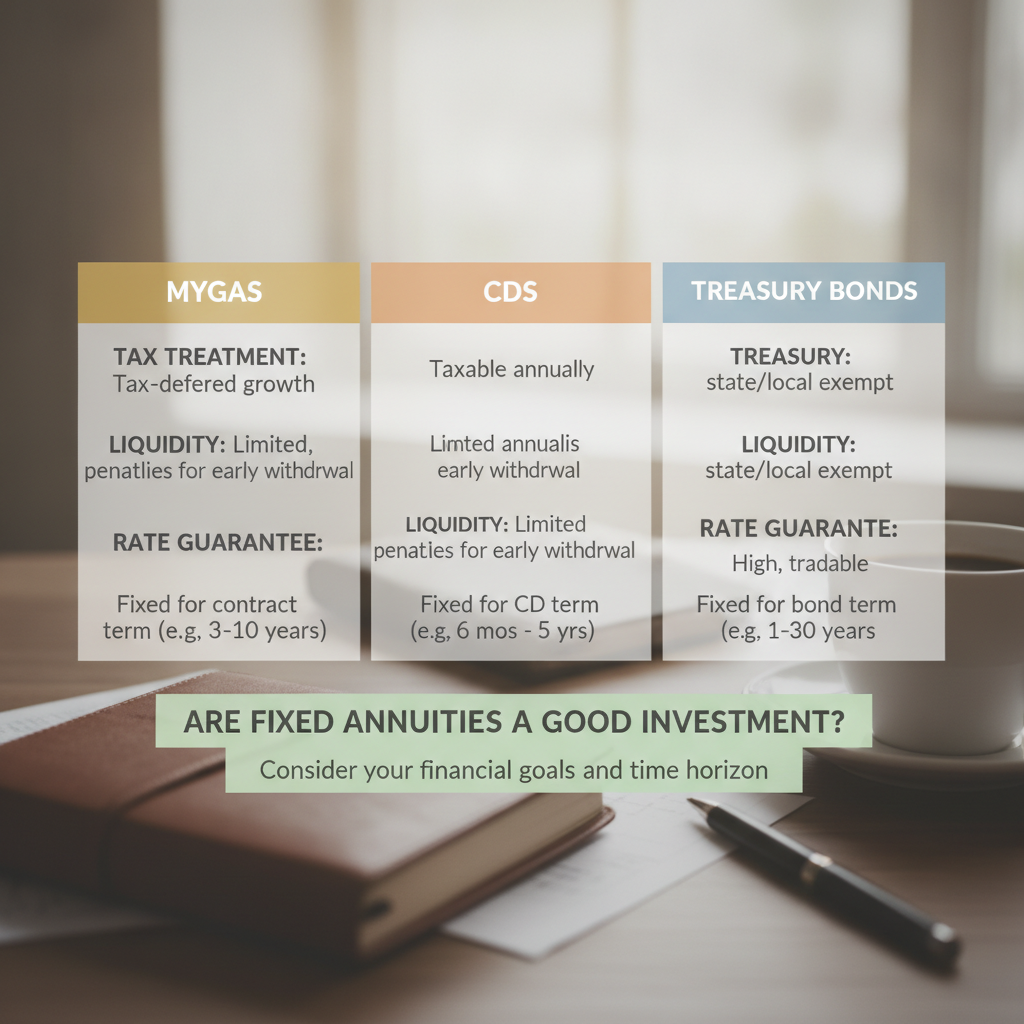
The HNW Comparison: Fixed Annuities vs. Other Conservative Alternatives
How Fixed Annuities Stack Up Against Common Alternatives
Mass-market financial media often compares fixed annuities to savings accounts or simple CDs. For high-net-worth investors, the relevant comparison set is broader. The table below offers a framework for thinking through the tradeoffs — though specific rates and terms change frequently and should be verified with current market data.
| Feature | MYGA (Fixed Annuity) | Treasury Bond / Note | Bank CD | Municipal Bond |
|---|---|---|---|---|
| Tax Treatment | Tax-deferred growth; ordinary income on withdrawal | Federal taxable; state/local exempt | Taxable annually (ordinary income) | Federal taxable; often state exempt |
| Liquidity | Limited; surrender charges apply | Highly liquid; marketable | Moderate; early withdrawal penalties | Moderate; depends on bond market |
| Inflation Protection | None (fixed rate) | TIPS offer inflation adjustment; standard Treasuries do not | None | None (fixed coupon) |
| Principal Guarantee | Yes (insurer backing + state guaranty) | Yes (U.S. government) | Yes (FDIC up to $250K) | No (issuer credit risk) |
| Estate / Basis Step-Up | No step-up; deferred gain taxable at death | Step-up in basis applies | Step-up in basis applies | Step-up in basis applies |
| State Guaranty Backstop | Yes (typically $250K/insurer) | Not applicable | Not applicable | Not applicable |
Note: This table is for educational comparison purposes. Rates, terms, and guaranty limits vary. Consult a qualified financial professional for your specific situation.
Why HNW Investors Need Different Advice Than Mass-Market Investors
Here’s the fundamental difference: a retiree with $300,000 in total assets who puts $100,000 into a MYGA is making a significant allocation decision that constrains their liquidity. A retiree with $5 million in investable assets who allocates $300,000 to a MYGA as part of a structured income sleeve is doing something qualitatively different — using a targeted tool within a broader plan.
For HNW investors, the question is rarely “should I buy a fixed annuity instead of stocks?” It’s “does a fixed annuity play a useful role in this specific layer of my income plan?” That’s a fundamentally different question requiring fundamentally different advice. It’s also why working with an advisor through comprehensive wealth management services — rather than a product-focused broker — changes the quality of the conversation.
7 Key Facts HNW Investors Should Know Before Buying a Fixed Annuity
Fact 1: Are Fixed Annuities a Good Investment for Tax Bracket Management?
Yes — when timed correctly. Because you control when you withdraw from a non-qualified annuity, you can defer recognition of income to years when your bracket is lower. This is especially useful for investors in the bridge period between retirement and required minimum distributions (RMDs) from IRAs and 401(k)s.
However, annuities inside an IRA or 401(k) offer no additional tax deferral benefit — the account is already tax-deferred. Placing an annuity inside a qualified account should be justified by other features, not by tax deferral, which you already have.
Fact 2: The 10% Penalty Rule Applies Before Age 59½
Withdrawals from an annuity before age 59½ are subject to a 10% federal early withdrawal penalty on top of ordinary income taxes, just as with IRAs. See IRS Publication 575 for the full rules governing pension and annuity income. This limits the flexibility of annuities for younger HNW investors who may need liquidity.
Fact 3: Carrier Ratings Matter More Than the Rate Alone
An annuity is only as good as the insurer behind it. When evaluating fixed annuities, always review the financial strength ratings from agencies such as A.M. Best, Moody’s, and S&P. A marginally higher rate from a lower-rated carrier is rarely worth the tradeoff. For large allocations, spreading capital across multiple highly-rated carriers is prudent.
Fact 4: The No-Step-Up Problem Matters More at $5M+ Estates
Assets held in a taxable brokerage account receive a step-up in cost basis at death, effectively eliminating capital gains taxes on appreciation for your heirs. Annuities do not. The deferred gain inside an annuity is taxable to beneficiaries as ordinary income when distributed.
For HNW families focused on multi-generational wealth transfer, this is a meaningful consideration. It doesn’t make fixed annuities categorically wrong — but it does argue for careful asset location decisions. Consult a qualified estate planning attorney and tax professional for your specific situation.
Fact 5: Are Fixed Annuities a Good Investment Inside a Broader Income Floor Strategy?
This is where fixed annuities make the most sense for sophisticated investors. The concept of an “income floor” — covering essential living expenses with guaranteed income sources — is well-documented in retirement income research, including work published by Morningstar on retirement income planning. Social Security, pension income, and annuity payments can together form a floor that frees the remainder of your portfolio to pursue growth without the pressure of meeting monthly cash needs.
Fact 6: Free Withdrawal Provisions and Liquidity Windows
Most fixed annuity contracts allow penalty-free withdrawals of 10% of account value per year without surrender charges. Understanding these provisions is essential before committing. For HNW investors, it’s also worth negotiating or selecting contracts with nursing home or terminal illness waivers, which provide liquidity in specific circumstances.
Fact 7: Annuity Commissions Are Possible and Should Be Disclosed
Fixed annuities are insurance products. When purchased through an advisor, commissions to the selling agent are typical — and should be transparently disclosed to you. At Davies Wealth Management, we operate as a fee-based fiduciary when providing investment advisory services, and any insurance commissions on annuity products are separately disclosed. Understanding how your advisor is compensated matters when evaluating any recommendation. The SEC provides investor resources on understanding advisor compensation structures.

Fixed Annuities and Estate Planning: What HNW Families Must Consider
How Fixed Annuities Interact With Your Estate Plan
With the federal estate and gift tax exemption now permanently set at $15,000,000 per individual and $30,000,000 per married couple — following the passage of the One Big Beautiful Bill Act in 2025 — most HNW families are not facing a federal estate tax problem. But estate planning still matters, and annuities add complexity.
Annuities pass to named beneficiaries outside of probate — which is an advantage. But the deferred income tax liability travels with the asset. A well-structured estate plan considers which assets to bequeath (those that get a step-up in basis, minimizing income tax) and which to spend down or give away during life (those with embedded ordinary income, like annuities).
Charitable Strategies Using Annuity Assets
For charitably inclined HNW investors, annuity assets can be directed to qualified charities at death, eliminating both the estate’s income tax liability and, if applicable, estate taxes. Some investors also use Charitable Remainder Trusts (CRTs) funded with appreciated or income-heavy assets. Consult a qualified estate planning attorney and tax advisor before implementing any trust strategy.
For more on how these strategies connect to comprehensive planning, explore our schedule a discovery conversation page to start a discussion.
Free Download
The Complete Florida Retirement Guide
A comprehensive, plain-English guide to retirement planning in Florida — income strategies, tax considerations, Social Security timing, and healthcare planning for Treasure Coast retirees.
Frequently Asked Questions About Fixed Annuities as an Investment
Are fixed annuities a good investment for retirees with $1M or more in assets?
Fixed annuities can be a useful component of a retirement income plan for HNW investors — particularly MYGAs used for tax-deferred accumulation, or income annuities used to establish a guaranteed income floor. They are rarely appropriate as a standalone investment for the entire portfolio and work best as one layer of a diversified strategy. Consult a qualified financial professional for guidance specific to your situation.
How are fixed annuity withdrawals taxed?
Withdrawals from a non-qualified fixed annuity are taxed using the “last in, first out” (LIFO) rule — earnings come out first and are taxed as ordinary income. Once the earnings are exhausted, remaining withdrawals represent a return of your original premium and are not taxable. See IRS Publication 575 for authoritative guidance on annuity taxation.
What is the difference between a fixed annuity and a fixed indexed annuity?
A fixed annuity credits a guaranteed interest rate with no market linkage. A fixed indexed annuity (FIA) credits interest based on the performance of an index — such as the S&P 500 — subject to caps, participation rates, or spreads. FIAs offer the potential for higher returns but with more complexity and typically no direct participation in dividends. Both are insurance products with distinct risk and return profiles.
Is a MYGA better than a CD for high-net-worth investors?
For investors in higher tax brackets, MYGAs often offer an after-tax advantage over CDs of similar duration because interest compounds tax-deferred rather than being taxed annually. However, MYGAs carry insurer credit risk rather than FDIC backing, and liquidity is more restricted. The right choice depends on your tax situation, liquidity needs, and overall portfolio construction. A qualified financial advisor can model the specific tradeoff for your situation.
Are fixed annuities a good investment for reducing IRMAA exposure?
Potentially yes. Since MYGA interest is deferred and not included in your Modified Adjusted Gross Income (MAGI) until withdrawn, strategic use of a MYGA can help HNW investors manage income in years when keeping MAGI below IRMAA thresholds matters — particularly in the years before Medicare enrollment or during Roth conversion planning windows. This is a nuanced strategy that requires careful coordination with your tax advisor. For more on Medicare income planning, Kiplinger offers extensive IRMAA planning resources.
The Bottom Line: Are Fixed Annuities a Good Investment for You?
The honest answer is: it depends — and that’s not a cop-out. It depends on your tax bracket, liquidity needs, income floor requirements, estate plan, time horizon, and the specific contract terms available to you today.
What we can say clearly is this: fixed annuities are not categorically good or bad — they are a tool. In the right context, particularly for HNW investors who want tax-deferred compounding on a conservative allocation or a reliable income floor for non-discretionary expenses, they deserve serious consideration. In the wrong context — poorly rated carriers, excessive surrender periods, inside a qualified account for tax deferral that already exists — they can be an expensive mistake.
The question of whether fixed annuities are a good investment is ultimately inseparable from the question of how they fit into your specific plan. That’s why sophisticated investors don’t evaluate annuities in isolation — they evaluate them within the context of a comprehensive, integrated financial strategy.
In my experience working with clients who have significant assets to protect and grow, the best annuity conversations start not with a rate sheet but with a retirement income map — knowing exactly what income you need, when you need it, and from where it will come. Everything else follows from that clarity.
Take the Next Step
Not sure whether a fixed annuity belongs in your retirement income strategy? Take our 60-second annuity quiz to get an instant framework for evaluating whether an annuity fits your situation — Take our 60-second annuity quiz.
If you’re ready to discuss your full retirement income picture with a fee-based fiduciary, we’d welcome the conversation. Book a complimentary phone call with Davies Wealth Management today.
This content is for educational purposes only and does not constitute personalized investment, tax, or legal advice. Consult a qualified financial, tax, or legal professional for guidance specific to your situation. Davies Wealth Management is an investment adviser registered with the State of Florida, acting as a fiduciary when providing investment advisory services. Insurance commissions on annuity products are separately disclosed.
This content is for general educational purposes only and does not constitute individualized investment advice. Past performance does not guarantee future results. Investment-advisory services are offered by Davies Wealth Management, LLC, an investment adviser registered with the State of Florida. Registration does not imply a certain level of skill or training. Please consult appropriately qualified financial, tax, or legal professionals regarding your specific circumstances.
Listen & Watch
Prefer audio or video? We’ve got you covered.
Leave a Reply