


Most high-net-worth retirees rolling over a 401(k) reach for the same playbook: move everything into an IRA, invest across a diversified mix of assets, and let the account grow tax-deferred. It is a reasonable default. But for executives, business owners, and long-tenured employees who hold significant company stock inside their retirement plan, that default approach can quietly cost hundreds of thousands of dollars in unnecessary taxes.
🎧 Prefer to listen to the podcast or watch the video? Jump to listen to the podcast & watch the video.
The strategy with the potential to change that outcome is called Net Unrealized Appreciation, or NUA. It is buried in the Internal Revenue Code, rarely explained by plan administrators, and almost never discussed in mass-market financial planning. Yet for the right person, it is one of the most powerful tax levers available at retirement.
This post explains exactly how NUA works, who qualifies, when it makes sense, and how it compares to the standard IRA rollover approach most advisors default to.
—
What Is Net Unrealized Appreciation?
The Core Definition
Net Unrealized Appreciation refers to the difference between what your employer stock cost inside your 401(k) — known as the cost basis — and its fair market value at the time it is distributed to you. That appreciation, which has built up over years or decades inside your plan, receives a special tax treatment under IRS Publication 575.
Instead of paying ordinary income tax on the entire value of the stock — the fate of nearly every other 401(k) distribution — you pay ordinary income tax only on the original cost basis. The accumulated appreciation (the NUA itself) is taxed at long-term capital gains rates when you eventually sell the stock, regardless of how long you actually hold it after distribution.
Why This Matters for High-Net-Worth Executives
For a senior executive or long-tenured employee, company stock purchased inside a 401(k) over 20 or 30 years may have a very low cost basis relative to today’s value. If that stock is now worth $2 million but has an average cost basis of $300,000, the NUA is $1.7 million.
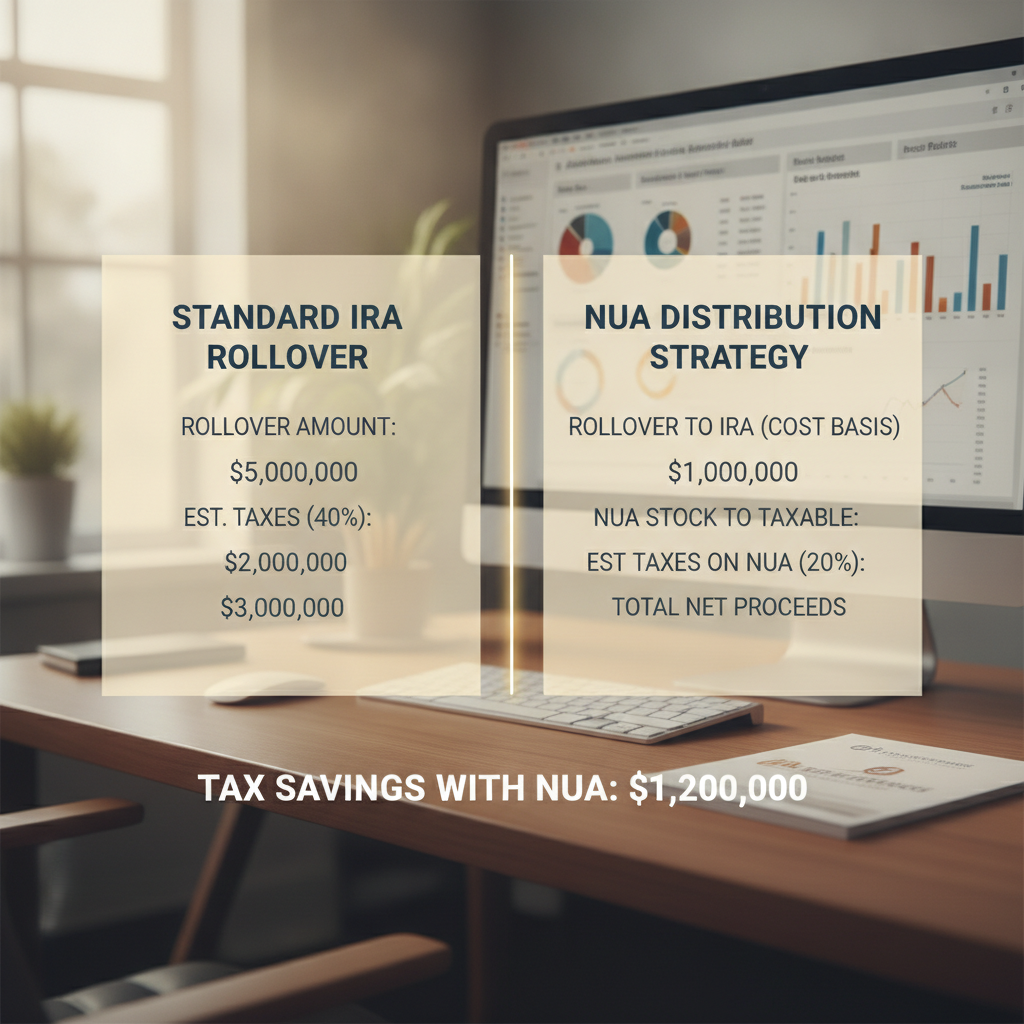
Under a standard IRA rollover, that entire $2 million would eventually be taxed at ordinary income rates — potentially 37% at the federal level for high earners. Under an NUA strategy, only the $300,000 cost basis is taxed as ordinary income. The $1.7 million in appreciation is taxed at the long-term capital gains rate, which currently tops out at 20% for high-income taxpayers, plus the 3.8% Net Investment Income Tax in some cases.
That spread — the difference between ordinary income rates and capital gains rates — is where the NUA strategy creates real, measurable value.
How the NUA Strategy Actually Works
Step One: Triggering a Qualifying Lump-Sum Distribution
The NUA strategy is not available at any time. It requires what the IRS calls a lump-sum distribution — meaning the entire balance of your 401(k) plan must be distributed within a single tax year. Partial distributions do not qualify.
A qualifying triggering event must also occur. The IRS recognizes four:
- Separation from service (retirement or termination)
- Reaching age 59½
- Death (for beneficiaries)
- Disability (for self-employed individuals)
For most retirees, separation from service at retirement is the triggering event. Consult a qualified tax professional to confirm your specific situation meets the lump-sum distribution requirements before taking any action.
Step Two: The Mechanics of the Distribution
Once you execute the strategy, the plan distributes the employer stock shares directly to a taxable brokerage account — in kind, meaning as actual shares, not as cash proceeds. This distinction is critical. If the plan sells the stock first and sends you cash, the NUA treatment is lost.
The remaining assets in the plan — cash, mutual funds, non-employer stock — are typically rolled over into an IRA in the same tax year to preserve their tax deferral. This combination is often called the “NUA + rollover” approach.
Step Three: Tax Reporting in the Year of Distribution
In the year of the distribution, you will receive a Form 1099-R from the plan. Box 6 will show the NUA amount — the IRS uses this to track that the appreciation qualifies for capital gains treatment. The cost basis of the shares is included in your gross income for the distribution year and taxed at ordinary income rates.
If you are under age 59½, a 10% early withdrawal penalty may apply to the cost basis portion. This is one reason NUA planning typically happens at or near retirement. Always verify the penalty exposure with a qualified tax advisor before proceeding.
Step Four: Selling the Shares After Distribution
Once the stock is in your taxable brokerage account, you decide when to sell. The NUA itself is automatically treated as long-term capital gain regardless of the holding period after distribution. Any additional appreciation that occurs after the distribution date is taxed at short-term or long-term capital gains rates depending on your actual post-distribution holding period.
NUA vs. IRA Rollover: A Direct Comparison for High-Net-Worth Retirees
To understand the real-world impact, let’s look at a side-by-side comparison. Mass-market financial planning advice almost universally recommends a straight rollover — and for most people, that is the right answer. But high-net-worth individuals with deeply appreciated company stock face a very different calculation.
| Factor | Standard IRA Rollover | NUA Strategy |
|---|---|---|
| Tax rate on stock appreciation | Ordinary income (up to 37%) | Long-term capital gains (0%, 15%, or 20%) |
| Tax due at distribution | Deferred until withdrawal | Ordinary income tax on cost basis in distribution year |
| Required Minimum Distributions | Yes, starting at age 73 | Stock in taxable account has no RMDs |
| Step-up in basis at death | No step-up; heirs pay ordinary income tax | Heirs receive step-up on post-distribution appreciation only |
| IRMAA impact | RMDs in future years raise MAGI, potentially triggering IRMAA surcharges | Smaller IRA balance may reduce future IRMAA exposure |
| Concentration risk | Diversified upon rollover | Remains concentrated until sold; requires management |
| Best candidate | Low-basis stock, limited appreciation, or high need for diversification | High-basis spread, lower current income, long investment horizon |
The comparison makes clear that NUA is not universally superior — it requires a specific set of conditions to be advantageous. But when those conditions are present, the after-tax savings can be dramatic.
Who Should Seriously Consider the NUA Strategy?
The Ideal NUA Candidate
In my experience working with retiring executives and business professionals, several factors consistently identify the strongest NUA candidates:
- Large NUA relative to cost basis. The greater the spread between cost basis and current value, the more the strategy saves. A ratio of 3:1 or higher (stock worth three times its cost basis) is often a reasonable threshold to begin the analysis.
- Meaningful company stock position. An NUA strategy typically makes sense when employer stock represents at least $500,000 to $1 million or more of the 401(k) balance.
- Lower income in the distribution year. Because the cost basis is taxed as ordinary income in the year of distribution, a retiree in a transition year with reduced income may face a lower marginal rate than they would during peak earning years.
- Desire to reduce future RMD exposure. Moving assets from the IRA to a taxable account through NUA permanently reduces the IRA balance subject to Required Minimum Distributions starting at age 73, which can meaningfully lower future MAGI and Medicare IRMAA surcharges.
- Estate planning considerations. Assets in a taxable account receive a step-up in basis at death on post-distribution appreciation, which can benefit heirs — a dimension entirely absent from an IRA.
Who Should NOT Use NUA
The strategy is not appropriate for everyone. Situations where NUA typically does not make sense include:
- Stock with a high cost basis relative to current value (minimal NUA)
- Individuals in a high marginal bracket in the year of distribution with no income transition period
- Retirees who need immediate liquidity and cannot manage concentration risk
- Cases where the plan balance is small relative to total wealth and the administrative complexity is not justified

NUA and the Broader High-Net-Worth Planning Picture
What to Do With the Proceeds After You Sell
Once company stock is distributed to a taxable brokerage account through an NUA strategy, the next question is: what happens after you sell? Many high-net-worth retirees use the proceeds to build a diversified portfolio that includes allocations to private credit, real estate investment trusts, hedge fund structures, or direct investments — alongside traditional equities and fixed income.
The capital gains generated from selling the NUA stock can be timed and managed strategically. For example, if you hold the stock for a period after distribution before selling, any additional appreciation beyond the NUA qualifies for long-term treatment after 12 months. Working with a fiduciary advisor, you can sequence the sale across tax years and reinvest proceeds into a broader asset allocation including private-market funds designed for accredited investors with $1 million or more in assets.
Tax-Loss Harvesting to Offset NUA Gains
High-net-worth investors often have taxable accounts with embedded losses in other positions. These can be harvested strategically to offset capital gains triggered by selling the NUA stock, reducing the net tax hit. This integration of NUA with active tax-loss harvesting is one area where sophisticated planning — available through comprehensive wealth management services — adds measurable value beyond what a brokerage relationship typically provides.
IRMAA and Medicare Planning Intersection
One often-overlooked benefit of the NUA strategy for high-net-worth retirees is its long-term effect on Medicare costs. IRMAA — the Income-Related Monthly Adjustment Amount — adds surcharges to Medicare Part B and Part D premiums for retirees whose modified adjusted gross income exceeds certain thresholds. These surcharges can add thousands of dollars per year per person.
By reducing the IRA balance through NUA (rather than leaving all assets in a tax-deferred account subject to mandatory withdrawals), retirees can structurally lower future RMD-driven income. This can reduce IRMAA exposure over a retirement spanning 20 or 30 years. Consult a qualified Medicare planning specialist to model your specific income trajectory before implementing this strategy.
Estate Planning Interaction
With the federal estate tax exemption now permanently set at $15 million per individual and $30 million per married couple under the One Big Beautiful Bill Act effective 2026, the urgency around reducing gross estate value has shifted. However, the character of assets in an estate still matters significantly.
Assets remaining in an IRA pass to heirs with embedded ordinary income tax liability — heirs generally must withdraw inherited IRA assets within 10 years under current rules, paying income tax on every dollar. By contrast, appreciated stock in a taxable account receives a step-up in basis at the owner’s death on any post-distribution appreciation, potentially eliminating capital gains entirely for heirs. This interaction between NUA and estate planning deserves careful attention, particularly for retirees with blended estates that include both taxable and tax-deferred accounts.
Common Mistakes That Disqualify or Undermine the NUA Strategy
Receiving Cash Instead of Shares
The most common and costly mistake is allowing the plan to liquidate the employer stock and distribute cash. Once the stock is sold inside the plan, the NUA treatment is permanently lost. Always request an in-kind distribution of the actual shares to a taxable brokerage account.
Partial Distributions in Different Tax Years
The lump-sum requirement means the entire plan must be distributed in a single calendar year. If you take some assets in December and the rest in January, you may lose qualification. Work with your plan administrator and tax advisor to coordinate the timing precisely.
Overlooking State Income Taxes
The NUA strategy’s tax advantage is driven by federal rates. Some states do not conform to federal capital gains treatment, which can reduce the benefit. Florida, with no state income tax, is an especially favorable jurisdiction for retirees executing an NUA strategy — one reason many executives who relocate to Florida find the strategy particularly compelling. For a broader look at why Florida is advantageous for retirees, our Florida Retirement Guide covers the full picture.
Ignoring the Net Investment Income Tax
High-income retirees may owe the 3.8% Net Investment Income Tax on the NUA gain in the year of sale. This does not eliminate the benefit compared to ordinary income treatment, but it must be factored into the after-tax comparison. Consult a qualified tax professional to run the numbers for your specific income level.

Free Download
The Complete Florida Retirement Guide
A comprehensive, plain-English guide to retirement planning in Florida — income strategies, tax considerations, Social Security timing, and healthcare planning for Treasure Coast retirees.
Frequently Asked Questions About Net Unrealized Appreciation
What exactly qualifies as “employer stock” for NUA purposes?
Employer stock for NUA purposes means stock of the corporation for which you are or were employed, distributed from a qualified retirement plan such as a 401(k), profit-sharing plan, or pension plan. Stock mutual funds or index funds held in the plan do not qualify — it must be individual company stock. Refer to IRS Publication 575 for the technical definition.
Can I use the NUA strategy if I have already started taking RMDs?
Yes, but the mechanics become more complex. The Required Minimum Distribution for the year must generally be taken before executing the lump-sum distribution, and it does not count toward the qualifying lump-sum amount. Work with a qualified tax advisor to sequence RMDs and the NUA distribution correctly in the same tax year.
What can you do with the proceeds after selling the stock?
Once company stock is distributed to a taxable brokerage account, proceeds from its eventual sale can be reinvested across a full range of asset classes, including private-market vehicles such as private equity funds, interval funds, or direct real estate vehicles available to accredited investors. The key is managing the timing of the sale and reinvestment to optimize the overall tax outcome across your portfolio.
Is there a minimum amount of company stock that makes the NUA strategy worthwhile?
There is no IRS minimum, but from a practical standpoint, the transaction costs, administrative complexity, and concentration risk introduced by keeping company stock in a taxable account generally require a meaningful position — often $500,000 or more in NUA — to justify the strategy. A detailed break-even analysis comparing after-tax outcomes under NUA versus rollover is the right starting point.
What happens to the NUA tax benefit if I die before selling the stock?
If you die holding the distributed employer stock in a taxable account, your heirs receive a step-up in basis on any appreciation that occurred after the distribution date. The original NUA amount does not receive a step-up — it remains taxable as long-term capital gain when heirs sell. However, heirs inherit your long-term holding period on the NUA, so it remains taxed at capital gains rates rather than ordinary income rates, which is still more favorable than inherited IRA assets.
How Davies Wealth Management Approaches NUA Planning
The NUA analysis is not a simple calculation. It requires integrating current and projected marginal tax rates, Medicare IRMAA thresholds, estate composition, Required Minimum Distribution projections, state tax rules, and the client’s investment goals for the proceeds — including any interest in private-market investments for the post-distribution portfolio.
As a fee-based fiduciary registered investment adviser, Davies Wealth Management provides this analysis as part of a comprehensive retirement income plan. Our approach is not to default every client toward a rollover because it is simple, or toward NUA because it is sophisticated. The right answer depends entirely on your numbers, your timeline, and your broader financial picture.
We serve executives, professional athletes, business owners, and retirees with $500,000 to $10 million or more in investable assets — people who have complex financial situations and deserve advice tailored to those complexities, not mass-market defaults. To learn more about the full range of strategies we bring to retirement income planning, visit our page on comprehensive wealth management services.
If you believe you may hold significant appreciated company stock in a 401(k) or other qualified plan, the time to analyze this opportunity is before you initiate any rollover. Once assets leave the plan as cash, the NUA opportunity is gone permanently. You can also learn more from Fidelity’s overview of company stock in retirement plans and the Kiplinger guide to the NUA strategy as starting points for your research.
For additional context on how alternative investments can be integrated into a post-NUA portfolio, the SEC’s investor bulletin on alternative investments offers a clear overview of the risks and structures involved.
Take the Next Step
The NUA strategy sits at the intersection of retirement planning, tax strategy, and investment management — and it is precisely the kind of opportunity that gets overlooked when high-net-worth families work with advisors who are not focused on their specific level of complexity. Whether or not NUA applies to your situation, the discipline of stress-testing every default assumption before retirement is what separates good outcomes from great ones.
Ready to find out if the NUA strategy could save you significant taxes at retirement? Take our Financial Wellness Quiz to get a quick snapshot of where your retirement plan stands and identify planning gaps worth addressing.
Or, if you are already sitting on appreciated company stock and want a direct conversation about your options, book a complimentary phone call with our team. We will review your situation and give you a clear picture of what the NUA strategy — and the alternatives — would actually mean for your retirement income and tax bill.
This content is for general educational purposes only and does not constitute individualized investment advice. Past performance does not guarantee future results. Investment-advisory services are offered by Davies Wealth Management, LLC, an investment adviser registered with the State of Florida. Registration does not imply a certain level of skill or training. Please consult appropriately qualified financial, tax, or legal professionals regarding your specific circumstances.
Listen & Watch
Prefer audio or video? We’ve got you covered.
Leave a Reply