


If you have a portfolio investment strategy built for a different interest rate environment, the second half of 2026 is a good time to revisit it — methodically, not reactively. The Federal Reserve’s policy path, persistently elevated equity valuations, and a credit market adjusting to “higher for longer” rates have created a confluence of forces that affect $2M+ portfolios in ways that simply do not apply to smaller accounts.
🎧 Prefer to listen to the podcast or watch the video? Jump to listen to the podcast & watch the video.
This post walks through what that environment looks like, why it matters specifically for high-net-worth investors, and the disciplined adjustments worth considering between now and December 31, 2026.

Understanding the Fed’s Position Entering H2 2026
Where Monetary Policy Stands Right Now
The Federal Reserve has spent much of 2025 and early 2026 navigating a narrow corridor: inflation that has cooled but remains sticky above its 2% target, an employment market that is softening but not collapsing, and a housing sector still constrained by elevated mortgage rates. As of mid-2026, the Fed funds rate remains in restrictive territory — meaningfully above the “neutral” rate most economists estimate at 2.5%–3.0%.
The Fed has signaled one or two potential cuts in the back half of 2026, but Chair Powell and other voting members have been clear: cuts are data-dependent and will not be rushed. For investors, this means the rate environment is unlikely to revert dramatically to the near-zero conditions of 2009–2021.
You can follow the Federal Reserve’s current policy statements directly at FederalReserve.gov.
Why Rate Policy Affects HNW Portfolios Differently
Mass-market investors often hold target-date funds or simple 60/40 portfolios — they feel rate changes broadly but lack the tools to respond strategically. High-net-worth investors operating with $2M–$10M+ in investable assets have access to instruments and structures that can be actively calibrated to the rate environment.
Consider the difference:
- A $500K IRA investor might shift from a bond fund to a money market fund and call it done.
- A $3M investor can ladder individual Treasuries, access private credit, optimize municipal bond allocations for their marginal tax bracket, and harvest tax losses in taxable accounts simultaneously.
This is not complexity for its own sake — it is the difference between a reactive and a proactive portfolio investment strategy.
Equity Valuations in Mid-2026: Elevated but Not Uniform
The Valuation Picture at the Index Level
U.S. large-cap equities — particularly in the technology and artificial intelligence sectors — have continued to trade at historically elevated price-to-earnings multiples. Broad index valuations measured by cyclically adjusted metrics remain above their long-term historical averages, a trend that has persisted since the post-pandemic rally.
This does not mean equities are about to collapse. Valuations are notoriously poor short-term timing tools. What elevated valuations do mean for a disciplined portfolio investment strategy is that the margin of safety is thinner, and the return expectations for broad passive exposure over the next 7–10 years are more modest than the prior decade.
Morningstar’s equity research and valuation commentary — available at Morningstar.com — provides ongoing forward-return context worth reviewing with your advisor.
Where Relative Value Still Exists
Not all equity markets are equally stretched. In mid-2026, several pockets of relative value remain for investors willing to look beyond U.S. mega-cap growth:
- International developed markets (Europe, Japan) still trade at significant discounts to U.S. equivalents on most valuation metrics.
- U.S. small and mid-cap value has lagged large-cap growth significantly and offers more attractive starting valuations.
- Dividend-oriented equities with durable cash flows are better positioned in a higher-rate environment than speculative growth names.
- Real assets — including infrastructure, energy, and certain REITs — provide inflation linkage that pure growth equities do not.
A thoughtful portfolio investment strategy in H2 2026 does not mean abandoning equities. It means being deliberate about where equity risk is concentrated.
What a $2M+ Portfolio Investment Strategy Should Actually Look Like
Rethinking the Classic 60/40 for Affluent Investors
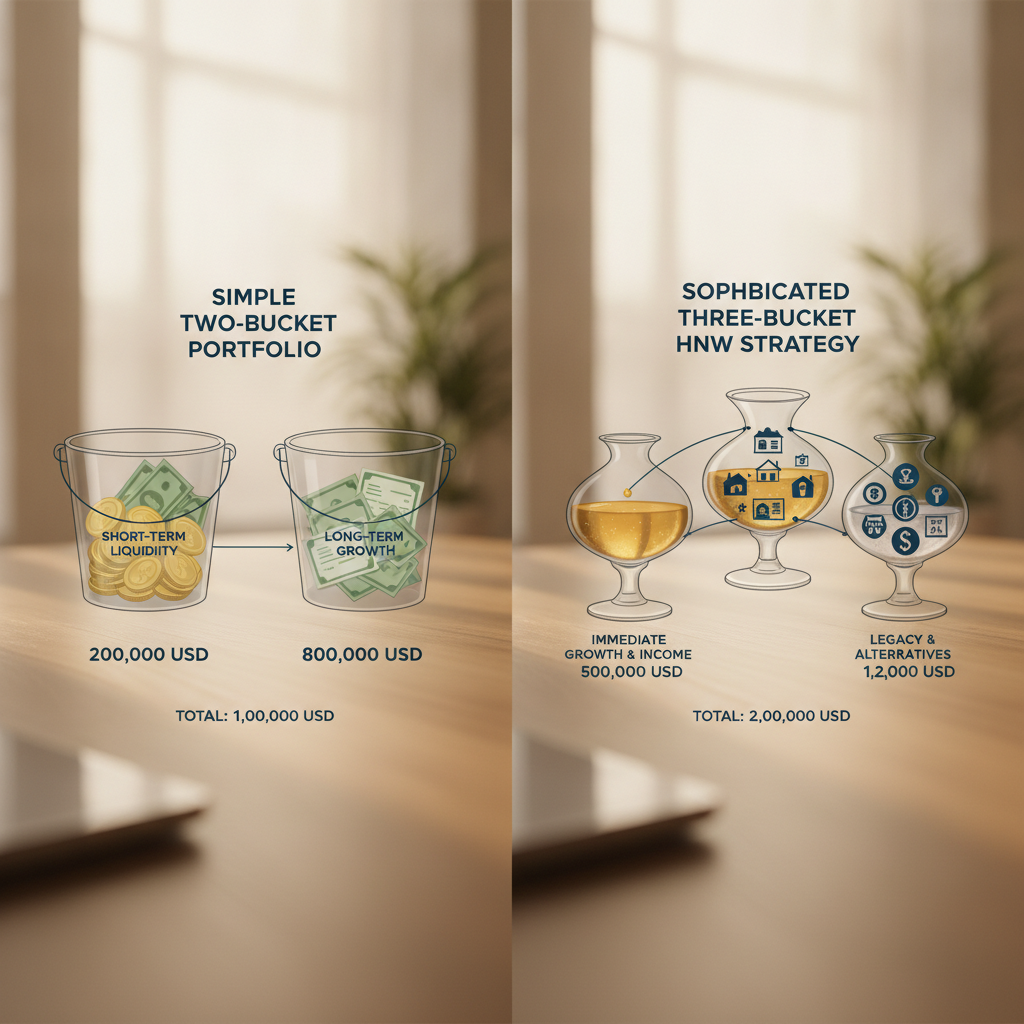
The traditional 60% equity / 40% bond allocation was designed for a different era. For HNW investors with $2M+ portfolios, a more nuanced framework serves better. Think of the portfolio in three distinct “buckets” rather than two asset classes:
- Liquidity Bucket (1–3 years of spending): Cash, money market funds, short-duration Treasuries. With rates still elevated, this bucket actually generates meaningful return while preserving capital. A $3M portfolio with $180K/year in spending needs $360K–$540K here — and that capital is finally working again.
- Core Growth Bucket (3–10 year horizon): Diversified equities (domestic and international), investment-grade bonds, dividend strategies, and alternative assets. This is where the bulk of portfolio investment strategy decisions live.
- Long-Term / Legacy Bucket (10+ years): More aggressive growth, private equity, real assets, and structures designed for generational transfer — dynasty trusts, irrevocable life insurance trusts (ILITs), and qualified opportunity zone investments for those with capital gains to defer.
Fixed Income: The Return of Real Yield
One meaningful shift from the 2010s: fixed income actually earns a real yield again. For the first time in years, high-quality bonds and Treasuries offer returns that exceed inflation expectations. This fundamentally changes how bonds function in a portfolio — not just as ballast, but as a genuine return contributor.
For HNW investors in the top federal brackets (37% ordinary income, 20% long-term capital gains, plus the 3.8% net investment income tax), municipal bonds deserve particular attention. A 4.5% tax-exempt municipal yield is equivalent to approximately 7%+ on a taxable basis for someone in the 37% bracket. Consult a qualified tax professional to evaluate the after-tax math for your specific situation.
Tax-Aware Portfolio Investment Strategy Moves for H2 2026
For $2M+ taxable accounts, the second half of the year is prime time for tax-aware repositioning. Strategies worth reviewing with your advisor include:
- Tax-loss harvesting: In a volatile equity environment, harvesting losses in positions that have declined while maintaining market exposure through similar (not substantially identical) securities can add meaningful after-tax value.
- Roth conversion laddering: If income in 2026 is lower than anticipated (common for business owners in transition), the window between now and year-end may be valuable for partial Roth conversions — particularly at rates below the 32% or 35% brackets.
- IRMAA cliff management: High-income Medicare enrollees need to monitor 2026 MAGI carefully. The 2028 IRMAA surcharges will be based on 2026 income, and the cliffs are steep. The top IRMAA tier adds over $4,000 per person per year in Medicare Part B and D premiums.
- Qualified charitable distributions (QCDs): Investors over 70½ with IRA assets can direct up to $105,000 per year (2026 limit, indexed for inflation) directly to charity, satisfying RMD obligations while avoiding income recognition entirely.
For detailed guidance on IRMAA thresholds and Roth conversion planning, see the IRS’s official income and bracket guidance at IRS.gov.
Concentrated Stock, Private Equity, and Alternative Assets
The Concentrated Stock Problem at $2M+
Many HNW investors arrive at substantial wealth through a concentrated position — employer stock, a long-held business interest, or a single equity that performed exceptionally well. A position that represents more than 20% of total net worth is a meaningful risk concentration that most portfolio investment strategy frameworks would flag for action.
Strategies for managing concentrated stock without triggering immediate capital gains include:
- Exchange funds: Pool your concentrated position with other investors to achieve diversification without a taxable event (subject to eligibility requirements).
- Charitable remainder trusts (CRTs): Contribute the appreciated stock, receive an income stream, and take a partial charitable deduction — useful for donors with philanthropic intent.
- Protective puts and collars: Options strategies that cap downside risk while deferring the tax event. Consult a qualified financial and tax professional before implementing.
- Installment sales: Particularly relevant for business owners selling private companies — spread the gain recognition over multiple years.
Private Markets and Alternatives in H2 2026
The democratization of alternative investments has continued, and accredited investors with $2M+ portfolios now have access to private credit funds, interval funds, and direct real estate vehicles that were once institutional-only.
Private credit, in particular, has gained attention as a complement to traditional fixed income — offering floating-rate exposure and yield premiums over public bonds. However, liquidity constraints are real and must be factored into the overall portfolio investment strategy before commitment.
The SEC’s investor education resources on alternative investments are available at SEC.gov.
Portfolio Investment Strategy Comparison: Mass-Market vs. HNW
The table below illustrates how portfolio investment strategy differs materially between a typical retail investor and a high-net-worth client at Davies Wealth Management:
| Dimension | Mass-Market Investor ($200K–$500K) | HNW Investor ($2M–$10M+) |
|---|---|---|
| Bond Allocation | Bond index funds | Individual munis, laddered Treasuries, private credit |
| Tax Strategy | Basic tax-deferred contributions | Tax-loss harvesting, Roth conversions, QCDs, IRMAA management |
| Equity Exposure | S&P 500 or target-date fund | Diversified across domestic, international, value, dividend, private equity |
| Alternatives Access | Limited or none | Private credit, interval funds, real assets, exchange funds |
| Estate Integration | Basic beneficiary designations | Dynasty trusts, ILITs, CRTs, GRATs, stepped-up basis planning |
| Advisor Model | Commission-based broker or robo-advisor | Fee-based fiduciary with integrated tax, estate, and investment oversight |
Estate and Legacy Considerations That Cannot Wait
The 2026 Estate Tax Exemption Cliff
For couples with combined estates above $14M–$15M, the difference between acting before a potential sunset and waiting could represent millions of dollars in estate tax exposure. Strategies to explore immediately with a qualified estate planning attorney include:
- Spousal Lifetime Access Trusts (SLATs) to shift assets outside the taxable estate while retaining indirect access
- Grantor Retained Annuity Trusts (GRATs) to pass appreciating assets to heirs with minimal gift tax exposure
- Irrevocable life insurance trusts (ILITs) to provide estate liquidity outside the taxable estate
- Annual gifting up to the 2026 annual exclusion ($19,000 per recipient) to begin systematic wealth transfer
For families with more than $5M in assets, this is not a theoretical concern — it is an active planning imperative. Our team offers comprehensive wealth management services that integrate investment strategy with estate and tax planning in a coordinated framework.
Multi-Generational Portfolio Investment Strategy
For clients building wealth intended to last two or three generations, a portfolio investment strategy must account for dramatically different time horizons within a single family. A 65-year-old retiree and their 35-year-old child have investment horizons that are 30+ years apart — yet many families manage all assets under a single framework.
Sophisticated multi-generational structures include dynasty trusts (designed to span multiple generations), 529 superfunding for grandchildren (up to $95,000 in 2026 using five-year gift-tax averaging), and family limited partnerships for centralized management and valuation discounts. Consult a qualified estate planning attorney for your specific situation.

Working with a Fiduciary vs. a Broker in This Environment
Why the Fiduciary Standard Matters More in Volatile Markets
When markets are calm and everything is rising, the difference between a commission-based broker and a fee-based fiduciary may feel academic. In a period of elevated equity valuations and rate uncertainty — it is anything but academic.
A fiduciary is legally required to act in your best interest. A broker operating under a suitability standard is required only to recommend products that are “suitable” — a materially lower bar. In a complex environment where the right portfolio investment strategy may involve recommending fewer products, simpler structures, or even cash — a fee-based fiduciary is structurally incentivized to give you that advice. A commission-based broker is not.
Vanguard’s research on the value of financial advice — available at Vanguard.com — suggests that advisor-added value (“Advisor’s Alpha”) can add approximately 3% in net returns annually when behavioral coaching, tax strategy, and portfolio construction are all optimized.
What to Ask Your Current Advisor
If you are currently working with an advisor and want to evaluate whether your portfolio investment strategy is appropriately calibrated for H2 2026, these questions are worth raising:
- What is our after-tax expected return on the current allocation, not just the gross return?
- How are we positioned if equity valuations compress by 20% over the next 18 months?
- Are we on track to manage IRMAA thresholds in 2028 based on 2026 income?
- What is the total all-in fee I am paying — advisory, fund expense ratios, and any transaction costs?
If you are not getting clear, confident answers to these questions, it may be time to schedule a discovery conversation with a fiduciary who specializes in complex HNW situations.
Frequently Asked Questions
What is the right portfolio investment strategy for a $2M portfolio in H2 2026?
A $2M portfolio in H2 2026 should prioritize tax efficiency, diversification beyond U.S. large-cap equities, and integration with estate and income planning. The three-bucket framework — liquidity, core growth, and legacy — provides a useful structure. Consult a qualified financial professional to calibrate the exact allocation to your income needs, tax situation, and timeline.
How does Fed rate policy affect a high-net-worth portfolio investment strategy?
Elevated rates increase the attractiveness of fixed income, reduce the relative appeal of highly valued growth equities, and shift the calculus on borrowing for real estate or business investments. For HNW investors, this environment also reopens the opportunity to earn meaningful yields in high-quality short-duration instruments that were unavailable for much of the past decade.
Should I reduce equity exposure given elevated valuations in 2026?
Valuations alone are a poor short-term market timing tool, and reducing equity exposure entirely creates its own risks — including the risk of missing recovery gains and generating taxable events in appreciated positions. A more prudent portfolio investment strategy involves tilting toward relatively undervalued segments (international, value, dividend-oriented equities) while maintaining long-term equity exposure appropriate to your time horizon.
What is IRMAA and why should HNW investors care in 2026?
IRMAA (Income-Related Monthly Adjustment Amount) is a Medicare surcharge applied to higher-income beneficiaries based on their income from two years prior. Your 2026 MAGI will determine your 2028 Medicare premiums. For married couples with income above $394,000 in 2026, surcharges can exceed $8,000 per year combined. Strategic Roth conversions, QCDs, and deferred compensation timing can help manage this exposure — consult a qualified tax professional for your situation.
How do I know if my current advisor is implementing a fiduciary portfolio investment strategy?
Ask directly whether your advisor is a registered investment adviser (RIA) with a fiduciary duty when providing advice. Also ask how they are compensated: transparent, disclosed fee structures make alignment easier to evaluate than opaque commission arrangements. The SEC’s Investment Adviser Public Disclosure database at IAPD.SEC.gov allows you to verify registration status and review any disclosures.
Taking Action in the Second Half of 2026
The second half of 2026 presents both challenge and opportunity for investors with $2M+ portfolios. Fed policy is creating genuine value in fixed income for the first time in years. Equity markets offer selective opportunity but demand more nuance than passive index exposure alone. Estate tax planning windows may be closing faster than families realize.
A disciplined, tax-aware portfolio investment strategy calibrated to this specific environment — not a generic one-size-fits-all allocation — is what separates investors who navigate this period well from those who simply react to it.
In my experience working with executives, business owners, and affluent retirees, the families who come out ahead are not those who predicted the market correctly. They are the ones who had a coherent, reviewed, and coordinated plan in place before uncertainty arrived.
📊 Ready to Stress-Test Your Financial Plan?
Take our Financial Wellness Quiz to benchmark your current strategy across tax efficiency, estate readiness, investment diversification, and income planning — and identify where your $2M+ portfolio may have gaps.
→ Take the Free Financial Wellness Quiz at tdwealth.net
📅 Prefer a Direct Conversation?
Ready for personalized guidance from a fee-based fiduciary? Book a complimentary phone call with Davies Wealth Management. We work with high-net-worth individuals and families in Stuart, Florida and nationwide.
This content is for educational purposes only and does not constitute investment advice. Past performance is not indicative of future results. Advisory services offered through Davies Wealth Management, a Registered Investment Adviser. Please consult a qualified financial, tax, or legal professional regarding your specific situation.
Listen & Watch
Prefer audio or video? We’ve got you covered.
Leave a Reply