

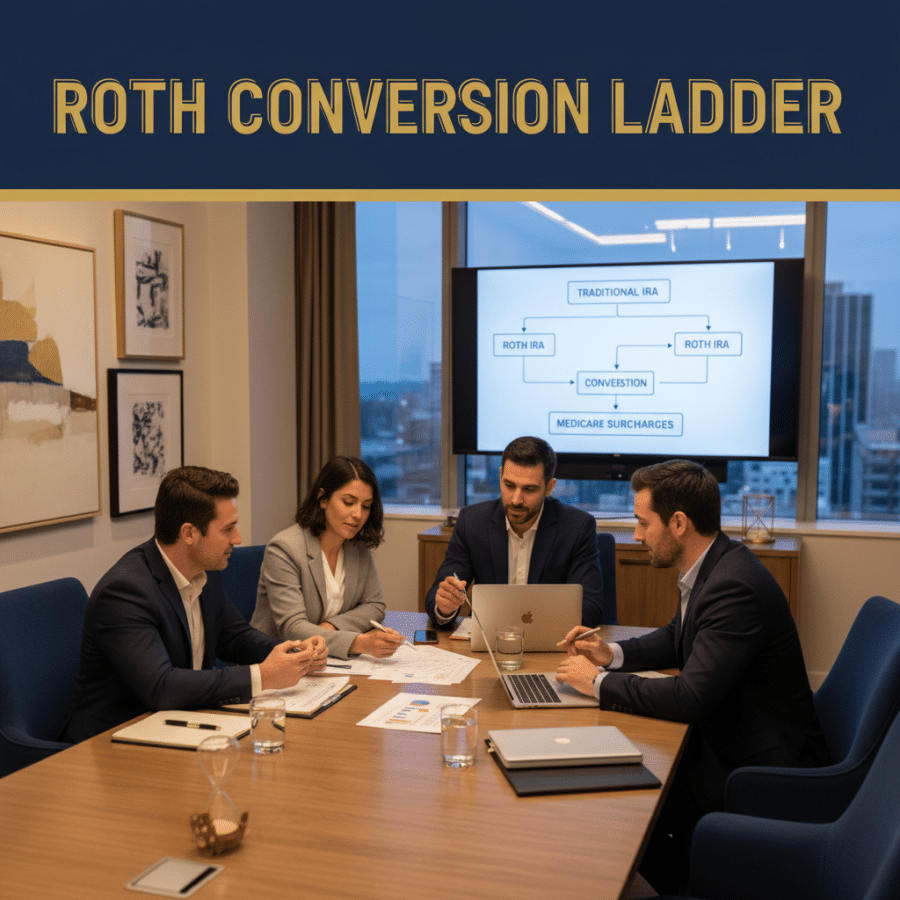
A roth conversion ladder is one of the most powerful — and most misunderstood — strategies available to high-net-worth investors who want to move wealth from tax-deferred accounts into tax-free Roth IRAs without triggering painful Medicare surcharges. If you have $1 million or more sitting in traditional IRAs or 401(k) accounts, every dollar you convert carries tax implications, and those implications extend far beyond your income tax bracket.
For affluent retirees and pre-retirees, the stakes are uniquely high. A poorly timed or oversized conversion can push your modified adjusted gross income (MAGI) above IRMAA thresholds, adding thousands of dollars in Medicare Part B and Part D surcharges — costs that mass-market financial advice rarely addresses. This guide walks you through the seven proven steps to build an effective roth conversion ladder that optimizes your tax bill and protects your retirement income.
What Is a Roth Conversion Ladder and Why HNW Investors Need One
The Core Mechanics of a Roth Conversion Ladder
A roth conversion ladder is a multi-year strategy in which you convert a calculated amount from traditional tax-deferred accounts (traditional IRA, 401(k), 403(b), or SEP IRA) into a Roth IRA each year. Rather than converting everything at once — which could generate a six- or seven-figure taxable event — you spread conversions across multiple years to manage your marginal tax rate.
Each “rung” of the ladder represents one year’s conversion. After a five-year holding period, the converted amount can be withdrawn entirely tax-free and penalty-free (if you’re 59½ or older). Over time, the ladder creates a growing pool of tax-free capital that’s exempt from required minimum distributions (RMDs) and provides estate planning flexibility.
Why a Roth Conversion Ladder Matters More for High-Net-Worth Households
If you have $500,000 or more in tax-deferred retirement accounts, you’re facing a ticking time bomb: required minimum distributions beginning at age 73 (or 75 for those born in 1960 or later), as established by SECURE 2.0. For someone with $3 million in traditional IRAs, RMDs at age 75 could exceed $120,000 per year — income you cannot avoid, cannot defer, and cannot control.
This is fundamentally different from the mass-market investor with $200,000 in a 401(k). Their RMDs are manageable. Yours are not. A roth conversion ladder gives you the ability to proactively move money before RMDs force your hand, controlling the timing and amount of taxable income in each year.

The IRMAA Trap: How Roth Conversions Can Trigger Medicare Surcharges
Understanding IRMAA Thresholds for 2026
Income-Related Monthly Adjustment Amounts (IRMAA) are Medicare’s way of charging higher-income beneficiaries more for Part B and Part D coverage. In 2026, the first IRMAA threshold for individual filers is $109,000 in MAGI, and $218,000 for married filing jointly. Cross that line and your Medicare premiums jump immediately.
What many affluent retirees don’t realize is that Roth conversion income counts as MAGI for IRMAA purposes. Even though IRMAA is determined using income from two years prior (so your 2026 income affects your 2028 Medicare premiums), a large conversion today plants a costly surprise down the road. Consult a qualified tax professional for your specific situation, as IRMAA brackets are adjusted annually.
The Real Cost of IRMAA for HNW Retirees
The surcharges are not trivial. At the highest IRMAA tier (MAGI above $750,000 for joint filers), a married couple can pay more than $11,000 per year in additional Medicare premiums — per person. Over a decade of retirement, that’s a potential six-figure cost that erodes the very savings your conversions were meant to protect.
| 2026 MAGI (Married Filing Jointly) | Monthly Part B Premium (per person) | Estimated Annual IRMAA Surcharge (per couple) | Roth Conversion Ladder Impact |
|---|---|---|---|
| $218,000 or less | Standard (~$202.90) | $0 | No surcharge — conversion stays within safe zone |
| $218,001 – $268,000 | ~$284.10 | ~$1,948 | Moderate risk — first IRMAA tier triggered |
| $268,001 – $335,000 | ~$370 | ~$4,440 | Significant surcharge — conversion sizing critical |
| $335,001 – $750,000 | ~$480 | ~$7,080 | Costly tier — multi-year ladder essential |
| Above $750,000 | ~$689.90 | ~$11,688+ | Maximum surcharge — avoid with precise ladder spacing |
Key takeaway: Every dollar of Roth conversion income that pushes you into the next IRMAA bracket costs you real money in Medicare surcharges — not just income tax. The roth conversion ladder approach mitigates this by keeping each year’s conversion below the next threshold.
7 Proven Steps to Build Your Roth Conversion Ladder
Step 1: Map Your Projected Income for the Next 10–15 Years
Before converting a single dollar, you need a multi-year income projection. This includes Social Security benefits (for both spouses), pension income, rental income, capital gains distributions from taxable accounts, and any earned income from consulting or board positions.
For executives with deferred compensation or restricted stock units (RSUs) vesting over several years, this step is critical. A roth conversion ladder only works when you know exactly how much “room” you have below key tax brackets and IRMAA thresholds each year.
Step 2: Identify Your Optimal Conversion Ceiling Each Year
The optimal conversion amount is the maximum you can convert without:
- Jumping into the next marginal tax bracket (e.g., staying in the 24% bracket rather than crossing into 32% for 2026)
- Triggering the next IRMAA tier (remembering the two-year lookback)
- Triggering or increasing the 3.8% Net Investment Income Tax (NIIT) on investment income above $250,000 for joint filers
- Pushing capital gains into a higher rate tier
This ceiling varies every year. In years with lower income — perhaps after retirement but before Social Security begins at 70 — you may have a wide-open window to convert aggressively. These “gap years” are golden opportunities in a roth conversion ladder strategy.
Step 3: Prioritize Which Accounts to Convert First
Not all tax-deferred dollars are equal. Consider converting in this order:
- Traditional IRA accounts with the highest expected growth — moving high-growth assets early maximizes tax-free compounding
- Pre-tax 401(k) rollovers — consolidate old employer plans first
- SEP IRA balances — particularly for business owners who no longer contribute
If you hold both pre-tax and after-tax (basis) amounts in traditional IRAs, be aware of the IRS pro-rata rule, which requires you to treat all traditional IRA assets as a single pool when calculating the taxable portion of any conversion.
Step 4: Pay the Tax from Non-Retirement Assets
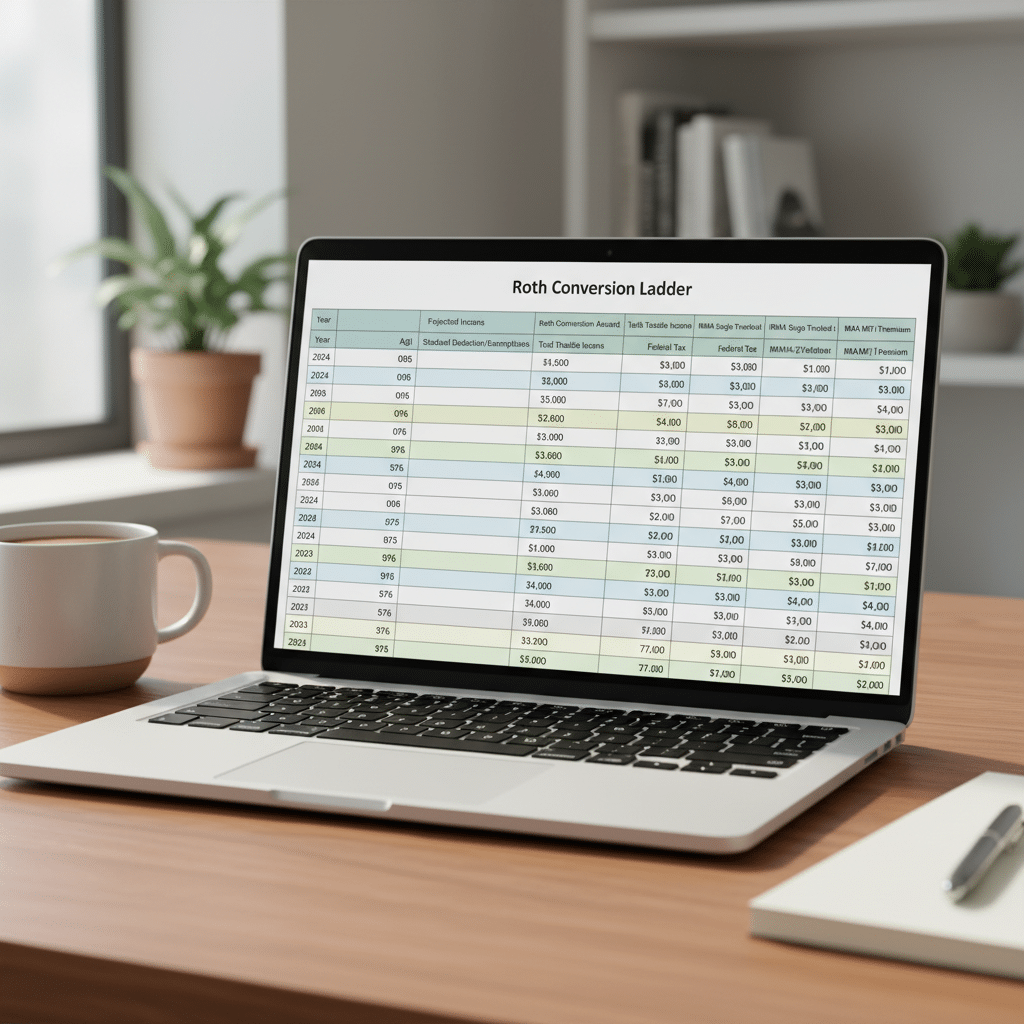
This is where discipline separates effective HNW planning from amateur moves. Always pay the income tax on your Roth conversion from taxable (non-retirement) accounts, not from the conversion itself. If you withhold tax from the converted amount, you’re reducing the dollars that go into the Roth — and if you’re under 59½, the withheld portion may be treated as an early distribution subject to a 10% penalty.
For a client converting $200,000 at a 32% marginal rate, that means setting aside $64,000 from taxable savings to cover the federal tax bill. If you don’t have sufficient liquidity outside retirement accounts, you may need to shrink your annual conversion amounts.
Step 5: Time Conversions Strategically Within Each Year
Many advisors recommend executing conversions in December, when you have the clearest picture of your annual income. However, there’s a compelling argument for converting earlier in the year — or even quarterly — to capture more time in the Roth’s tax-free growth environment.
If markets decline mid-year, that’s actually an ideal time to convert: you’re moving the same number of shares at a lower value, generating a smaller taxable event. This is particularly relevant for concentrated stock positions or volatile asset classes.
Step 6: Coordinate with Other Tax-Efficient Strategies
A roth conversion ladder doesn’t operate in isolation. For high-net-worth families, it should integrate with:
- Tax-loss harvesting — realized losses in taxable accounts can offset conversion income
- Qualified Charitable Distributions (QCDs) — once you’re 70½ or older, QCDs of up to $105,000 (2026 limit) directly from traditional IRAs satisfy charitable goals without increasing MAGI
- Charitable Remainder Trusts (CRTs) — for clients with large concentrated positions, a CRT can provide income while reducing the taxable estate
- Donor-Advised Fund (DAF) bunching — front-loading charitable deductions in high-conversion years to offset the tax impact
Consult a qualified financial and tax professional to coordinate these strategies for your specific situation. The interplay between conversions, charitable giving, and investment management requires precision that goes beyond generic tax software.
Step 7: Monitor, Adjust, and Extend the Ladder Annually
Tax law changes. Markets fluctuate. Your income changes. A roth conversion ladder is not a “set and forget” strategy — it requires annual recalibration.
Each January, reassess your projected income, review IRMAA thresholds (which are adjusted for inflation), check for any legislative changes to Roth rules, and set your conversion target for the year. At Davies Wealth Management, we build these reviews into our comprehensive wealth management services to ensure every conversion decision reflects current law and your evolving financial picture.
The High-Net-Worth Difference: Why Mass-Market Advice Falls Short
Generic Roth Conversion Advice Can Be Dangerous for Affluent Families
Most online roth conversion ladder guides target middle-market investors — people with $200,000–$500,000 in retirement savings. The advice is simple: “Convert to the top of the 22% bracket and you’ll be fine.”
For a family with $3 million in traditional IRAs, $500,000 in annual income from multiple sources, and a $7 million estate, that advice is incomplete at best and harmful at worst. Here’s what the generic guidance misses:
- IRMAA coordination — most calculators ignore Medicare surcharges entirely
- State tax implications — Florida residents benefit enormously from no state income tax on conversions, making the roth conversion ladder even more attractive for those who’ve relocated
- Estate tax interplay — paying income tax on conversions reduces your taxable estate. For estates approaching the $15 million federal exemption (permanent as of 2026), this is a feature, not a bug
- NIIT impact — the 3.8% surtax on net investment income above $250,000 (joint) is triggered by higher MAGI from conversions
- Multi-generational planning — under the SECURE Act’s 10-year distribution rule, inherited traditional IRAs force heirs to recognize all deferred income within a decade. Inherited Roth IRAs also have the 10-year rule, but the distributions are tax-free
This is precisely why high-net-worth families need a fiduciary advisor who understands the full picture, not a robo-advisor or a commission-based broker who earns nothing from the planning itself.

Real-World Roth Conversion Ladder Scenarios for HNW Clients
Scenario 1: The Retired Executive Approaching 73
Consider a 68-year-old retired executive in Stuart, Florida with $4.2 million in traditional IRAs, $1.8 million in taxable accounts, and Social Security benefits of $42,000 per year (starting at 70). She has five years before RMDs begin.
By implementing a roth conversion ladder converting approximately $250,000 per year for five years, she could move $1.25 million into a Roth IRA — reducing her future RMDs by roughly 30%. With Florida’s zero state income tax, her effective rate on conversions is federal-only. By keeping each year’s MAGI below $268,000 (joint), she avoids the second IRMAA tier.
Scenario 2: The Professional Athlete Planning for Life After Sports
A 32-year-old professional athlete has $2 million in a 401(k) and expects his income to drop dramatically after retirement at 35. The years immediately following his career — when his earned income may be $50,000–$100,000 — create an extraordinary window for Roth conversions at the 22% or even 12% bracket.
Starting a roth conversion ladder at age 36 and running it for 10 years could move the entire $2 million (plus growth) into a Roth at an average effective tax rate far below what he’d pay during his playing years. This is a strategy that requires early planning with a firm experienced in working with athletes — not advice you’ll find in a generic retirement article.
Scenario 3: The Business Owner Selling a Company
A 55-year-old business owner sells her company for $8 million, creating a large one-time capital gain. In the years following the sale, her income drops significantly. This is when a roth conversion ladder becomes most valuable — converting $300,000–$400,000 per year from her rollover IRA during the low-income window, filling up the 24% or 32% bracket while staying below IRMAA thresholds.
Paired with a dynasty trust for the Roth assets and strategic use of a donor-advised fund for charitable bunching in high-conversion years, this integrated approach can save her family hundreds of thousands in lifetime taxes.
Common Mistakes That Derail a Roth Conversion Ladder
Mistake 1: Converting Too Much in a Single Year
Eagerness to “get it done” is the most common error. A $500,000 conversion in one year might push you into the 37% federal bracket and trigger top-tier IRMAA surcharges two years later. Spreading that same amount across three or four years through a disciplined roth conversion ladder often saves $50,000 or more in combined taxes and surcharges.
Mistake 2: Ignoring the Two-Year IRMAA Lookback
IRMAA uses your tax return from two years prior. A large conversion in 2026 won’t affect your 2026 Medicare premiums — it affects 2028 premiums. This creates a planning trap: you may not feel the pain until years later. As Kiplinger notes, many retirees are blindsided by IRMAA letters because they didn’t account for the lookback period.
Mistake 3: Forgetting About State Taxes (or Not Leveraging Florida’s Advantage)
If you’ve recently relocated to Florida, you’re in a uniquely advantageous position. With no state income tax, every dollar you convert is taxed only at the federal level. Clients who moved from New York, California, or New Jersey can save 5%–13% on their conversion tax bill compared to their former state. This makes building a roth conversion ladder in Florida substantially more cost-effective.
Mistake 4: Not Coordinating with Your Advisor and CPA Simultaneously
Roth conversions sit at the intersection of investment management, tax planning, and estate planning. If your financial advisor doesn’t talk to your CPA — or worse, if you’re doing this without professional guidance — you’re almost certainly leaving money on the table or creating unintended consequences. This is one area where Fidelity’s research on Roth conversions reinforces the importance of professional coordination.
The Long-Term Payoff: Why a Roth Conversion Ladder Is Worth the Upfront Tax
Tax-Free Growth Over Decades Compounds Dramatically
A $250,000 Roth conversion growing at 7% annually for 20 years becomes approximately $967,000 — entirely tax-free. In a traditional IRA, that same growth would be taxed at withdrawal, potentially at higher rates if future tax brackets increase. For high-net-worth families, the math is compelling: pay tax at today’s known rates to eliminate tax on decades of future growth.
No RMDs Mean More Control Over Your Retirement Income
Roth IRAs are not subject to RMDs during the owner’s lifetime. This means you control when — and whether — you ever touch the money. For retirees with sufficient income from other sources, the Roth becomes an emergency reserve, a legacy asset, or a flexible withdrawal source that doesn’t affect MAGI, IRMAA, or the taxation of Social Security benefits.
Multi-Generational Wealth Transfer Benefits of a Roth Conversion Ladder
Under current law (per the SECURE Act rules), most non-spouse beneficiaries must empty an inherited IRA within 10 years. With a traditional IRA, that means your children or grandchildren could face massive tax bills during their peak earning years. With an inherited Roth, the 10-year distribution requirement still applies — but the withdrawals are tax-free.
For a family with a $5 million estate, converting $2 million to Roth over a decade through a carefully executed roth conversion ladder could save the next generation hundreds of thousands in taxes. It also reduces the taxable estate, potentially keeping it below the federal estate tax exemption.
Frequently Asked Questions About Roth Conversion Ladders
How much should I convert each year in a roth conversion ladder?
The optimal annual conversion amount depends on your total income, marginal tax bracket, IRMAA thresholds, and long-term goals. For most high-net-worth clients, the target is converting to the top of the 24% or 32% bracket without triggering the next IRMAA tier. A qualified financial professional can model this precisely for your situation.
Can I reverse or undo a Roth conversion if I convert too much?
No. Since the Tax Cuts and Jobs Act of 2017, Roth conversion recharacterizations are no longer permitted. Once you convert, it’s permanent. This makes careful planning before each conversion essential — there is no undo button.
Does a roth conversion ladder work if I’m already taking RMDs?
Yes, but your RMD amount for the year must be taken first — it cannot be converted. After satisfying your RMD, you can convert additional amounts. The roth conversion ladder still reduces future RMDs by shrinking the traditional IRA balance, even if you start later than ideal.
Will Roth conversion income affect my Social Security benefits taxation?
Yes. Conversion income increases your combined income, which can cause up to 85% of your Social Security benefits to become taxable. This is another reason to execute the bulk of your roth conversion ladder before Social Security benefits begin, ideally in the gap years between retirement and age 70.
Is there a maximum amount I can convert to a Roth IRA each year?
No. Unlike Roth IRA contributions (which have income limits), Roth conversions have no annual dollar limit. You could convert $5 million in a single year if you chose to — though the tax and IRMAA consequences would almost certainly make that inadvisable. The roth conversion ladder approach exists precisely to prevent such a costly mistake.
Take Control of Your Tax-Free Future
A roth conversion ladder is not a hack or a loophole — it’s a disciplined, multi-year strategy that requires precision, coordination, and expertise. For high-net-worth individuals, executives, professional athletes, and business owners, it represents one of the most impactful decisions you can make for your retirement and your legacy.
The window to optimize your roth conversion ladder is always closing. Tax brackets may rise, IRMAA thresholds may tighten, and your RMD clock keeps ticking. The best time to start planning was five years ago. The second-best time is today.
To schedule a discovery conversation about whether a Roth conversion ladder belongs in your financial future, reach out to our team. We’re a fee-based fiduciary firm — we don’t earn commissions and our only incentive is your long-term success.
📘 Want to understand how IRMAA affects your retirement income? Download our Medicare IRMAA Planning Guide — it’s free and covers the thresholds, surcharges, and strategies every high-net-worth retiree should know.
📞 Ready for personalized guidance from a fee-based fiduciary? Book a complimentary phone call with our team today.
This content is for general educational purposes only and does not constitute individualized investment advice. Past performance does not guarantee future results. Investment-advisory services are offered by Davies Wealth Management, LLC, an investment adviser registered with the State of Florida. Registration does not imply a certain level of skill or training. Please consult appropriately qualified financial, tax, or legal professionals regarding your specific circumstances.
Davies Wealth Management does not provide legal advice or tax-return-preparation services. Tax and estate-planning information is provided for general educational purposes and may become outdated. Figures and rules are current only as of the article’s stated review date. Verify current information with authoritative sources and consult a qualified tax professional or estate-planning attorney before acting.
Leave a Reply