


Why Your RMD Timing Strategy Matters More Than You Think
If you have a seven-figure IRA or 401(k) balance, your RMD timing strategy is one of the most consequential tax decisions you will make in retirement. The IRS gives you a generous window for your first required minimum distribution—and most retirees instinctively push it to the latest possible date. That instinct can cost you tens of thousands of dollars.
Here is the core issue: when you turn 73 (the current RMD age for individuals born between 1951 and 1959 under SECURE 2.0 Act rules), you must begin taking distributions from tax-deferred retirement accounts. For your first RMD only, you can delay until April 1 of the following year. But exercising that delay creates a tax pileup that hits high-net-worth retirees especially hard.
This article walks you through exactly why early timing beats late timing for your first RMD, the cascading tax consequences of deferral, and five specific strategies to optimize your distributions. If you have $1 million or more in tax-deferred accounts, this decision deserves the same attention you give your investing allocation.
Understanding the First-Year RMD Window
The April 1 Deadline and the Double-RMD Trap
When you reach your required beginning date (RBD), the IRS requires your first distribution by April 1 of the year after you turn 73. Your second RMD is then due by December 31 of that same year. This means deferring your first RMD forces two taxable distributions into a single calendar year.
For a retiree with a $2 million traditional IRA, the math is stark. Using the IRS Uniform Lifetime Table, the RMD at age 73 is approximately $75,472 (dividing $2,000,000 by the factor of 26.5). If you defer that first distribution to the following year, you would owe roughly $75,472 plus your age-74 RMD of approximately $78,125—a combined $153,597 in taxable income from RMDs alone in a single year.
For a mass-market retiree with a $300,000 IRA, doubling up on RMDs might bump them from the 12% bracket to the 22% bracket—a manageable increase. But for a high-net-worth retiree already receiving Social Security, pension income, and investment returns, that double distribution can trigger a cascade of tax consequences that go far beyond the marginal rate increase.
Why HNW Retirees Face a Different RMD Timing Strategy Calculus
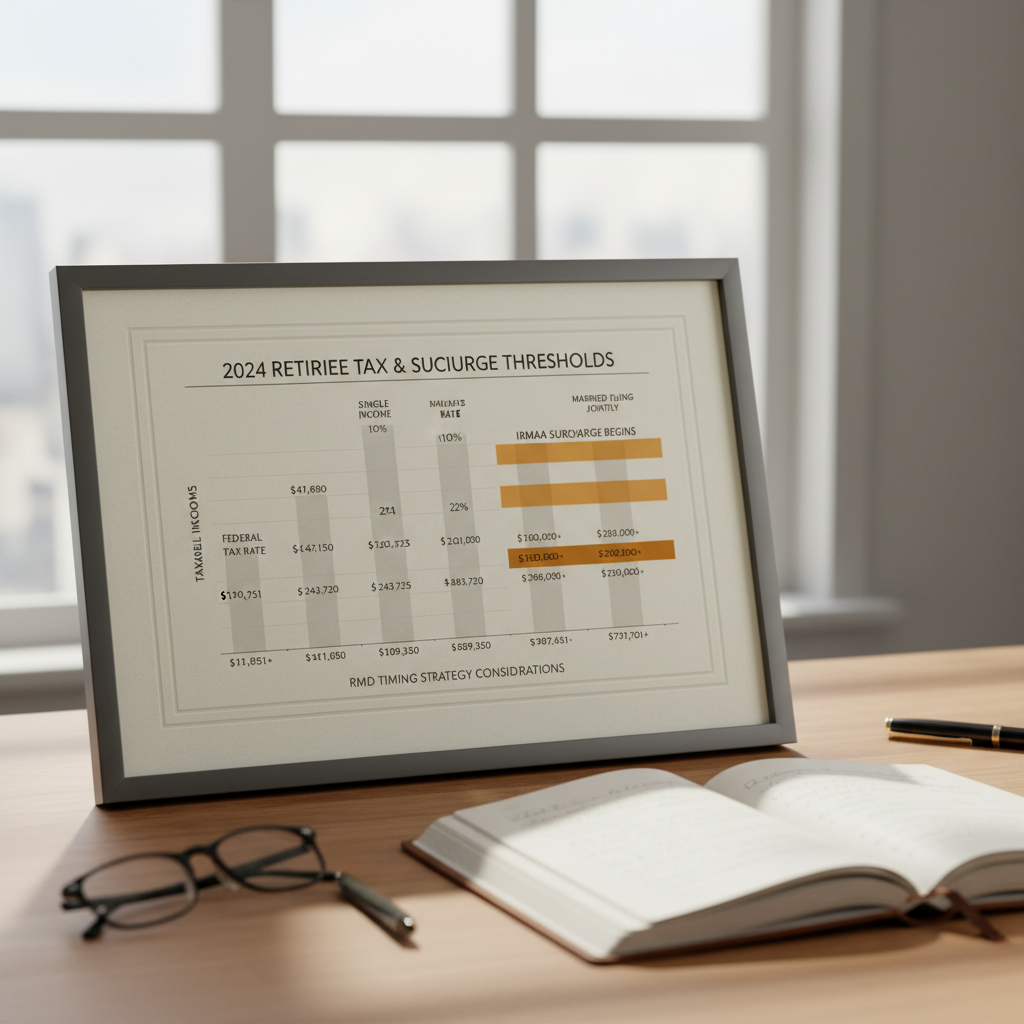
When your household income already sits in the 24% or 32% federal tax bracket before RMDs, adding $150,000+ in taxable distributions can push you into the 35% or even 37% bracket for 2026. But the bracket jump is only the beginning. High-income retirees face a web of income-triggered surcharges that multiply the pain:
- IRMAA surcharges: Medicare Part B and Part D premiums spike at income thresholds starting at $109,000 (single) and $218,000 (married filing jointly) based on your modified adjusted gross income from two years prior
- Net Investment Income Tax (NIIT): The 3.8% surtax on investment income kicks in at $200,000 (single) or $250,000 (MFJ)
- Social Security taxation: Up to 85% of your Social Security benefits become taxable once provisional income exceeds $44,000 (MFJ)
- Capital gains bracket creep: Higher ordinary income can push long-term capital gains from the 15% rate to the 20% rate
A well-designed RMD timing strategy accounts for every one of these thresholds—not just the marginal tax bracket.
The Real Cost of Deferring Your First RMD: A Side-by-Side Comparison
How Two RMDs in One Year Multiply Your Tax Bill
Let us compare two scenarios for a married couple, both age 73 in 2026, with $2.5 million in a traditional IRA, $90,000 in Social Security income, and $60,000 in other investment income.
| Factor | Take First RMD in Year You Turn 73 (2026) | Defer First RMD to April 1 of Following Year (2027) |
|---|---|---|
| RMD income in 2026 | ~$94,340 (one RMD) | $0 (deferred) |
| RMD income in 2027 | ~$97,656 (one RMD) | ~$192,000 (two RMDs stacked) |
| Estimated marginal federal bracket in 2027 | 32% | 35% |
| IRMAA surcharge triggered (2029 premiums) | Tier 1 increase (~$900/yr per person) | Tier 2-3 increase (~$2,700–$4,500/yr per person) |
| NIIT exposure | Partial—on investment income above threshold | Full—3.8% on all $60K+ of investment income |
| Estimated additional tax cost from deferral | Baseline | $8,000–$15,000+ in added taxes and surcharges |
The table above illustrates why the conventional “defer as long as possible” advice—which may work for someone with a $400,000 IRA—can be actively harmful for a high-net-worth household. The effective marginal rate on that second stacked RMD is not just the federal bracket rate; it includes IRMAA, NIIT, and increased Social Security taxation. The all-in marginal rate on a double-RMD year can substantially exceed the headline federal bracket rate.
The IRMAA Cliff: A Hidden Cost in Your RMD Timing Strategy
IRMAA (Income-Related Monthly Adjustment Amount) deserves special attention because it operates as a cliff, not a gradient. Cross the threshold by even $1, and you pay the higher premium for the entire year. For 2026, the base monthly Part B premium is $202.90. At the highest IRMAA tier, it can reach $689.90 per month—per person.
Because IRMAA is calculated on your MAGI from two years prior, a double-RMD year in 2027 would elevate your premiums in 2029. For a married couple, the additional cost at a middle IRMAA tier can easily reach $5,000–$8,000 per year. This is a pure penalty with zero additional benefit. Consult a qualified tax professional to model your specific IRMAA exposure before making your RMD timing decision.
5 Proven Strategies to Optimize Your RMD Timing
Strategy 1: Take Your First RMD Early in the Calendar Year You Turn 73
The simplest and most powerful RMD timing strategy for most high-net-worth retirees is straightforward: take your first RMD in the same calendar year you reach age 73. Do not wait until December. Do not wait until the following April. By distributing early in the year—January or February—you spread your taxable income evenly across two calendar years instead of compressing it into one.
Early-year distributions also give your advisor time to coordinate the rest of your income plan. If markets decline later in the year, you may have already satisfied your RMD at higher share prices, reducing the number of shares you need to sell.
Strategy 2: Pair Your RMD Timing Strategy with Roth Conversions Before Age 73
The most powerful RMD timing strategy actually begins years before your first distribution. If you retire at 62 or 65 but do not start RMDs until 73, you have a “gap” period of potentially 8-11 years where your taxable income may be relatively low. This is the ideal window for strategic Roth conversions.
By converting portions of your traditional IRA to a Roth during these lower-income years, you can:
- Reduce the IRA balance subject to future RMDs
- Lock in tax rates at the 22% or 24% bracket rather than 32-37%
- Create a pool of tax-free income that does not count toward IRMAA or NIIT thresholds
- Leave tax-free assets to heirs who may be in their peak earning years
For a client with a $3 million traditional IRA, converting $200,000 per year over a 10-year gap period could reduce the eventual RMD by roughly $75,000 annually—permanently lowering their tax bracket in every subsequent year. This approach requires careful modeling of projected tax rates, and you should consult a qualified financial planning professional for your specific situation.

Strategy 3: Use Qualified Charitable Distributions (QCDs) to Offset RMDs
If you are 70½ or older and charitably inclined, Qualified Charitable Distributions allow you to send up to the annual per-person limit (indexed for inflation under SECURE 2.0) directly from your IRA to a qualifying charity. The distribution satisfies your RMD but is excluded from taxable income entirely.
QCDs are especially powerful for high-net-worth retirees who already give to charity through donor-advised funds or private foundations, as they can redirect that giving to flow through the IRA instead.
Important: QCDs must go directly from the IRA custodian to the charity. If the check is made payable to you first, it does not qualify. Coordinate with your custodian and investment team well before year-end.
Strategy 4: Coordinate RMD Timing with Capital Gains Harvesting
In years when your RMD is smaller—such as the year you take your first distribution on time rather than doubling up—you may have room in the 15% long-term capital gains bracket to harvest gains in taxable accounts. This is the mirror image of tax-loss harvesting: you deliberately realize gains while you are in a lower bracket, resetting your cost basis higher.
This strategy only works when your total income, including the RMD, stays below the threshold where long-term gains jump from 15% to 20% (the inflation-adjusted threshold for married filing jointly). A double-RMD year almost certainly pushes you past this threshold, eliminating the opportunity.
Strategy 5: Consider the “RMD Smoothing” Approach for Large IRA Balances
For ultra-high-net-worth retirees with $5 million or more in tax-deferred accounts, even a single RMD can push income well into the 35% bracket. An RMD timing strategy alone is not enough—you need RMD smoothing.
This involves taking voluntary distributions larger than your RMD in years when your income is lower, deliberately drawing down the IRA balance to reduce future mandatory distributions. The goal is to flatten your lifetime tax curve rather than allowing RMDs to grow exponentially as you age (since the divisor shrinks each year while the account may continue to grow).
According to Fidelity’s RMD analysis, a $3 million IRA growing at 6% annually would generate RMDs exceeding $250,000 per year by age 85—even after years of prior distributions. Proactive smoothing can prevent this escalation.
Common Mistakes HNW Retirees Make with RMD Timing
Mistake 1: Treating the April 1 Deadline as Free Tax Deferral
Many retirees view the extended first-year deadline as a gift from the IRS—one more year of tax-deferred growth. But the math rarely supports this view for high-income households. The additional growth on your deferred RMD (perhaps 6-8% over a few months) is almost always dwarfed by the incremental tax cost of stacking two distributions.
For example, deferring a $94,000 RMD by four months might generate $2,000–$3,000 in additional growth. But the bracket jump, IRMAA surcharge, and NIIT exposure from the double-RMD year could cost $10,000–$15,000. That is a negative trade by any measure.
Mistake 2: Ignoring the Two-Year IRMAA Look-Back
Because IRMAA uses your tax return from two years prior, the income spike from a double-RMD year creates a delayed penalty you may not anticipate. By the time you receive the higher Medicare premium notice, it is too late to do anything about it. A sound RMD timing strategy always projects IRMAA impact at least three years forward.
Mistake 3: Failing to Coordinate Across All Retirement Accounts
If you have multiple traditional IRAs, a 401(k) from a former employer, and perhaps a 403(b), each account has its own RMD calculation—though IRA RMDs can be aggregated and taken from any one IRA. Employer plan RMDs generally must be taken from each plan separately. Failing to coordinate across accounts can result in over-distribution from one account (missing tax-loss harvesting opportunities) or under-distribution from another (triggering the 25% penalty on missed RMDs under SECURE 2.0, reduced from the prior 50%).

How to Build Your Personalized RMD Timing Strategy
Step 1: Map Your Entire Income Picture
Before making any RMD timing decisions, document every source of retirement income for the next five years:
- Social Security (both spouses, including any delayed credits)
- Pension or deferred compensation payments
- Rental income, royalties, or business distributions
- Taxable portfolio income (dividends, interest, realized gains)
- Roth account balances (which are RMD-free for the original owner)
This baseline determines how much “room” you have in your current tax bracket before RMDs push you higher.
Step 2: Model Multiple RMD Timing Scenarios
Run at least three scenarios: (1) take the first RMD in the year you turn 73, (2) defer to April 1 of the following year, and (3) take voluntary extra distributions in the gap years before 73. Compare the total lifetime tax cost across all three, not just the single-year difference. The gap-year acceleration strategy often produces the best outcome for portfolios above $2 million.
Step 3: Integrate with Your Estate Plan
Under the SECURE Act’s 10-year rule, most non-spouse beneficiaries must fully distribute inherited IRAs within 10 years—and the IRS has clarified that annual distributions are required during those 10 years if the original owner had already begun RMDs. This means the size of the IRA you leave behind directly affects your heirs’ tax burden.
Reducing your IRA balance through strategic distributions, Roth conversions, or QCDs during your lifetime can save your beneficiaries from inheriting a tax bomb. For families with $5 million+ estates, this RMD timing strategy dovetails with broader tools like charitable remainder trusts, dynasty trusts, and private placement life insurance to optimize the multi-generational transfer. Consult a qualified estate planning attorney to evaluate these structures for your situation.
Step 4: Review and Adjust Annually
Tax law changes. Markets fluctuate. Your income picture shifts. The optimal RMD timing strategy in 2026 may not be optimal in 2028. Build an annual review into your financial planning calendar—ideally in the first quarter—so you can make distribution decisions when you still have the full year to manage taxable income.
This is where working with a fiduciary advisor who understands the full picture becomes indispensable. A broker focused on product sales will not model your IRMAA exposure or coordinate your Roth conversion ladder with your RMD schedule. Our comprehensive wealth management services are designed specifically for this level of integrated planning.
RMD Timing Strategy and the Broader Tax Landscape in 2026
What HNW Retirees Should Know About Current Tax Brackets
The One Big Beautiful Bill Act (July 2025) made the TCJA’s individual rate structure permanent. Even with the brackets settled, the principle remains: income bunching always costs more for high-income taxpayers because progressive rates punish concentration.
With the top marginal rate permanently set at 37%, the RMD timing strategy of spreading distributions across calendar years will produce savings. The only question is how large the savings are.
The Interaction Between RMD Timing and State Taxes
One reason Florida is such a popular retirement destination for high-net-worth individuals is the absence of state income tax. If you are a Florida resident, your RMD is only subject to federal taxation—which makes optimizing the federal brackets even more impactful since there is no state-level buffer.
However, if you maintain residency or income connections in a high-tax state (New York, California, New Jersey), some or all of your RMD could be subject to state income tax as well. Proper domicile establishment is essential before your first RMD year. If you are considering a move to Florida, our team can help you navigate this transition.
Frequently Asked Questions About RMD Timing Strategy
What is the penalty for missing an RMD deadline?
Under SECURE 2.0, the penalty for failing to take a required minimum distribution was reduced from 50% to 25% of the shortfall amount. If you correct the error within a specific correction window, the penalty drops further to 10%. Even so, a missed $100,000 RMD could cost $25,000 in penalties, making proper timing critical.
Can I take my RMD in monthly installments rather than a lump sum?
Yes. The IRS does not dictate when during the year you take your RMD or whether it comes as a single distribution or multiple payments. Many retirees set up monthly or quarterly automatic distributions, which can smooth cash flow and reduce the behavioral temptation to time the market. Just ensure the full RMD amount is distributed by December 31 (or April 1 for your first year).
Do Roth IRAs require minimum distributions?
No. Roth IRAs are exempt from RMDs for the original account owner during their lifetime. This is one reason Roth conversions before age 73 are such a powerful complement to an RMD timing strategy. However, inherited Roth IRAs are subject to the 10-year distribution rule for most non-spouse beneficiaries under the SECURE Act.
How does the RMD timing strategy work if I am still working at 73?
If you are still employed and participating in your current employer’s 401(k), you may be able to delay RMDs from that specific plan until you retire (the “still working” exception). This does not apply to IRAs or 401(k)s from former employers. For high-net-worth executives still working past 73, consolidating old 401(k)s into your current employer’s plan—if permitted—can extend the deferral. Consult a qualified financial professional to evaluate whether this applies to your situation.
Should I take my RMD as cash or reinvest it in a taxable account?
If you do not need the cash for living expenses, reinvesting your RMD in a taxable brokerage account allows continued growth. The key difference is that future growth will be taxed at capital gains rates (generally lower than ordinary income rates) rather than being trapped in a tax-deferred account where all withdrawals are ordinary income. For high-net-worth retirees, this shift from ordinary income taxation to capital gains taxation can produce meaningful long-term savings.
Take Control of Your RMD Timing Strategy Today
The decision of when to take your first required minimum distribution is not a simple calendar choice—it is a multi-year tax optimization decision with implications for your bracket, your Medicare premiums, your investment income taxes, and your heirs’ inheritance. For high-net-worth retirees with $1 million or more in tax-deferred accounts, the right RMD timing strategy can save tens of thousands of dollars over a retirement that may span 25-30 years.
Do not let the default choice—deferring to the last possible moment—cost you money simply because it feels like the right thing to do. The math, for affluent households, almost always favors early and intentional action.
📘 Concerned about how your RMDs will affect your Medicare premiums? Download our Medicare IRMAA Planning Guide to see how income thresholds, RMD timing, and Roth conversions interact—and how to stay below the IRMAA cliffs that cost high-income retirees thousands each year.
📞 Ready for personalized guidance from a fee-based fiduciary? Book a complimentary phone call with our team to discuss your specific RMD timing strategy and build a tax-efficient distribution plan tailored to your wealth.
This content is for educational purposes only and does not constitute investment advice. Past performance is not indicative of future results. Advisory services offered through Davies Wealth Management, a Registered Investment Adviser. Please consult a qualified financial, tax, or legal professional regarding your specific situation.
Leave a Reply