

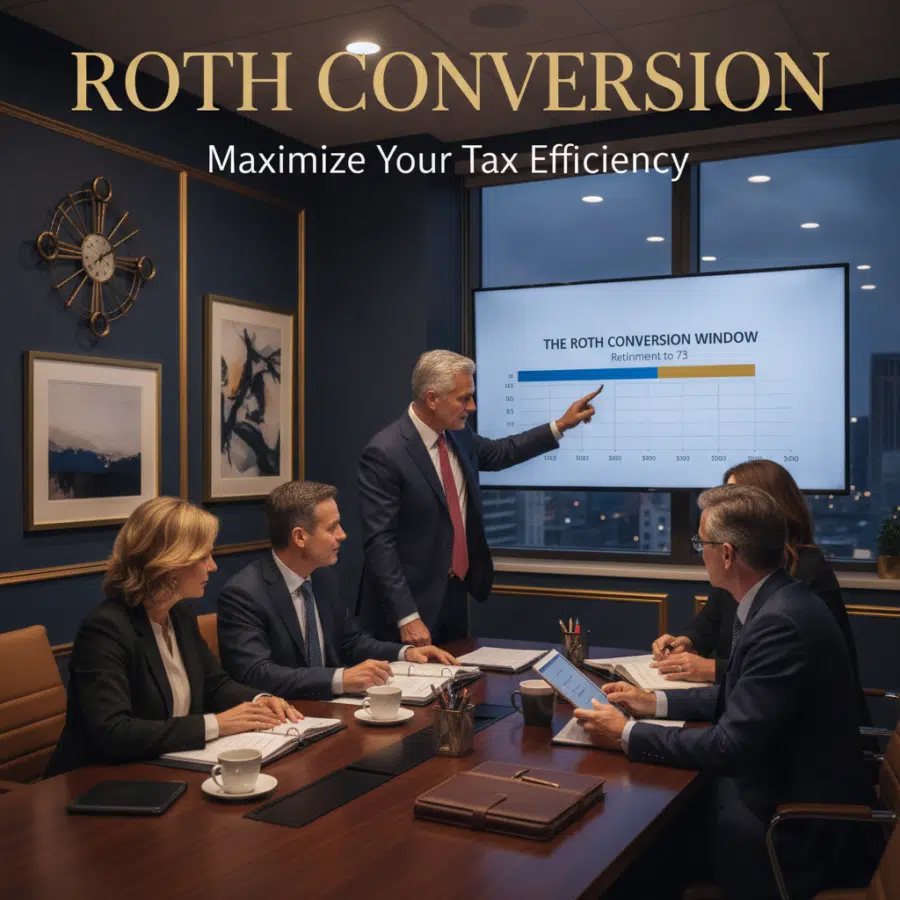
A roth conversion is one of the most powerful tax-planning tools available to retirees — and there is a specific window in which it works best. If you have retired but have not yet reached age 73, you may be living through the most tax-efficient years of your financial life without realizing it.
For high-net-worth individuals with $1 million or more in pre-tax retirement accounts, this window is not a minor planning footnote. It is a multi-decade, six-figure tax decision hiding in plain sight. And it closes faster than most people expect.
This guide explains why the gap between retirement and required minimum distributions is so valuable, how to structure a roth conversion strategy that works for your situation, and what mistakes to avoid along the way.

What Is the Roth Conversion Window — and Why Does It Matter?
When you retire, something remarkable often happens to your income: it drops. After decades of W-2 income, bonuses, and business distributions pushing you into the 32%, 35%, or 37% bracket, your taxable income may temporarily fall to the lowest levels it has been since early in your career.
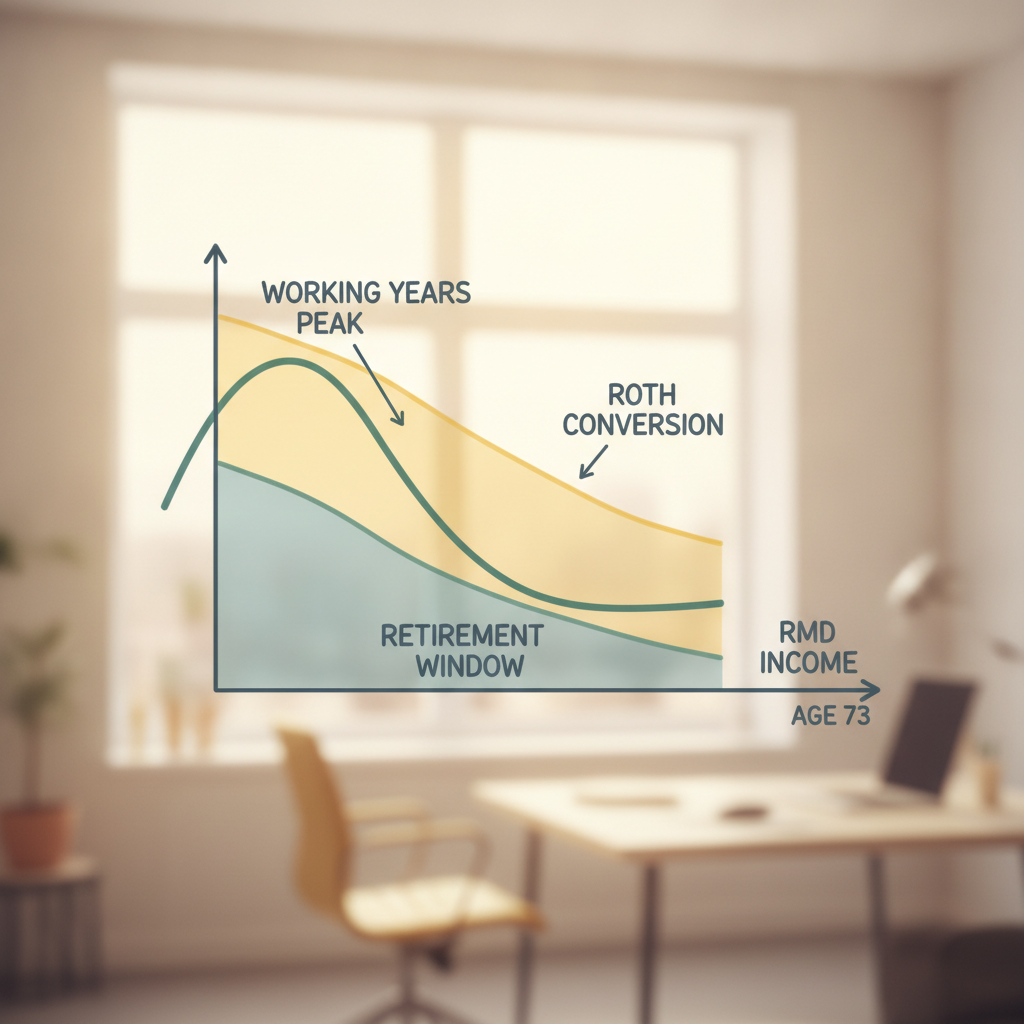
This creates a gap — sometimes called the roth conversion window — between the year you stop working and the year you turn 73 and must begin taking required minimum distributions (RMDs) from your traditional IRA or 401(k). That gap may last anywhere from a few years to more than a decade, depending on when you retire.
Why the Roth Conversion Window Is Uniquely Valuable for HNW Retirees
During this window, your taxable income is low but your wealth is not. You likely have:
- Large pre-tax retirement accounts that will eventually generate forced, taxable withdrawals
- Investment portfolios that may produce qualified dividends or long-term capital gains taxed at preferential rates
- No more earned income pushing you into the top brackets
- The flexibility to control how much income you recognize in any given year
This combination is rare. It is the one period in most people’s financial lives when they have significant assets and significant control over their tax bracket simultaneously. A disciplined roth conversion strategy during this window can permanently shift wealth from a taxable bucket to a tax-free one.
How Roth Conversion Differs from Mass-Market Advice
Generic financial advice often treats roth conversion as a simple question: “Should I pay taxes now or later?” For someone with a $150,000 IRA, that framing might be adequate.
For someone with a $2 million, $5 million, or $10 million pre-tax retirement account, the stakes are categorically different. At that level, the question becomes: How much of this balance can we permanently protect from income tax, and how do we do it without triggering IRMAA surcharges, Medicare premium spikes, or net investment income tax? That requires a different kind of planning — and a different kind of advisor.
Understanding RMDs: The Clock Driving Your Roth Conversion Strategy
Required minimum distributions are the IRS’s mechanism for collecting taxes on pre-tax retirement savings. Once you reach age 73, you must withdraw a minimum amount from your traditional IRA each year, calculated by dividing your prior year-end account balance by an IRS life expectancy factor.
For more on the current RMD rules, see the IRS guidance on required minimum distributions.
How RMDs Interact with the Roth Conversion Decision
Here is the problem for high-net-worth retirees: if you have $3 million in a traditional IRA at age 73, your first RMD alone may be $112,000 or more. Add Social Security benefits — up to 85% of which are taxable — and you may find yourself firmly in the 22% or 24% bracket before you spend a single dollar.
By age 80, with reasonable market growth, that same account may have grown to $4 million or more despite distributions. Your RMDs — and your tax bill — grow with it. This is the RMD snowball problem, and it affects virtually every retiree with substantial pre-tax savings.
Why the Years Before 73 Are Your Best Defense Against the RMD Snowball
A proactive roth conversion reduces the balance in your traditional IRA before RMDs begin. Every dollar you convert today is a dollar that will never be subject to a future mandatory distribution. You control the timing. You control the bracket. You choose when to pay — ideally at the lowest rate available over your lifetime.
This is why the window before age 73 is so strategically important: it is the last period of meaningful tax-bracket control before the IRS imposes its schedule on you.
7 Proven Roth Conversion Strategies for High-Net-Worth Retirees
A thoughtful roth conversion plan is not a single event. It is a multi-year strategy calibrated to your income, tax brackets, and long-term goals. Below are seven approaches we use with clients at Davies Wealth Management.
1. Fill the Bracket Annually with Roth Conversion
Each year, identify the top of your current tax bracket and convert enough to reach — but not exceed — that threshold. For 2026, the 22% bracket tops out at a meaningful level for married filers, and the 24% bracket extends further. Consult your tax advisor for current thresholds and your specific situation.
The goal is systematic, annual conversion at the most favorable rate. Done consistently over a 5–10 year window, this can shift hundreds of thousands — or millions — of dollars into a tax-free Roth IRA.
2. Watch for IRMAA Cliffs Before Each Roth Conversion
IRMAA (Income-Related Monthly Adjustment Amount) is the Medicare surcharge imposed on Part B and Part D premiums when your modified adjusted gross income (MAGI) exceeds certain thresholds. For high-net-worth retirees, aggressive roth conversion can inadvertently push income over an IRMAA cliff, adding thousands of dollars in annual Medicare premiums.
IRMAA is measured using income from two years prior. A large conversion in 2026, for example, affects your Medicare premiums in 2028. This two-year look-back makes multi-year planning essential. Download our Medicare IRMAA Planning Guide to understand how these thresholds interact with your conversion strategy.
3. Use Roth Conversion in Low-Income Years Strategically
Not all years are equal. Years in which you have large deductions — charitable contributions, business losses, significant medical expenses — may allow for larger conversions at the same effective tax rate. Coordinate your roth conversion with your deduction planning to maximize efficiency.
4. Consider a Roth Conversion Ladder for Multi-Year Planning
A roth conversion ladder involves staggering conversions over multiple years to smooth out your tax liability and avoid large single-year spikes. This is particularly useful for retirees who have 8–15 years before RMDs begin — a horizon long enough to build a substantial tax-free balance incrementally.
5. Coordinate Roth Conversion with Social Security Timing
If you have not yet begun Social Security, the years before you claim can be the lowest-income years of your retirement. Consider concentrating larger roth conversion amounts in those years. Once Social Security begins — especially if up to 85% is taxable — your available bracket space may shrink significantly.
6. Use Qualified Charitable Distributions (QCDs) Alongside Roth Conversion
Once you reach age 70½, you may direct up to $105,000 (indexed; confirm current limit with your advisor) per year from your IRA directly to qualified charities as a qualified charitable distribution. QCDs count toward your RMD but are excluded from your taxable income, which can create additional bracket space for a roth conversion in the same year.
7. Integrate Roth Conversion with Estate and Trust Planning
For families with significant estates, Roth accounts offer a compelling legacy advantage: there are no RMDs for the original owner, and inherited Roth accounts, while subject to the 10-year distribution rule for non-spouse beneficiaries, distribute income-tax-free. A strategic roth conversion can shift tax burden from your beneficiaries to your own lower-bracket retirement years — a meaningful intergenerational planning tool.
Learn more about how these strategies integrate with our comprehensive wealth management services for high-net-worth families.
The Roth Conversion Tax Comparison: Pre-Tax vs. Roth at Different Wealth Levels
The math behind a roth conversion decision changes dramatically based on account size. The table below illustrates why this strategy is particularly high-impact for larger portfolios.
| Scenario | Traditional IRA at 73 | Estimated Year-1 RMD | Approximate Tax Impact | Roth Conversion Strategy Value |
|---|---|---|---|---|
| Moderate Saver | $500,000 | ~$18,700 | Modest; likely stays in lower bracket | Moderate — some bracket filling useful |
| Affluent Retiree | $1,500,000 | ~$56,000 | Likely pushes into 22–24% bracket; IRMAA risk | High — conversion window can offset 5–10 years of RMDs |
| High-Net-Worth Retiree | $3,000,000 | ~$112,000+ | Stacks on Social Security; likely 24–32% bracket | Very High — systematic conversion can shift $1M+ tax-free |
| Ultra-HNW / Multi-Generational | $7,000,000+ | ~$260,000+ | Top bracket RMDs; significant estate tax exposure at state level | Critical — Roth conversion + trust integration essential |
RMD estimates are illustrative and based on general IRS Uniform Lifetime Table factors. Consult a qualified tax professional for your specific situation.
Common Roth Conversion Mistakes High-Net-Worth Retirees Make
In my experience working with high-net-worth clients, the most costly mistakes in roth conversion planning are not doing too much — they are doing too little, too late, or without coordination across the full financial picture.
Waiting Too Long to Begin a Roth Conversion Plan
Many retirees delay roth conversion thinking they should “wait and see.” But each year of inaction is a year of growth inside a taxable account — growth that will eventually be subject to mandatory distribution. The window between retirement and age 73 is finite. Starting even two years earlier can make a measurable difference in lifetime tax paid.
Ignoring the Two-Year IRMAA Look-Back in Roth Conversion Planning
Executing a large roth conversion in a single year without accounting for the IRMAA look-back can result in an unexpected Medicare premium spike two years later. This is a common and entirely avoidable mistake with proper planning.
Failing to Coordinate Roth Conversion with a Spouse
Married couples have two lives to plan across — and two sets of RMDs. A coordinated roth conversion strategy that accounts for both spouses’ accounts, ages, and income sources will almost always outperform one that looks at a single account in isolation.
Using Converted Funds to Pay the Tax Bill
When you execute a roth conversion, the converted amount is taxable income. If you pay the tax bill from the converted funds themselves, you are reducing the amount that actually lands in the Roth account — and losing the compounding power of those dollars permanently. Where possible, pay conversion taxes from taxable accounts rather than retirement funds. Fidelity’s Roth conversion overview explains this concept well.

Estate Planning and the Roth Conversion Advantage
With the federal estate and gift tax exemption now permanently set at $15 million per individual ($30 million per married couple) under the One Big Beautiful Bill Act signed in 2025, many high-net-worth families have gained meaningful planning certainty at the federal level.
However, state-level estate taxes remain a significant factor in many states. And income tax planning — including roth conversion strategy — is entirely separate from estate tax planning. Even families well below the federal exemption threshold can benefit enormously from reducing the income tax exposure embedded in large pre-tax retirement accounts.
How Roth Conversion Supports Multi-Generational Wealth Transfer
When you leave a traditional IRA to your children or other non-spouse beneficiaries, they must distribute the full balance within 10 years under current rules. If those heirs are in peak earning years, every dollar they withdraw stacks on top of their existing income — potentially at 32% or higher.
A Roth IRA inherited under the same 10-year rule distributes income-tax-free. The roth conversion you do today at 22% or 24% may save your heirs from paying 32% or 37% on those same dollars. That is a meaningful, calculable benefit that belongs in every estate plan for families with substantial retirement accounts.
For additional reading on inherited IRA rules, see Kiplinger’s guide to Roth IRA rules.
Roth Conversion and the Step-Up in Basis Consideration
One nuance worth understanding: assets held in taxable investment accounts receive a step-up in basis at death, potentially eliminating embedded capital gains entirely. Assets in a traditional IRA do not receive a step-up. A roth conversion — funded with taxable account assets to pay the tax — may involve giving up a future step-up to gain a permanent income-tax-free account. Your advisor should model both scenarios before you commit to a conversion amount.
If you are unsure how your current strategy aligns with your goals, we invite you to schedule a discovery conversation with our team.
Frequently Asked Questions About Roth Conversion
What is the best age to start a roth conversion strategy?
The optimal time to begin a roth conversion is typically the year after you retire, when your earned income drops and your taxable income is at its lowest. Starting in your early-to-mid 60s maximizes the number of years available before RMDs begin at age 73 and allows for the most systematic, bracket-efficient conversions over time. Consult a qualified tax professional to identify the right starting point for your situation.
How much can you convert in a roth conversion each year?
There is no annual limit on how much you can convert from a traditional IRA to a Roth IRA — unlike Roth IRA contributions, which have income and dollar limits. However, the full amount converted is treated as ordinary income in the year of conversion, so the practical limit is determined by how much additional income you can absorb without moving into a higher bracket or triggering IRMAA surcharges.
Does a roth conversion affect Medicare premiums?
Yes. Because IRMAA is calculated based on your MAGI from two years prior, a large roth conversion in the current year can increase your Medicare Part B and Part D premiums two years later. For high-net-worth retirees, managing conversions to stay below IRMAA thresholds is a critical part of a well-designed conversion strategy. Download our Medicare IRMAA Planning Guide for a detailed breakdown.
Can you do a roth conversion if you are already taking RMDs?
Yes, but with an important caveat: you cannot convert your required minimum distribution itself — you must take the RMD first, and then convert additional amounts if desired. This is one reason proactive roth conversion before RMDs begin is so valuable: once RMDs start, a portion of your annual withdrawal is no longer eligible for conversion. Consult a qualified financial professional before combining RMDs and conversions.
Is a roth conversion worth it if I am already in a high tax bracket?
It depends on the projected trajectory of your tax situation. If your pre-tax account is growing substantially and your future RMDs will push you into the same or higher bracket, converting now at your current rate may still be advantageous — particularly for estate planning purposes where heirs would otherwise pay income tax on inherited IRA distributions. The analysis is highly individual and should involve multi-year tax projections.
Taking the Next Step: Building Your Roth Conversion Plan
The roth conversion window between retirement and age 73 is one of the most valuable — and most underused — planning opportunities in high-net-worth retirement. For investors with substantial pre-tax accounts, getting this right is not a minor optimization. It can mean the difference between a retirement that is unnecessarily expensive from a tax standpoint and one that is genuinely efficient across your lifetime and beyond.
Every year this window is open without a strategy in place is a year of opportunity that cannot be recovered. A thoughtful, coordinated roth conversion plan — integrated with your Social Security timing, IRMAA exposure, estate plan, and investment allocation — is worth building now, while the window is still open to you.
The key is not acting rashly or converting as much as possible. It is converting strategically, at the right amounts, in the right years, with a clear view of the full financial picture. That is precisely the kind of work that distinguishes a fee-based fiduciary from a transactional broker.
Ready to Explore Your Roth Conversion Strategy?
Download our Medicare IRMAA Planning Guide to understand how your conversion amounts interact with Medicare premium thresholds — one of the most frequently overlooked variables in roth conversion planning for retirees.
→ Download the Medicare IRMAA Planning Guide
Already ready to discuss your specific situation? Book a complimentary phone call with our team at Davies Wealth Management. We work exclusively with high-net-worth individuals, executives, and business owners who want fiduciary, fee-based guidance — not product sales.
→ Book Your Complimentary Phone Consultation
This content is for general educational purposes only and does not constitute individualized investment advice. Past performance does not guarantee future results. Investment-advisory services are offered by Davies Wealth Management, LLC, an investment adviser registered with the State of Florida. Registration does not imply a certain level of skill or training. Please consult appropriately qualified financial, tax, or legal professionals regarding your specific circumstances.
Davies Wealth Management does not provide legal advice or tax-return-preparation services. Tax and estate-planning information is provided for general educational purposes and may become outdated. Figures and rules are current only as of the article’s stated review date. Verify current information with authoritative sources and consult a qualified tax professional or estate-planning attorney before acting.
Leave a Reply