


A roth conversion ladder is not a set-it-and-forget-it move — it is a carefully sequenced, multi-year tax strategy that can permanently shift how much of your retirement wealth ends up with the IRS versus your family. For high-net-worth retirees with $1 million or more in tax-deferred accounts, getting this right is one of the highest-leverage planning decisions you will ever make.
Done correctly, a roth conversion ladder lets you systematically convert traditional IRA or 401(k) assets into tax-free Roth accounts over a period of years — filling your lower tax brackets deliberately, reducing future required minimum distributions, and potentially saving your heirs hundreds of thousands of dollars in taxes. Done wrong, it triggers IRMAA Medicare surcharges, unnecessary capital gains, and tax bills that wipe out the benefits entirely.
This guide is written specifically for retirees and pre-retirees who have accumulated significant wealth in tax-deferred accounts and want a clear, honest picture of how this strategy works — and where it can go wrong.

What Is a Roth Conversion Ladder and Why Does It Matter for HNW Investors?
A roth conversion ladder refers to the practice of converting a portion of your traditional IRA or pre-tax retirement accounts to a Roth IRA each year over a multi-year period. Rather than converting everything at once — which would create a catastrophic tax event — you convert in controlled increments designed to optimize your tax position year by year.
For mass-market investors, the typical advice is simple: convert enough to fill your current bracket. For high-net-worth individuals, the analysis is far more complex. You are managing multiple interacting variables simultaneously.
Why the Roth Conversion Ladder Is Different for High-Net-Worth Families
Consider the contrast between a retiree with $250,000 in an IRA and one with $3 million in tax-deferred accounts. For the first person, a modest annual conversion may be straightforward. For the second, every conversion decision ripples across:
- IRMAA thresholds — Medicare Part B and Part D surcharges that can add thousands annually if your modified adjusted gross income crosses key levels
- Net Investment Income Tax (NIIT) — a 3.8% surtax on investment income for higher earners
- Capital gains rates — Roth conversions count as ordinary income and can push capital gains into higher tax tiers
- Required Minimum Distributions (RMDs) — a growing tax liability that compounds each year you delay planning
- State income taxes — particularly relevant for clients who have not yet relocated to a no-income-tax state like Florida
- Beneficiary income taxes — under the SECURE 2.0 Act, most non-spouse beneficiaries must deplete inherited IRAs within 10 years, creating potential high-bracket distribution events for your heirs
The goal of a roth conversion ladder is to navigate all of these variables simultaneously — not just minimize taxes this year, but minimize lifetime taxes across your household and your estate.
The Roth Conversion Ladder vs. a Single Large Conversion
| Factor | Single Large Conversion | Multi-Year Roth Conversion Ladder |
|---|---|---|
| Tax Rate Exposure | Pushes large amounts into top brackets (37%+) | Fills lower brackets deliberately over time |
| IRMAA Risk | High — likely triggers multiple surcharge tiers | Manageable with careful annual income projection |
| RMD Reduction | Immediate but at high tax cost | Gradual and tax-efficient over the conversion window |
| Cash Flow Requirement | Requires large lump sum to pay taxes outside IRA | Spread across years, easier to fund from taxable accounts |
| Heir Benefit | Large immediate tax hit reduces net wealth transferred | Maximizes after-tax wealth transferred to beneficiaries |
| Complexity | Simpler to execute once | Requires annual coordination with tax and financial advisors |
The Ideal Window: When to Begin Your Roth Conversion Ladder
The most valuable years to execute a roth conversion ladder are typically the years between retirement and the onset of required minimum distributions — what many planners call the “gap years.” For most retirees, this window runs from age 60 to age 73 (when RMDs currently begin under SECURE 2.0).
Why the Gap Years Are the Core of the Roth Conversion Ladder Strategy
During this window, several favorable conditions often align:
- Income is lower than peak earning years — you may be in the 22% or 24% bracket rather than 32% or 37%
- No RMDs yet — you control how much income you recognize each year
- Social Security may not have started — delaying Social Security to age 70 keeps provisional income lower in the early years
- Time horizon remains long — even a 65-year-old retiree likely has a 20–30-year investment runway for Roth assets to compound tax-free
In my experience working with clients who have built substantial pre-tax retirement balances, those who begin systematic conversions early in retirement consistently end up with more after-tax wealth — and far more flexibility — than those who wait until RMDs force distributions at higher income levels.
How the Roth Conversion Ladder Interacts with Social Security Timing
If you delay Social Security benefits to maximize your monthly amount, your early retirement years may have little or no guaranteed income — making them ideal for aggressive but controlled conversions. Once Social Security begins, and especially once RMDs begin, your taxable income floor rises substantially and the opportunity to convert at lower rates narrows.
This is not hypothetical. A retiree with a $2.5 million IRA at age 62, taking no Social Security yet, might have the flexibility to convert $150,000–$200,000 per year while staying in a moderate bracket. Wait until 73, and RMDs on that same account — which will have grown — may force $100,000+ per year in taxable distributions whether you want them or not.
For authoritative information on RMD rules and ages, see the IRS guidance on Required Minimum Distributions.

5 Steps to Build a Roth Conversion Ladder That Works
Building an effective roth conversion ladder is not a one-time calculation. It requires a structured annual process with input from your financial advisor, CPA, and in some cases your estate planning attorney. Here is the framework we use with clients.
Step 1 — Project Your Full Income Picture Before Each Conversion
Before determining your conversion amount for the year, you must project every source of taxable income: Social Security benefits (85% of which may be taxable), dividends and capital gains from taxable accounts, any part-time income, rental income, and RMDs if they have begun. Your conversion amount fills the remaining space in your target bracket — not the other way around.
For high-net-worth households, this projection must also account for IRMAA thresholds. Medicare’s IRMAA surcharges are based on your Modified Adjusted Gross Income (MAGI) from two years prior. Converting too aggressively in 2026 affects your Medicare premiums in 2028.
Step 2 — Identify Your Target Conversion Amount Using Bracket-Filling Math
The roth conversion ladder works by systematically filling available bracket space each year. Common targets include:
- Converting up to the top of the 22% or 24% bracket before crossing into 32%
- Converting to just below the first IRMAA income threshold for your filing status
- Converting to just below the Net Investment Income Tax threshold
- Converting to the point where your capital gains rate would increase
These thresholds interact in complex ways. A conversion that looks safe from a bracket perspective can still trigger IRMAA or NIIT. This is why spreadsheet-based projections — not rough estimates — are essential. Consult a qualified tax professional before executing any conversion to model the full impact on your specific situation.
Step 3 — Pay the Conversion Tax from Outside the IRA
This point is non-negotiable for the math to work in your favor. If you withhold taxes from the IRA itself to pay the conversion bill, you reduce the principal that grows tax-free — and you may trigger a 10% early withdrawal penalty if you are under 59½ on the withheld amount.
High-net-worth clients generally have taxable brokerage accounts from which they can fund the annual tax bill. This effectively transfers value from a taxable environment into a tax-free Roth environment — a permanent improvement to the household’s tax efficiency.
Step 4 — Coordinate the Roth Conversion Ladder with Your Estate Plan
Roth IRAs are exceptional estate planning vehicles. They carry no lifetime RMDs for the original owner, and while non-spouse beneficiaries are subject to the 10-year distribution rule under SECURE 2.0, they withdraw those assets tax-free. A $1 million Roth IRA left to your children is worth meaningfully more than a $1 million traditional IRA — because every dollar of the traditional IRA will eventually be taxed at your heir’s ordinary income rate during a compressed withdrawal window.
For clients with taxable estates or multi-generational planning goals, coordinating the roth conversion ladder with trust structures, charitable strategies, and beneficiary designations is essential. Our team at Davies Wealth Management integrates these layers as part of our comprehensive wealth management services.
Step 5 — Review and Adjust the Ladder Every Year
Tax law changes. Your income changes. Your account balances change. A roth conversion ladder is a living plan — not a fixed schedule. Each year, you revisit the projections, recalibrate the conversion amount, and confirm that the strategy still makes sense given current conditions.
This annual discipline is one of the primary reasons high-net-worth families benefit from ongoing fiduciary advice rather than transactional relationships with brokers or one-time tax preparers.
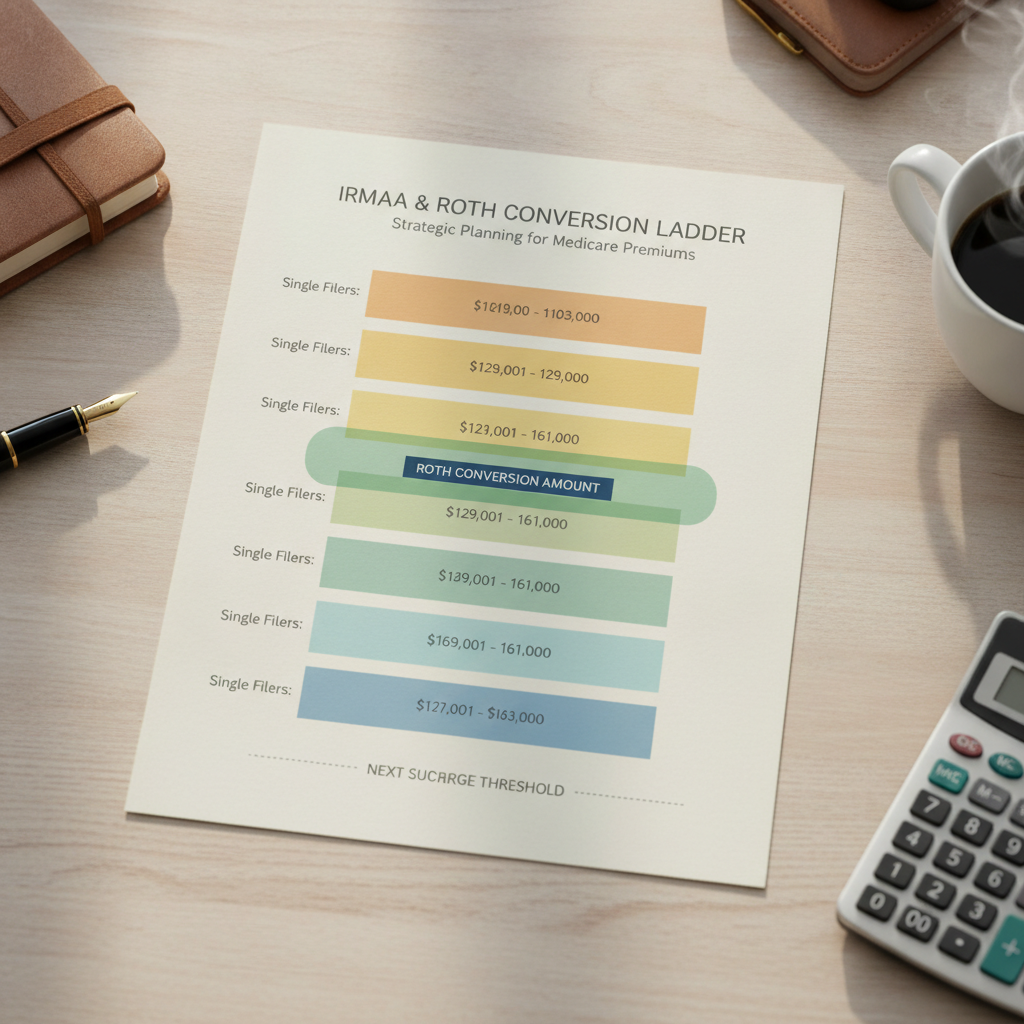
IRMAA and the Roth Conversion Ladder: The Hidden Landmine Most Advisors Miss
For clients on Medicare or approaching Medicare eligibility, IRMAA is often the single most important constraint on Roth conversion sizing. Many advisors who work primarily with younger accumulators or mass-market clients underestimate how dramatically IRMAA surcharges can affect the economics of a conversion.
How the Roth Conversion Ladder Triggers IRMAA Surcharges
IRMAA surcharges are income-based Medicare premium increases that apply in tiers. Because they use a two-year look-back period, a large conversion today affects your Medicare costs two years from now — and the penalties can be substantial across multiple tiers of both Part B and Part D coverage.
For a high-income couple, crossing into a higher IRMAA tier can mean thousands of dollars in additional Medicare premiums annually — costs that persist and must be factored into the net benefit calculation of any given conversion amount. The Fidelity overview of IRMAA is a useful primer if you want to understand how tiers are structured.
Balancing the Roth Conversion Ladder Against IRMAA Sensitivity
The right approach is not to avoid conversions out of IRMAA fear — it is to convert to the optimal point just below the next surcharge tier. Sometimes it makes sense to accept a modestly higher Medicare premium in exchange for a large permanent reduction in future taxable income. The math must be modeled explicitly, not estimated.
This is exactly the kind of analysis that separates fiduciary planning from generic advice. A fee-based advisor with no product commissions has every incentive to run the honest numbers rather than recommend a conversion because it generates a transaction.
Advanced Roth Conversion Ladder Strategies for High-Net-Worth Families
Beyond the core framework, there are several sophisticated overlays that can enhance the roth conversion ladder for clients with complex financial situations.
Pairing the Roth Conversion Ladder with Charitable Giving
Qualified Charitable Distributions (QCDs) allow IRA owners age 70½ or older to transfer up to a specific annual limit directly to charity — satisfying RMDs without the amount appearing in adjusted gross income. This can meaningfully lower the income base on which your conversion sits, allowing you to convert more at the same effective bracket.
For clients who are charitably inclined, pairing QCDs with the roth conversion ladder is one of the most tax-efficient strategies available. Consult a qualified tax advisor to model how QCDs and conversions interact in your specific situation.
Roth Conversion Ladder Coordination with Concentrated Stock Positions
If you hold a concentrated position in a taxable account, you may be deferring the realization of significant embedded gains. In years when you have large capital gain realization events — such as a partial sale of a business interest or equity compensation — your income will spike. In those years, Roth conversions may not be viable, and the ladder must pause or shrink.
Mapping your entire financial picture — including equity compensation vesting schedules, business sale timelines, and investment portfolio rebalancing needs — against your roth conversion ladder is essential for high-net-worth households.
Using the Roth Conversion Ladder to Reduce Your Taxable Estate
With the federal estate and gift tax exemption now permanently set at $15 million per individual (and $30 million per married couple) under the One Big Beautiful Bill Act, most high-net-worth families will not face a federal estate tax. However, state-level estate taxes remain a significant concern in many states — and the composition of your estate (taxable vs. tax-free assets) affects the long-term after-tax value of what you transfer.
Moving assets from a traditional IRA (which passes as a tax-encumbered asset) to a Roth IRA (which passes as a tax-free asset) is a form of value enhancement for your heirs that operates independently of estate tax exposure. It is worth pursuing even for families well under federal estate tax thresholds.
The Roth Conversion Ladder in a Post-TCJA Environment
With the TCJA provisions now permanently extended under current law, current income tax brackets provide a stable planning backdrop. This permanence actually strengthens the case for systematic roth conversion ladder planning — you can model multi-year projections with reasonable confidence about the rate environment, rather than planning around legislative uncertainty. For further reading on current income tax provisions, see the Kiplinger guide to federal tax brackets.
Common Mistakes That Undermine a Roth Conversion Ladder
In our experience, the most costly errors in roth conversion ladder execution come not from bad intentions but from incomplete analysis. Here are the mistakes we see most frequently.
Converting Without Modeling the Full Two-Year IRMAA Look-Back
Clients who focus only on their current-year tax bracket sometimes forget that today’s conversion income affects Medicare premiums two years from now. A conversion that looks ideal on a tax return can quietly increase Medicare costs for years.
Funding the Tax Bill from Inside the IRA
As noted above, using IRA funds to pay the conversion tax defeats much of the mathematical benefit. Every dollar withheld for taxes is a dollar that never compounds tax-free.
Ignoring State Income Tax
High-net-worth clients in high-tax states may find that relocating to Florida before executing large conversions substantially improves the net result. Florida has no state income tax, which means a conversion that would be taxed at a combined federal and state rate of 40%+ in some states costs meaningfully less in Florida. If you are exploring Florida retirement as part of your planning, that decision and your roth conversion ladder should be coordinated.
Converting Too Aggressively Too Early
Roth conversions are generally irreversible. Converting more than your projected tax bracket can efficiently absorb in a given year wastes money on unnecessary taxes. Patience and precision beat urgency.
Frequently Asked Questions About the Roth Conversion Ladder
What is a roth conversion ladder and how does it work?
A roth conversion ladder is a multi-year strategy of converting portions of a traditional IRA or pre-tax retirement account into a Roth IRA in controlled annual amounts. The goal is to fill lower tax brackets systematically over time, reducing future taxable income from RMDs and creating a tax-free pool of retirement assets.
Who benefits most from a roth conversion ladder strategy?
High-net-worth retirees with significant tax-deferred account balances — typically $500,000 or more in traditional IRAs or 401(k)s — benefit most. The ideal candidate has a multi-year window between retirement and full RMD onset where income is lower and conversion opportunities are widest.
How does a roth conversion ladder affect Medicare premiums?
Roth conversions increase Modified Adjusted Gross Income (MAGI), which can trigger IRMAA surcharges on Medicare Part B and Part D premiums two years after the conversion year. Careful sizing of each annual conversion to stay below key IRMAA thresholds is a critical part of the planning process. Consult a qualified financial or tax professional to model IRMAA exposure before converting.
Can I do a roth conversion ladder if I am already taking RMDs?
Yes, but with important nuances. You must first satisfy your annual RMD before converting any additional amount. RMDs themselves cannot be converted — only amounts above the RMD can be rolled into a Roth. For high-balance IRA owners, combining QCDs with conversions can be a powerful tool during RMD years.
How many years does it take to complete a roth conversion ladder?
There is no fixed timeline. Most high-net-worth retirees execute ladders over 5 to 15 years, depending on account size, annual conversion capacity, IRMAA limits, and planning objectives. The ladder continues as long as there are pre-tax assets to convert and a tax-efficient opportunity to do so. Working with a fiduciary advisor ensures the pace is calibrated correctly year by year.
Take Control of Your Retirement Tax Strategy
A well-executed roth conversion ladder is one of the most consequential tax strategies available to high-net-worth retirees — but it demands precision, patience, and coordination across tax, investment, and estate planning. The families who benefit most are those who start planning early, model the full picture, and execute with discipline over multiple years.
If you have a substantial pre-tax retirement balance and want to understand how a roth conversion ladder could reduce your lifetime tax burden, the first step is running the numbers for your specific situation. To schedule a discovery conversation with our team, we are glad to walk through the strategy in the context of your full financial picture.
Ready to download our Medicare IRMAA Planning Guide? Since IRMAA management is central to any successful roth conversion ladder, this guide is required reading for anyone approaching or already in Medicare. Download our Medicare IRMAA Planning Guide here.
Or, if you are ready to speak with a fee-based fiduciary advisor about your retirement tax strategy: Book a complimentary phone call with Davies Wealth Management.
This content is for educational purposes only and does not constitute investment advice. Past performance is not indicative of future results. Advisory services offered through Davies Wealth Management, a Registered Investment Adviser. Please consult a qualified financial, tax, or legal professional regarding your specific situation.
Leave a Reply