


Market downturns make headlines for all the wrong reasons — but for high-net-worth investors who plan carefully, volatility quietly opens one of the most valuable windows in tax planning: the roth conversion. When asset values fall, converting pre-tax retirement dollars to a Roth IRA costs less in taxes today and positions those dollars to recover — and grow — completely tax-free.
🎧 Prefer to listen to the podcast or watch the video? Jump to listen to the podcast & watch the video.
This isn’t a strategy for the faint of heart, and it certainly isn’t the same advice your broker at a national wirehouse is handing out. For investors with $1 million or more in pre-tax retirement assets, a disciplined roth conversion strategy during periods of volatility can reduce lifetime taxes by hundreds of thousands of dollars. The key is knowing when to act, how much to convert, and what traps to avoid.
Why Market Volatility and Roth Conversions Go Together
The mechanics are straightforward. When you execute a roth conversion, you move money from a traditional IRA or 401(k) — where it has never been taxed — into a Roth IRA, where it grows and is withdrawn tax-free. The amount converted is added to your ordinary income for that year and taxed accordingly.
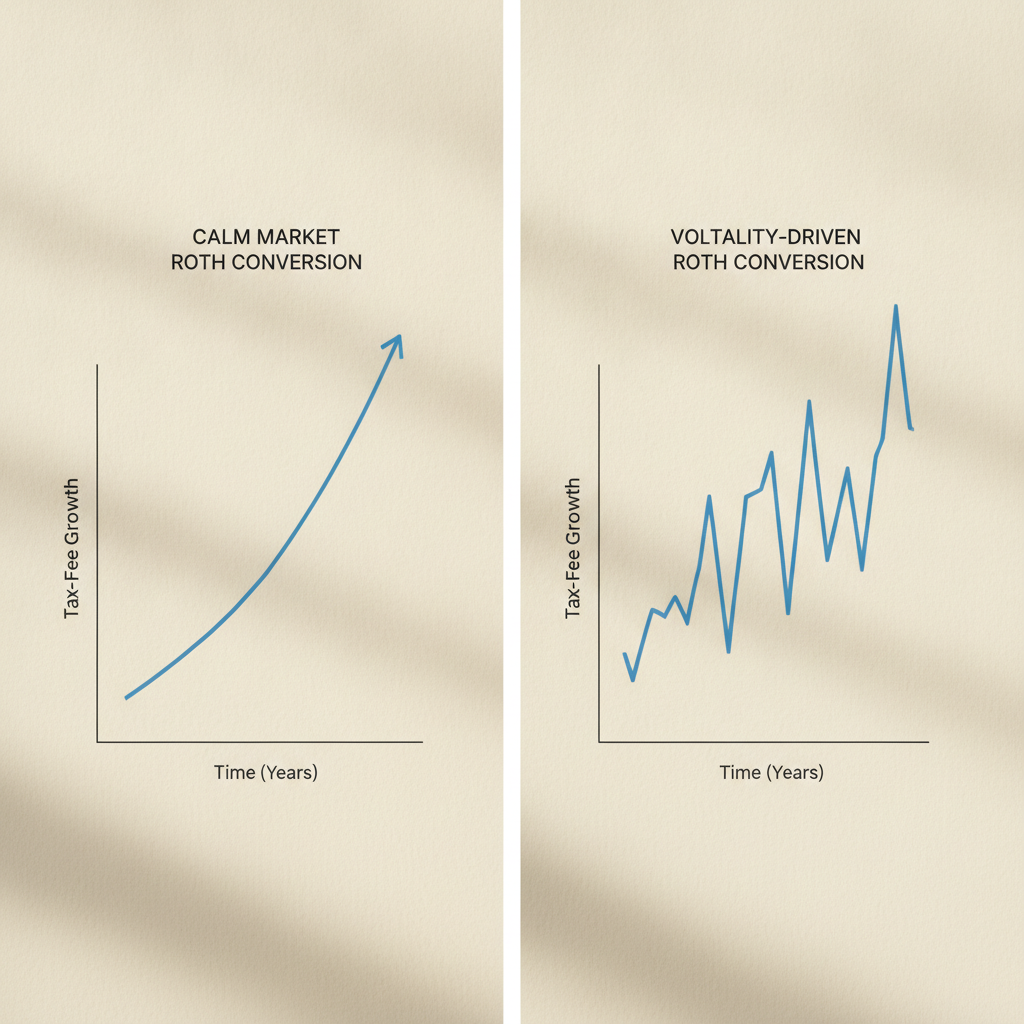
Here’s where volatility becomes your ally: if your account balance is temporarily depressed by a market pullback, you can convert the same number of shares at a lower taxable value. When those assets recover inside the Roth, the recovery happens tax-free. You’ve essentially shifted future gains out of the IRS’s reach at a discount.
A Simple Example That Illustrates the Leverage
Suppose you hold 10,000 shares of a broad equity fund in your traditional IRA. In a calm market, those shares are worth $100 each — a $1 million position. A correction brings them to $70 per share. Converting during the dip means recognizing $700,000 in income rather than $1 million. If those shares recover to $130 in the following years, you’ve sheltered $300,000 in gains — plus the recovery — inside the Roth. The tax savings on that scenario can easily exceed $100,000 for a taxpayer in the 35–37% bracket.
Why This Matters More for High-Net-Worth Investors
Mass-market investors with smaller balances may not have the flexibility to absorb the tax hit of a large conversion. But for investors with diversified income sources, taxable brokerage accounts to fund living expenses, and existing tax-planning infrastructure, volatility-driven roth conversions can be engineered with precision. This is a strategy that rewards sophistication — and requires it.

5 Proven Roth Conversion Strategies During Market Downturns
1. Convert Depressed Equity Positions First
Not all assets in a traditional IRA decline equally during a correction. Growth stocks and equity funds often fall faster and further than bonds or cash equivalents. This creates an opportunity to be selective: convert the most beaten-down positions first, capturing the largest discount relative to their long-term potential.
This approach requires knowing your IRA’s allocation in detail — which is itself a reason to work with a fiduciary advisor rather than managing it on your own. The goal is to convert assets you believe will recover strongly, so the tax-free growth period inside the Roth does the heavy lifting.
2. Stack Conversions in Income Gap Years
For executives who’ve recently retired or sold a business, there’s often a two-to-five-year window before Social Security begins, before Required Minimum Distributions (RMDs) kick in, and before other income streams ramp up. These are income gap years — and they’re among the most powerful opportunities to execute a roth conversion at a lower marginal rate.
When a market correction coincides with an income gap year, the result is a double discount: lower account values and a lower effective tax rate. Consult a qualified tax professional for your specific situation, but many high-net-worth retirees in this window can convert $200,000–$500,000 per year while staying within the 24% or 32% federal bracket — a fraction of the rates they’ll face later when RMDs push income higher.
3. Manage IRMAA Cliffs Strategically
One of the most overlooked hazards in roth conversion planning is the Medicare Income-Related Monthly Adjustment Amount — known as IRMAA. In 2026, Medicare Part B and Part D surcharges kick in at specific income thresholds. A large, unplanned conversion can push a couple from paying standard Medicare premiums to paying significantly more — sometimes $5,000–$10,000 in additional annual costs.
The solution is not to avoid conversions — it’s to size them carefully. A skilled advisor models the exact income threshold where IRMAA surcharges activate and converts just below that line. Volatility-driven conversions are especially attractive here because a depressed account value means you can convert more shares while recognizing less income — keeping you below the IRMAA cliff.
4. Use Charitable Strategies to Offset Conversion Income
For donors with significant charitable intent, a roth conversion year can be paired with a large charitable contribution — either directly or through a Donor-Advised Fund (DAF) or Charitable Remainder Trust (CRT). The charitable deduction offsets the income recognized from the conversion, effectively reducing or eliminating the net tax cost.
This is a strategy rarely discussed in mass-market financial media because it requires both a meaningful conversion amount and meaningful charitable assets. High-net-worth families executing roth conversions of $300,000 or more have real opportunity to pair the conversion with a $100,000+ DAF contribution, reducing their adjusted gross income and potentially keeping them in a lower bracket. Consult a qualified tax and legal professional for your specific situation.
5. Coordinate with Estate Planning to Reduce the Tax Burden on Heirs
Under current law, non-spouse beneficiaries who inherit traditional IRAs are generally required to distribute the entire account within 10 years — and pay ordinary income tax on every dollar. For a beneficiary in a high-income year, that could mean paying 37% or more on inherited funds. A roth conversion executed by the original account owner — potentially at a lower rate — permanently removes that burden.
For investors building multi-generational wealth, this framing is critical: a roth conversion today is often a gift to your heirs tomorrow. Inherited Roth IRAs still carry the 10-year distribution rule, but distributions are tax-free. That distinction is worth real dollars at the scale most high-net-worth families operate. Learn more about how our comprehensive wealth management services integrate roth conversion planning with your broader estate strategy.
Understanding the Tax Math: A Side-by-Side Comparison
The table below illustrates the difference between converting during a market correction versus in a calm market — and what it means for a taxpayer in the 35% federal bracket. These are illustrative numbers; actual results vary based on your specific situation, state taxes, and other income sources. Consult a qualified tax professional before executing any conversion strategy.
| Scenario | Account Value at Conversion | Tax at 35% Rate | Future Value at Recovery (Roth, Tax-Free) | Tax-Free Gain Sheltered |
|---|---|---|---|---|
| Calm Market Conversion | $1,000,000 | $350,000 | $1,300,000 | $300,000 |
| Volatility-Driven Conversion (30% Dip) | $700,000 | $245,000 | $1,300,000 | $600,000 |
| Tax Savings vs. Calm Market | — | $105,000 saved | — | — |
| With Charitable DAF Offset ($150K gift) | $700,000 converted | $192,500 (net taxable $550K) | $1,300,000 | $600,000 |
This table is for illustrative purposes only and does not constitute tax advice. Actual results depend on your full income picture, filing status, state taxes, and other factors. Work with a qualified tax professional.
Common Mistakes High-Net-Worth Investors Make with Roth Conversions
Converting Too Much in One Year
Enthusiasm for the roth conversion strategy leads many investors to convert as much as possible during a dip — which can be counterproductive. A large conversion can push income into the 37% bracket, trigger IRMAA surcharges two years later (Medicare uses a two-year lookback on income), phase out other deductions, and create a large tax bill that strains liquidity.
The right approach is to model the conversion amount that fills the current bracket without crossing into the next one. For many high-net-worth retirees, this means annual conversions of $150,000–$400,000, executed systematically over five to ten years rather than all at once.
Ignoring State Tax Implications
Federal tax planning is only half the equation. If you live in a high-income-tax state and plan to retire in Florida — which has no state income tax — it may make sense to delay large roth conversions until after you’ve established Florida domicile. Converting $500,000 in a state with a 9% income tax costs $45,000 more than converting the same amount as a Florida resident. Consult a qualified tax professional for your specific situation.
This is one reason IRS Roth IRA rules are only the starting point — state-level planning is equally important for investors with significant assets.
Failing to Have Funds Outside the IRA to Pay the Tax
One of the most damaging mistakes is paying the conversion tax from the IRA itself. Doing so reduces the amount that enters the Roth, and if you’re under 59½, the funds used to pay the tax may also be subject to a 10% early withdrawal penalty. Always pay conversion taxes from taxable brokerage funds or savings — not from the IRA being converted.
Waiting Too Long to Start
The most powerful roth conversion windows often close faster than investors expect. RMDs begin at age 73 under current law and add mandatory income every year, pushing brackets higher. Social Security — up to 85% of which is taxable — begins between 62 and 70. The income gap between retirement and these income triggers is finite. Fidelity’s roth conversion guidance emphasizes the importance of acting in those early retirement years before the income stacking begins.
How a Fiduciary Approaches Roth Conversion Planning
The Difference Between a Fiduciary and a Broker
Most investors working with a broker at a national firm receive generic guidance: “Roth conversions are generally good.” What they don’t receive is a detailed, multi-year tax projection that accounts for their specific RMD schedule, Social Security income, IRMAA thresholds, charitable giving plans, estate structure, and state tax situation.
A fiduciary advisor — legally required to act in your interest when providing advice, with compensation disclosed — builds that projection. The difference is material. According to research from Vanguard, personalized financial guidance — sometimes called “Advisor’s Alpha” — can add approximately 3% in net returns annually, much of which comes from tax-efficient planning like roth conversions. See Vanguard’s Advisor’s Alpha framework for more detail.
How We Model Roth Conversion Opportunities at Davies Wealth Management
In my experience working with clients, the most impactful conversations happen during market corrections — not because we’re making emotional decisions, but because we’ve already built the analytical framework to act quickly when the opportunity appears. We maintain rolling tax projections for clients with significant pre-tax assets, so we know within days whether a pullback opens a conversion window worth taking.
We coordinate with your CPA, estate attorney, and other advisors to ensure that a roth conversion is sized and timed properly — not executed in isolation. If you’re ready to explore what a disciplined roth conversion plan could mean for your portfolio, schedule a discovery conversation with our team. You can also learn more about our approach to comprehensive wealth management services for high-net-worth families.
What Good Roth Conversion Planning Looks Like Year-Round
Roth conversion planning isn’t a one-time event — it’s an annual process. A disciplined framework includes:
- January: Model the current year’s projected income and identify available bracket space
- Q1–Q2: Monitor market conditions for dip-driven conversion windows
- Q3: Finalize conversion amount based on year-to-date income and projected year-end income
- October–November: Execute final conversion before year-end; coordinate with CPA on estimated tax payments
- December: Review for any QCD (Qualified Charitable Distribution) opportunities to further reduce traditional IRA balance and future RMDs
For investors with $2 million or more in pre-tax retirement assets, this kind of structured approach can save more in lifetime taxes than the cost of comprehensive advisory fees over many years. As Kiplinger’s roth conversion guidance notes, the window for strategic conversions is finite — and the cost of inaction compounds over time.

Frequently Asked Questions About Roth Conversion During Market Volatility
Is a roth conversion a good idea when the market is down?
Yes — for many high-net-worth investors, a market downturn is one of the best times to execute a roth conversion. When account values are temporarily depressed, you recognize less income on the same number of shares, and any subsequent recovery happens inside the Roth where growth is tax-free. The key is to size the conversion carefully to avoid bracket creep and IRMAA surcharges.
How much can I convert in a roth conversion each year?
There is no IRS limit on the dollar amount of a roth conversion — unlike Roth IRA contributions, which are subject to income and contribution limits. The practical limit is determined by your tax situation: how much income you can recognize while staying in your target bracket, below IRMAA thresholds, and without triggering other phase-outs. Consult a qualified tax professional for your specific situation.
Will a roth conversion affect my Medicare premiums?
Yes, potentially. Medicare Part B and Part D premiums are subject to IRMAA surcharges based on your modified adjusted gross income (MAGI) from two years prior. A large roth conversion in 2026 could affect your 2028 Medicare premiums. Strategic sizing of conversions — staying just below IRMAA thresholds — is an important part of planning for high-net-worth retirees.
Can I do a roth conversion if I’m still working?
Yes. There is no age or employment restriction on roth conversions from a traditional IRA. However, if you’re in your peak earning years, your marginal tax rate may be at its highest — which reduces the attractiveness of converting. Most high-net-worth individuals find the most compelling conversion windows in the years between retirement and the onset of RMDs and Social Security. Consult a qualified tax professional for your specific situation.
What is the five-year rule for roth conversions?
Each roth conversion has its own five-year clock. Converted amounts must remain in the Roth IRA for at least five years — or until age 59½, whichever comes later — to avoid a 10% early withdrawal penalty on the converted principal. Earnings in a Roth IRA are subject to a separate five-year rule tied to the account’s opening date. For investors over 59½, the five-year penalty rule on conversions generally does not apply, though the earnings rule still matters.
The Window Is Finite — Act With Intention
Market volatility will always create uncertainty — but for disciplined, well-advised high-net-worth investors, it also creates opportunity. A well-timed roth conversion during a correction doesn’t just save taxes in the current year — it repositions assets for decades of tax-free compounding, reduces future RMD pressure, protects against higher future tax rates, and can meaningfully reduce the tax burden on heirs.
The investors who benefit most are those who arrive at the correction already prepared: with a tax projection in hand, a target conversion amount identified, and taxable funds available to pay the bill. That preparation is the work of ongoing, sophisticated financial planning — not a reactive decision made in the middle of a downturn.
At Davies Wealth Management, we work with high-net-worth individuals, executives, professional athletes, and business owners who are ready to move beyond generic advice and build a roth conversion strategy that reflects the full complexity of their financial lives.
Take the Next Step
Ready to see how a roth conversion strategy could reduce your lifetime tax burden? Download our Medicare IRMAA Planning Guide — it includes specific thresholds, conversion sizing strategies, and actionable guidance for high-net-worth retirees navigating Medicare premiums and roth conversion planning together.
Already know you want personalized guidance? Book a complimentary phone call with our team — we’ll spend 30 minutes reviewing your current situation and identifying whether a volatility-driven roth conversion belongs in your 2026 plan.
This content is for educational purposes only and does not constitute investment advice. Past performance is not indicative of future results. Advisory services offered through Davies Wealth Management, a Registered Investment Adviser. Please consult a qualified financial, tax, or legal professional regarding your specific situation.
Listen & Watch
Prefer audio or video? We’ve got you covered.
Leave a Reply