


A qualified personal residence trust is one of the most powerful — and frequently overlooked — estate planning tools available to high-net-worth homeowners in Florida. If your primary residence or vacation home has appreciated significantly, a QPRT may allow you to transfer that asset to your heirs at a fraction of its current fair market value, potentially saving your estate hundreds of thousands of dollars in federal estate tax.
This strategy isn’t for everyone. But if your estate exceeds — or is approaching — the federal estate tax exemption, and you own a Florida home that represents a meaningful portion of your wealth, understanding how a qualified personal residence trust works could be one of the most important conversations you have this year.
What Is a Qualified Personal Residence Trust?
The Core Mechanics of a QPRT
A qualified personal residence trust is an irrevocable trust to which you transfer ownership of your home while retaining the right to live there for a specified term — typically 5 to 15 years. At the end of that term, ownership passes to your beneficiaries, usually your children or a trust established for their benefit.
The gift you make when funding the trust is not valued at the home’s full fair market value. Instead, the IRS allows you to discount that value to reflect the fact that you’re retaining use of the home for a number of years. The longer the trust term and the higher the IRS Section 7520 interest rate, the smaller the taxable gift — and the greater the estate tax savings.
How the Gift Value Is Calculated
The taxable gift is calculated using IRS actuarial tables that take two inputs into account: the trust term you select and the Section 7520 rate published by the IRS each month. The result is a “remainder interest” value — representing what the IRS estimates your beneficiaries’ deferred ownership interest is worth today.
For example, if you transfer a $2 million Florida beach home into a 10-year QPRT, the taxable gift might be valued at only $900,000 to $1,100,000 depending on prevailing rates. You use a portion of your federal lifetime gift and estate tax exemption to cover that discounted value — but the full $2 million (plus all future appreciation) exits your taxable estate.
Why Florida Homeowners Have a Particular Advantage
Florida has no state income tax and no state estate tax, which makes it an exceptionally attractive domicile for high-net-worth families. But federal estate tax still applies — and Florida’s luxury real estate market has seen dramatic appreciation over the past decade.
A waterfront home in Palm Beach, Naples, or Jupiter Island purchased for $1.5 million a decade ago may now be worth $4 million or more. That appreciation doesn’t just represent personal wealth — it represents a growing estate tax liability. A qualified personal residence trust freezes the value of that asset for estate tax purposes at today’s discounted gift value, not tomorrow’s appreciated price.

Who Should Consider a Qualified Personal Residence Trust?
The High-Net-Worth Threshold for QPRT Suitability
The federal estate tax exemption is permanently set at $15 million per individual ($30 million for married couples) under current law, indexed for inflation going forward. Families with estates above those thresholds, or those projected to reach that level, should be evaluating strategies like QPRTs as part of their long-term estate planning.
Even if you are not currently above the exemption threshold, rapid appreciation in real estate, a business sale, or an inheritance could change that calculus quickly. Consult a qualified estate planning attorney for your specific situation before determining whether a QPRT is appropriate for your estate.
Ideal Candidates for a Qualified Personal Residence Trust
Based on how this strategy works, the best candidates typically share several characteristics:
- Own a primary or secondary residence that has appreciated or is expected to appreciate significantly
- Have a taxable estate above $10 million or a clear trajectory toward that level
- Are in good health and confident they will outlive the trust term (more on this below)
- Do not anticipate needing to sell the home during the trust term
- Have sufficient exemption remaining to cover the taxable gift at funding
- Are comfortable with irrevocability — once established, a QPRT cannot be easily undone
This strategy is particularly well-suited for executives with concentrated wealth, professional athletes who purchased high-value Florida residences during peak earning years, and business owners whose estates will grow substantially upon a liquidity event.
QPRTs vs. Simply Leaving the Home in Your Estate
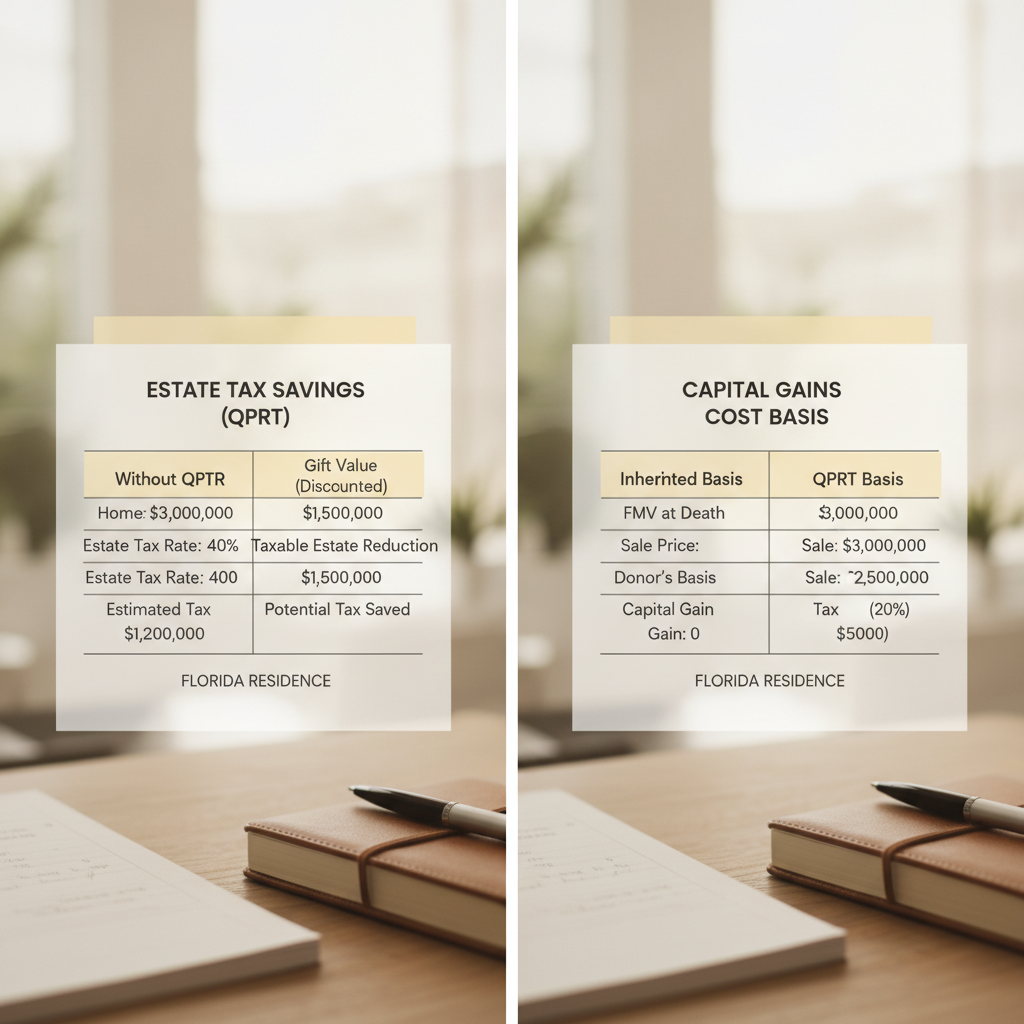
Many high-net-worth families assume they will simply pass their home through their estate and rely on the step-up in cost basis to eliminate capital gains for their heirs. That assumption may be correct for income tax purposes — but it does nothing to reduce estate tax. A qualified personal residence trust addresses the estate tax problem directly, at the cost of forfeiting that step-up in basis for the remainder interest.
This is an important trade-off to model carefully with your advisor. In estates above the exemption threshold, the estate tax savings often dwarf the cost-basis benefit. Consult a qualified tax professional before making this determination for your specific situation.
| Factor | Qualified Personal Residence Trust | Outright Bequest at Death |
|---|---|---|
| Estate Tax Treatment | Removed from estate at discounted gift value | Included at full fair market value at death |
| Capital Gains Basis | Carries over original cost basis (no step-up) | Heirs receive full step-up in basis at death |
| Gift/Exemption Used | Discounted remainder interest (e.g., 45–60% of FMV) | No gift tax; full value uses estate exemption |
| Future Appreciation | All appreciation passes to heirs estate-tax free | All future appreciation remains in taxable estate |
| Control of Property | Retained for trust term; must pay rent afterward | Full control retained until death |
| Risk Factor | If grantor dies during term, full value returns to estate | No execution risk; strategy operates automatically |
7 Proven Strategies to Maximize Your QPRT Results
1. Select the Right Trust Term for Your Age and Health
The single most important variable in a qualified personal residence trust is the term length. A longer term produces a smaller taxable gift — but it also increases the probability that you will die before the term expires. If you die during the trust term, the entire value of the home is pulled back into your taxable estate, negating the strategy entirely.
A common framework is to target a term that ends when you would be in your early-to-mid 70s. For a healthy 62-year-old, a 10-year QPRT balances meaningful gift tax savings with a reasonable mortality outlook. Your estate planning attorney will typically model multiple term lengths to identify the optimal balance. Consult a qualified estate planning attorney to determine the appropriate term for your situation.
2. Fund the QPRT When Home Values Are High — and Rates Are Favorable
The taxable gift in a qualified personal residence trust is influenced by the Section 7520 rate. A higher rate produces a smaller taxable gift, making QPRTs more efficient in rising-rate environments. With rates elevated relative to the historically low levels of the 2010s, the current environment can be advantageous for funding a QPRT if your home value supports the strategy.
Equally important: the gift is locked in at today’s value. If your Florida waterfront property is worth $3 million today and $5 million in 10 years, your estate has already captured that $2 million appreciation outside the taxable estate.
3. Use a Married Couple’s QPRTs in Tandem
Spouses can each establish a qualified personal residence trust for their respective interest in the same property — or one can establish a QPRT for the primary residence while the other establishes one for a vacation property. This approach can double the discounting benefit and allocate each spouse’s lifetime exemption efficiently.
This is a common structure for couples with multiple Florida properties — a primary residence in one county and a beach home in another — both of which have appreciated substantially.

4. Lease the Home Back After the Term Expires
Once the trust term ends, you no longer own the home — your beneficiaries do. If you wish to continue living there, you must pay fair market rent. While this may feel counterintuitive, it is actually an additional estate planning benefit: those rental payments transfer additional wealth to your heirs without triggering gift tax.
For high-net-worth families where the goal is multi-generational wealth transfer, this ongoing rent arrangement can meaningfully reduce the grantor’s estate over time while maintaining the family’s use of a cherished property.
5. Combine a QPRT with a Grantor Retained Annuity Trust for Broader Estate Reduction
A qualified personal residence trust works on real property the same way a Grantor Retained Annuity Trust (GRAT) works on investment assets — both freeze value and transfer future appreciation to heirs at a reduced gift tax cost. Affluent families often deploy both strategies in parallel: a QPRT for the Florida home and a GRAT for a concentrated equity position or pre-IPO stock.
This layered approach can address multiple categories of appreciated assets simultaneously, making it particularly relevant for executives with equity compensation, business owners approaching a sale, or professional athletes with both real estate wealth and investment portfolios.
6. Integrate with Your Broader Estate Plan — Including Dynasty Trusts
The remainder interest from a QPRT doesn’t have to pass outright to your children. It can instead flow into a dynasty trust — a generation-skipping trust designed to preserve assets for multiple generations free from estate tax at each generational transfer. This structure ensures the appreciated home remains in the family without triggering estate tax at your children’s deaths.
Florida is one of a handful of states with favorable dynasty trust legislation, making this combination particularly compelling for Florida-domiciled families. Our comprehensive wealth management services include coordination with estate planning counsel who specialize in exactly these multi-layered structures.
7. Plan for the Mortality Risk with Life Insurance
The primary risk in a qualified personal residence trust is dying before the trust term ends. The practical hedge against this risk is an irrevocable life insurance trust (ILIT) holding a term or permanent life insurance policy sized to cover the estate tax liability that would result if the home were pulled back into the estate.
This is not a speculative hedge — it is standard estate planning discipline. A seasoned advisor will model both the optimistic scenario (you outlive the term, the strategy works as intended) and the stress scenario (you don’t), and will recommend a life insurance structure that makes the estate whole in either case.
Common Mistakes That Can Undermine a Qualified Personal Residence Trust
Failing to Comply with Residency Requirements
The IRS requires that the property transferred into a qualified personal residence trust be used as a personal residence — either a primary home or a second home. If the property is converted to rental use or ceases to function as a personal residence during the trust term, the trust may no longer qualify, with potentially adverse tax consequences.
This is a meaningful compliance concern for clients who own multiple properties or who may relocate during the trust term. Proper drafting and ongoing trustee oversight are essential. According to IRS Treasury Regulation §25.2702-5, qualifying personal residence trusts are governed by specific rules that require careful attention to detail.
Choosing Too Long a Term Without Considering Health
The mathematical appeal of a longer term is clear — it reduces the taxable gift substantially. But a 75-year-old client who establishes a 20-year QPRT has created a high probability of failure. Experienced advisors will generally discourage trust terms that extend beyond age 80 for most clients, even when the gift savings look compelling on paper.
Ignoring the Step-Up in Basis Trade-Off
For clients with a low original cost basis on their home, the loss of the step-up in basis at death is a real economic cost that must be modeled carefully. A $500,000 home purchased decades ago that is now worth $3 million carries $2.5 million in embedded capital gains. If your estate is not subject to estate tax, the QPRT’s estate tax savings may be modest — while the cost-basis sacrifice is meaningful. Consult a qualified tax professional before making this determination for your specific situation.
How Davies Wealth Management Approaches QPRT Planning
A Fiduciary Perspective on Qualified Personal Residence Trust Strategy
As a fee-based fiduciary RIA, Davies Wealth Management does not earn commissions on trust products or insurance recommendations. Our role is to model the financial impact of strategies like the qualified personal residence trust objectively — running the numbers on both the estate tax savings and the potential drawbacks — and then coordinate with your estate planning attorney and CPA to implement the strategy properly.
In my experience working with clients in the $3 million to $15 million estate range, the QPRT conversation often surfaces unexpected planning opportunities. A client who came to us focused on retirement income planning may discover that their Jupiter Inlet home has quietly become their single largest estate tax liability — and that a straightforward QPRT structure could remove that liability at relatively modest exemption cost.
The Coordination Layer Most HNW Families Are Missing
The most common gap I see in high-net-worth estate plans is not a missing trust or a missing strategy — it is the absence of coordination between the wealth manager, the estate attorney, and the CPA. A QPRT affects your gift tax return (Form 709), your income tax treatment of the property, your homestead exemption in Florida, your insurance coverage, and your overall estate distribution plan. All of these threads must be pulled together by someone who understands the complete picture.
That coordination function is a core part of what Davies Wealth Management provides. If you want to explore how this strategy might fit within your broader plan, we encourage you to schedule a discovery conversation with our team.
For additional context on estate planning vehicles and gifting strategies, the Kiplinger estate planning resource center and Fidelity’s estate planning overview offer useful background reading.
Frequently Asked Questions About Qualified Personal Residence Trusts
What happens to a qualified personal residence trust if the grantor dies during the trust term?
If you die before the trust term ends, the full fair market value of the home is included back in your taxable estate — as if the QPRT had never been created. However, any gift tax exemption previously used to fund the trust is restored. The result is roughly a wash from an estate tax perspective, which is why life insurance coverage is often recommended as a risk management backstop.
Can I sell my home after transferring it into a qualified personal residence trust?
The trust document can allow for a sale, but the proceeds must either be used to purchase a new residence within a specified period or held in a separate trust that qualifies under IRS rules. Selling without reinvestment could disqualify the trust and trigger adverse tax consequences. Work closely with your estate attorney if a sale becomes necessary during the trust term.
Does a qualified personal residence trust affect my Florida homestead exemption?
This is a critically important question for Florida residents. Florida’s homestead exemption — including both the property tax reduction and the creditor protection benefit — generally continues to apply when a home is transferred into a QPRT, provided you remain the beneficial occupant. However, the homestead exemption does not automatically transfer to the remainder beneficiaries after the trust term ends. Consult a qualified Florida estate planning attorney to protect your homestead status throughout the process.
How does a QPRT interact with the federal estate tax exemption?
When you fund a qualified personal residence trust, you make a taxable gift equal to the discounted remainder interest value. This amount is applied against your federal lifetime gift and estate tax exemption — permanently set at $15 million per individual beginning in 2026, indexed for inflation going forward. Gifts made prior to any future legislative change to the exemption are generally protected under anti-clawback regulations finalized by the IRS in 2019.
Is a qualified personal residence trust still worthwhile if the estate tax exemption remains high?
Even with today’s elevated exemption levels, QPRTs make sense for estates that are already above — or likely to grow above — $14 million. They are also worth considering for clients who have significant business value, investment portfolios, or life insurance proceeds that could push the estate above the threshold unexpectedly. Future legislative changes could reduce the exemption, and strategies funded today may lock in favorable terms that would not be available under a lower exemption regime. Consult a qualified estate planning attorney to evaluate your specific situation.
Is a Qualified Personal Residence Trust Right for Your Florida Estate?
The qualified personal residence trust is not a universal solution — but for the right client, it is one of the most elegant estate tax reduction strategies available. It leverages the IRS’s own actuarial tables to discount a high-value asset, removes future appreciation from the taxable estate, and can be layered with dynasty trusts, GRATs, and life insurance to build a comprehensive multi-generational wealth transfer plan.
For Florida homeowners with taxable estates above $10 million, properties that have appreciated dramatically, and a planning horizon of 10 or more years, the qualified personal residence trust deserves a prominent place in the estate planning conversation. The key is to act before appreciation compounds further — and before any legislative changes reduce the exemptions that make this strategy effective.
If you are uncertain whether your estate warrants this level of financial planning, a good first step is to take our Financial Wellness Quiz to identify gaps in your current plan.
→ Take our Financial Wellness Quiz — identify the high-impact planning opportunities your current strategy may be missing.
Ready for personalized guidance from a fee-based fiduciary? Book a complimentary phone call with the Davies Wealth Management team to discuss your estate, your Florida home, and whether a qualified personal residence trust belongs in your plan.
This content is for educational purposes only and does not constitute investment advice. Past performance is not indicative of future results. Advisory services offered through Davies Wealth Management, a Registered Investment Adviser. Please consult a qualified financial, tax, or legal professional regarding your specific situation.
Leave a Reply